
A lightweight workflow engine built the way it should be: declarative, file-based, self-contained, air-gapped ready. One binary that scales from laptop to distributed cluster. Used as a sovereign AI-agent orchestration infrastructure.
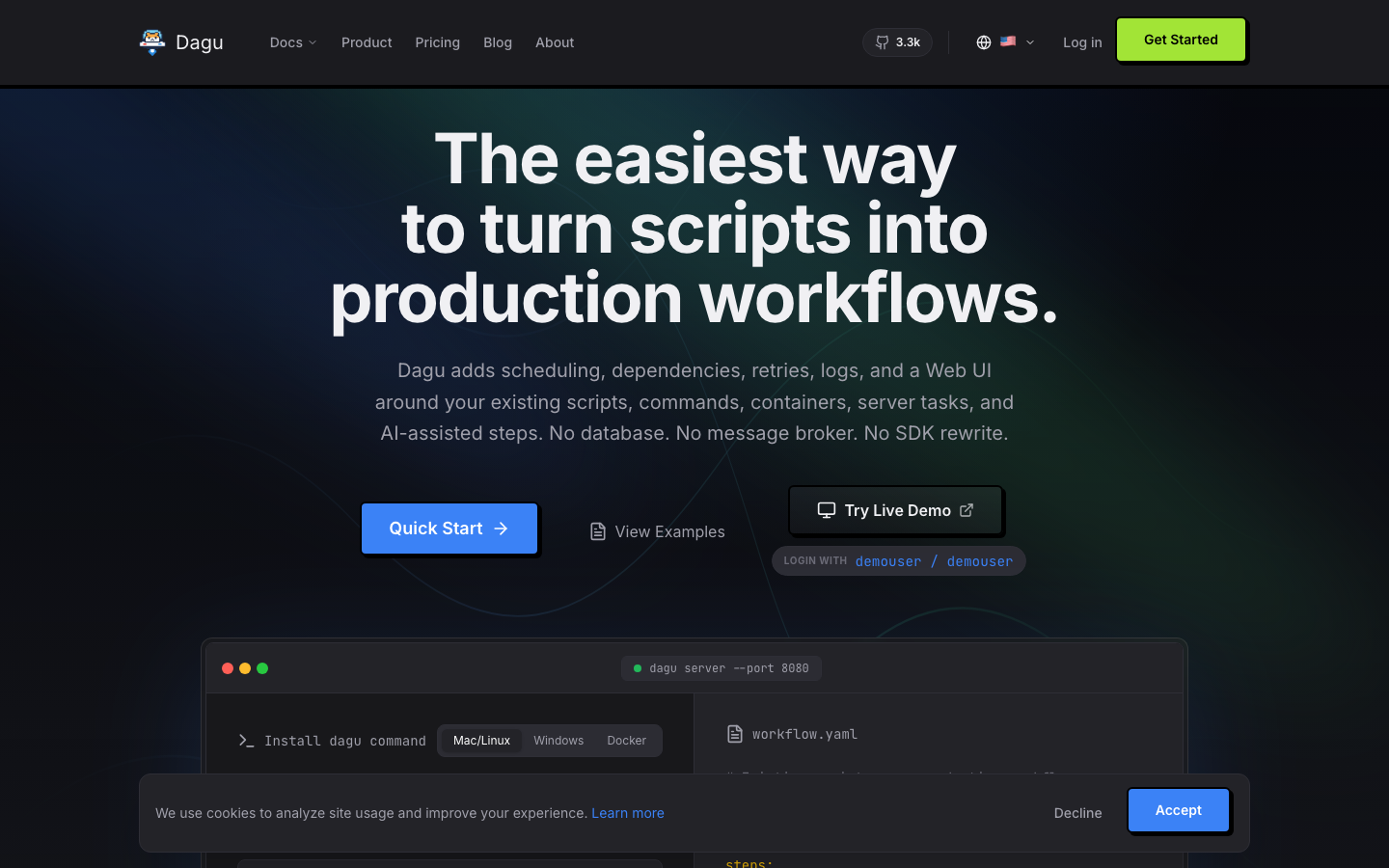
A lightweight, single-binary workflow engine that runs Directed Acyclic Graphs (DAGs) defined in YAML. It requires no database, message broker, or language-specific runtime, making it perfect for air-gapped environments and scaling from laptops to distributed clusters.
Dagu targets DevOps engineers, data engineers, infrastructure teams, and organizations seeking a lightweight, self-contained alternative to heavy orchestration platforms. It's ideal for teams running scripts and jobs on-premises or in air-gapped environments who want observability without operational complexity.

Fair-code workflow automation platform with native AI capabilities. Combine visual building with custom code, self-host or cloud, 400+ integrations.

Git with a cup of tea! Painless self-hosted all-in-one software development service, including Git hosting, code review, team collaboration, package registry and CI/CD

Apache Airflow - A platform to programmatically author, schedule, and monitor workflows

Event Driven Orchestration & Scheduling Platform for Mission Critical Applications

AI Agents & MCPs & AI Workflow Automation • (~400 MCP servers for AI agents) • AI Automation / AI Agent with MCPs • AI Workflows & AI Agents • MCPs for AI Agents

The open source Zapier alternative. Build workflow automation without spending time and money.
A list of Free Software network services and web applications which can be hosted on your own servers
Fair-code workflow automation platform with native AI capabilities. Combine visual building with custom code, self-host or cloud, 400+ integrations.

Get up and running with Kimi-K2.5, GLM-5, MiniMax, DeepSeek, gpt-oss, Qwen, Gemma and other models.

User-friendly AI Interface (Supports Ollama, OpenAI API, ...)

Virtual whiteboard for sketching hand-drawn like diagrams

The Postgres development platform. Supabase gives you a dedicated Postgres database to build your web, mobile, and AI applications.

High performance self-hosted photo and video management solution.

The world’s fastest framework for building websites.

A fancy self-hosted monitoring tool

Open Source Continuous File Synchronization
