








TL;DR
- Product teams building email workflows in Node.js or React should reach for nodemailer or react-email to own their sending stack without AWS lock-in and skip the sandbox approval dance.
- Organizations needing a self-hosted mail platform with full inbox & outbox will find postal or BillionMail eliminate per-email metering and give you complete infrastructure control.
- Newsletter and marketing teams benefit from keila as a lightweight, privacy-first alternative that avoids usage-based pricing and vendor dependency.
Why teams leave Amazon SES
Picture a growing SaaS startup: their transactional emails work fine on SES for three months, costs are pennies. Then they scale to millions of sends, the bill climbs, and they realize they're paying per email and managing SPF, DKIM, DMARC configuration themselves. A new team member asks, "Why are we tied to AWS for email?" The answer: because SES is a bare API, not a platform.
Amazon SES wins on price-per-send and scale, but it imposes real friction. You must build or integrate template management, list hygiene, bounce handling, and especially deliverability—the invisible work of warming IPs, monitoring sender reputation, and proving you're not a spammer. New accounts land in sandbox mode with strict limits until you request production access and convince AWS you're trustworthy. For teams that want sending control without AWS identity lock-in, or who'd rather avoid usage metering altogether, the structural appeal of open-source alternatives is clear: own the infrastructure, own the cost model, and avoid the approval gauntlet.
Quick comparison
| Name | License | Self-Hosted | Deliverability Setup | API / Automation | Best For |
|---|---|---|---|---|---|
| react-email | MIT | Yes (via Node.js) | Manual (via SMTP transport) | React component + Node.js SDK | Building email templates in React; integrating with custom sending pipelines |
| nodemailer | — | Yes | Manual (via SMTP/service config) | Node.js API; works with any SMTP | Node.js applications; transactional & bulk sends |
| postal | MIT | Yes | Built-in (full mail server) | REST API; webhook events | Full mail platform; incoming + outgoing; self-hosted infrastructure |
| BillionMail | AGPL-3.0 | Yes | Built-in (mail server) | REST API; dev-friendly | Self-hosted mail server; newsletter & marketing; no per-email fees |
| Haraka | MIT | Yes | Manual (extensible via plugins) | Event-driven plugin architecture | High-performance SMTP routing; advanced mail infrastructure |
| keila | AGPL-3.0 | Yes | Built-in | REST API; campaign automation | Newsletter & marketing campaigns; privacy-focused; small to mid teams |
| cloudserver | Apache-2.0 | Yes | N/A (object storage, not email) | S3-compatible API | Object storage; not an email platform |
Top open-source alternatives to Amazon SES
react-email
Build and send transactional emails using React components instead of string templates. It lets you write emails as JSX, preview them in a browser, and export them as HTML or plain text for any SMTP backend—including your own server or any third-party transport.
Pros:
- Component-based email design; reusable, testable, version-controlled.
- Works with any Node.js sending library (nodemailer, etc.); no vendor lock-in.
- Fast preview and iteration cycle.
Cons:
- Requires Node.js infrastructure; you still need to handle SMTP/sending separately.
- No built-in list management, bounce handling, or analytics.
nodemailer
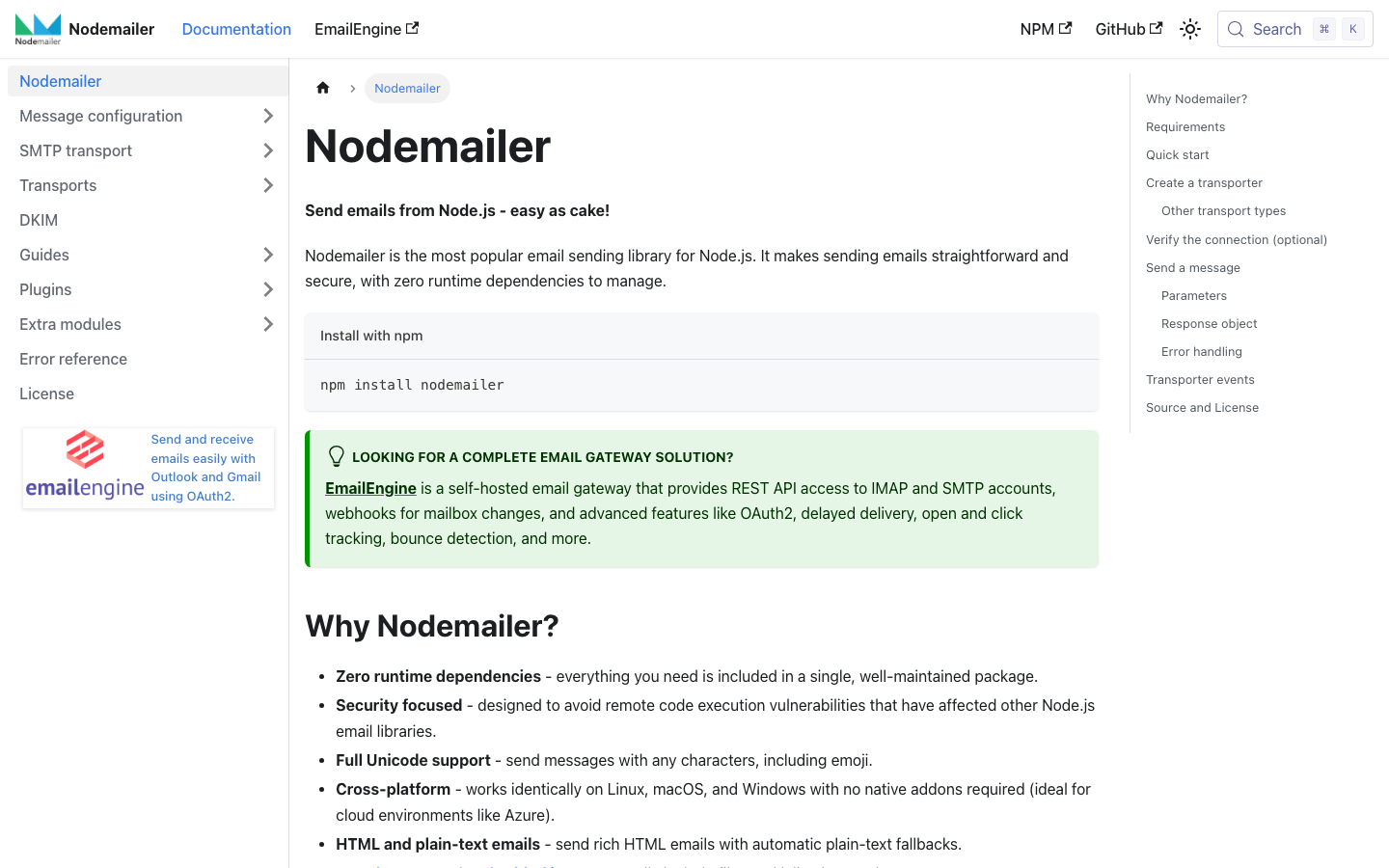
A lightweight, mature Node.js library for sending emails via SMTP, sendmail, or service transports. It handles attachments, HTML/plain-text variants, and integrates with any mail server you control or any third-party SMTP endpoint.
Pros:
- Minimal, stable, widely adopted; works with any SMTP backend.
- No metering or per-email costs; you pay only for your infrastructure or SMTP service.
- Flexible; you own the sending logic.
Cons:
- Bare API; no templates, list management, or analytics built in.
- You manage authentication, bounce handling, and deliverability yourself.
postal
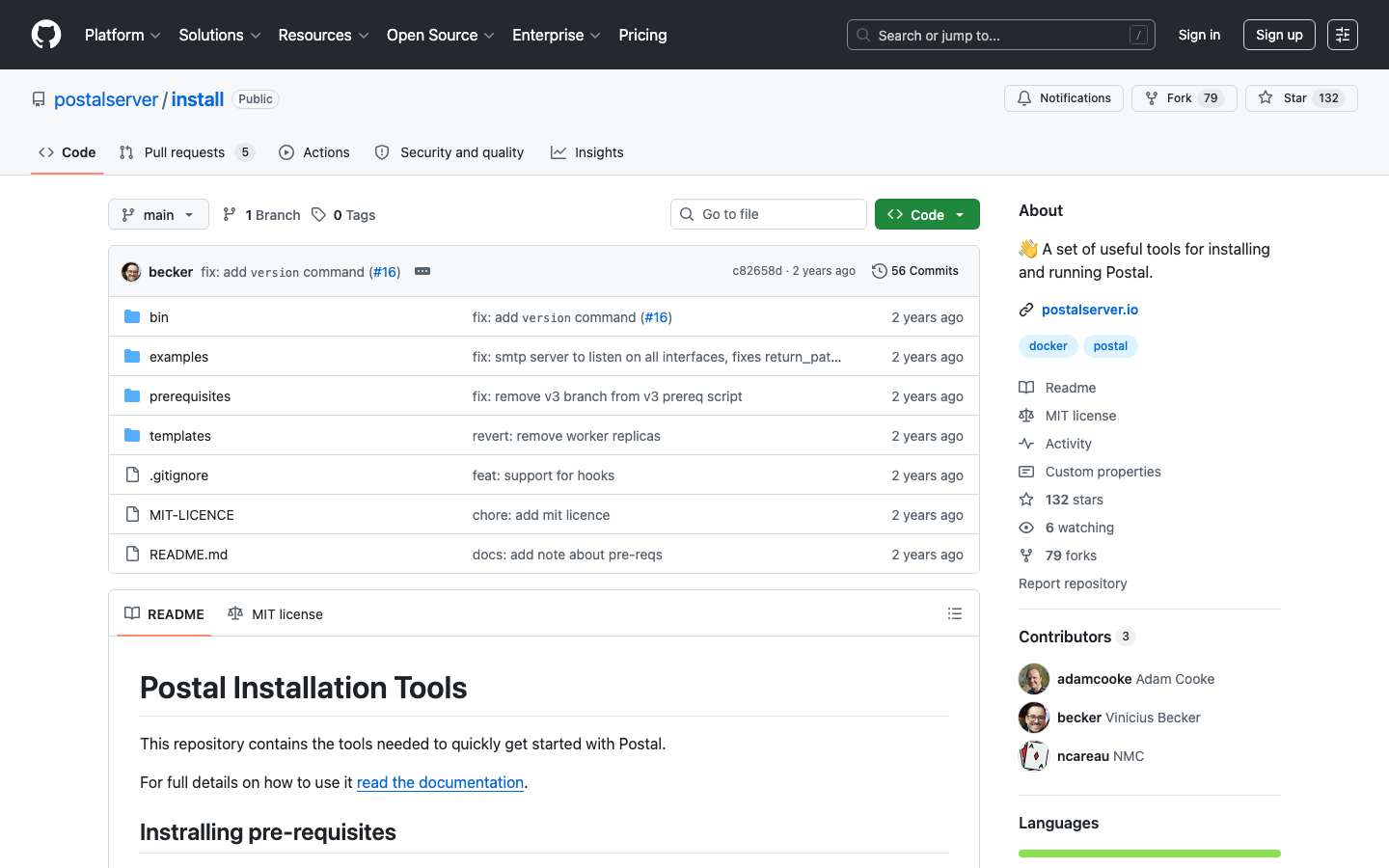
A fully featured, self-hosted mail delivery platform for incoming and outgoing email. It provides a complete mail server, REST API, webhook events, message queuing, and a web UI for monitoring and management.
Pros:
- All-in-one platform; handles inbound and outbound, bounces, complaints, and logs.
- REST API and webhooks; easy integration with applications.
- No per-email metering; flat infrastructure cost.
Cons:
- Requires self-hosting and operational overhead (updates, backups, monitoring).
- Larger footprint than a bare SMTP library.
BillionMail
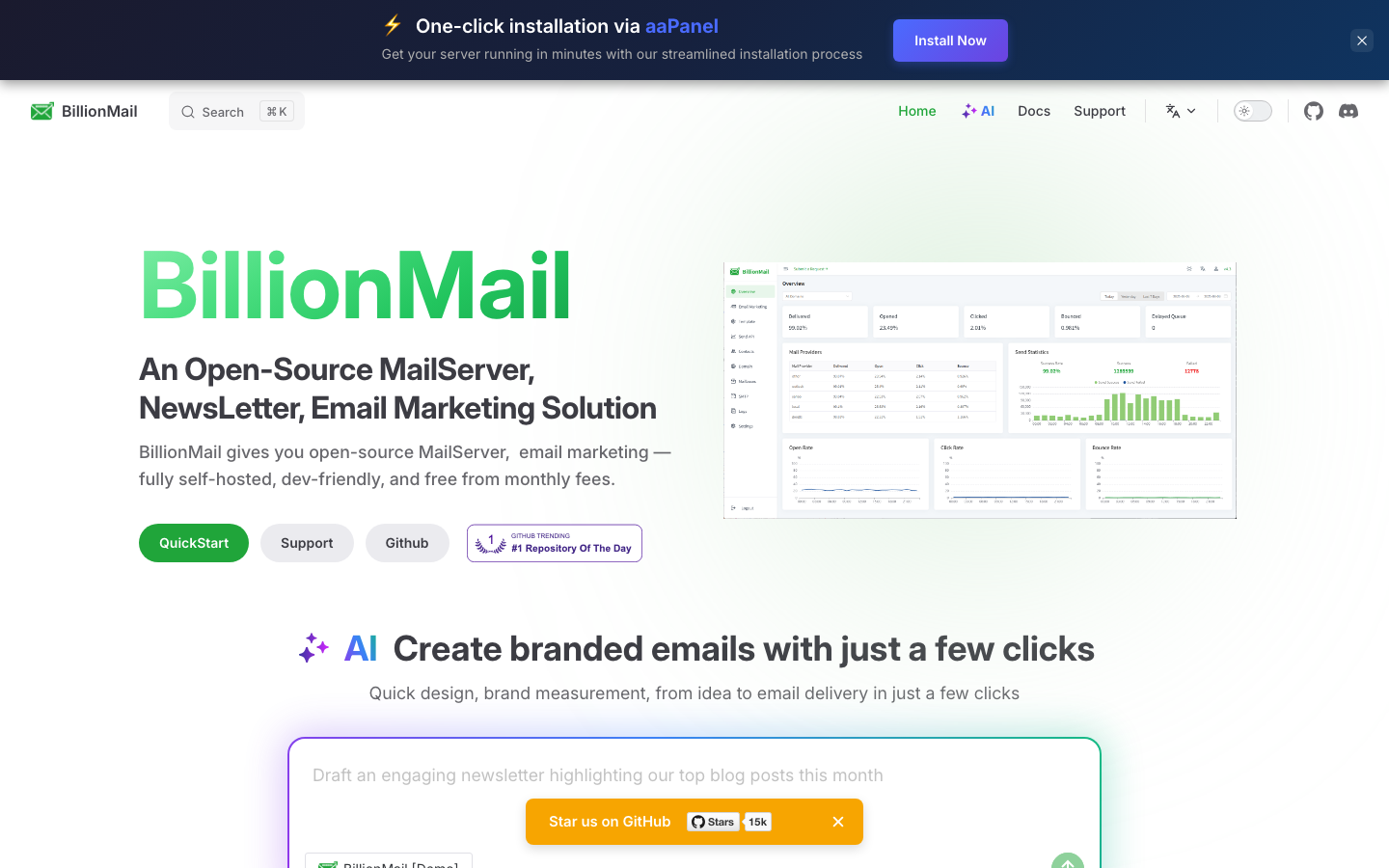
An open-source, self-hosted mail server and marketing platform built in Go. It includes newsletter features, email marketing campaigns, and a developer-friendly API—all without monthly per-email fees.
Pros:
- All-in-one mail server + marketing platform; no separate tools needed.
- Free from usage-based pricing; one-time infrastructure investment.
- Developer-friendly; active community support via Discord.
Cons:
- Self-hosted operational burden (deployment, scaling, maintenance).
- Smaller ecosystem than Postal or AWS SES; fewer third-party integrations.
Haraka
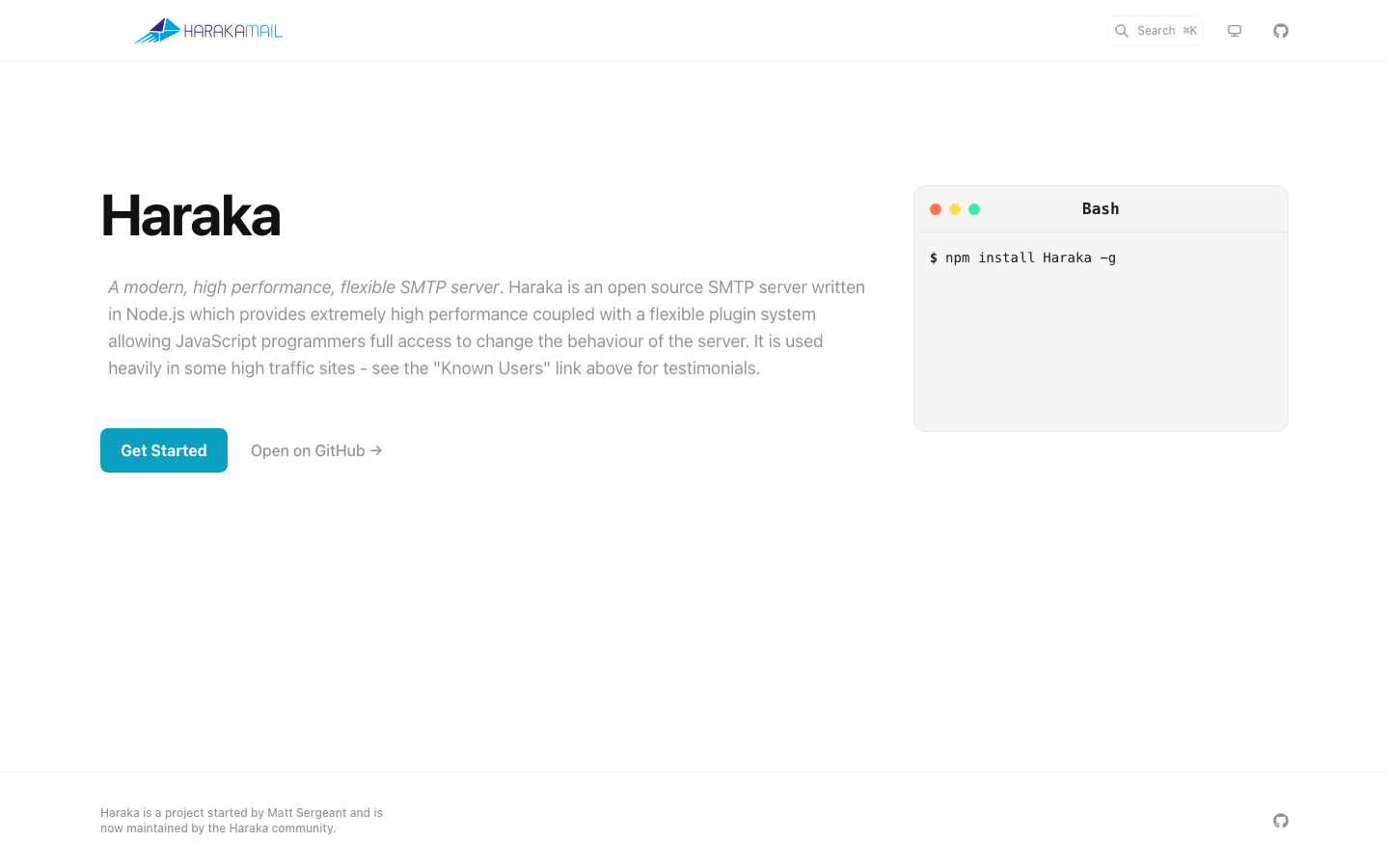
A fast, event-driven SMTP server written in JavaScript. It's designed for high-performance mail routing and filtering, with a plugin architecture that lets you customize behavior without modifying core code.
Pros:
- Extremely fast and extensible; ideal for custom mail routing, filtering, or relay logic.
- Event-driven plugin model; build exactly what you need.
- Low resource footprint.
Cons:
- Requires deep SMTP and mail infrastructure knowledge; steep learning curve.
- Not a marketing platform; bare mail server only.
keila
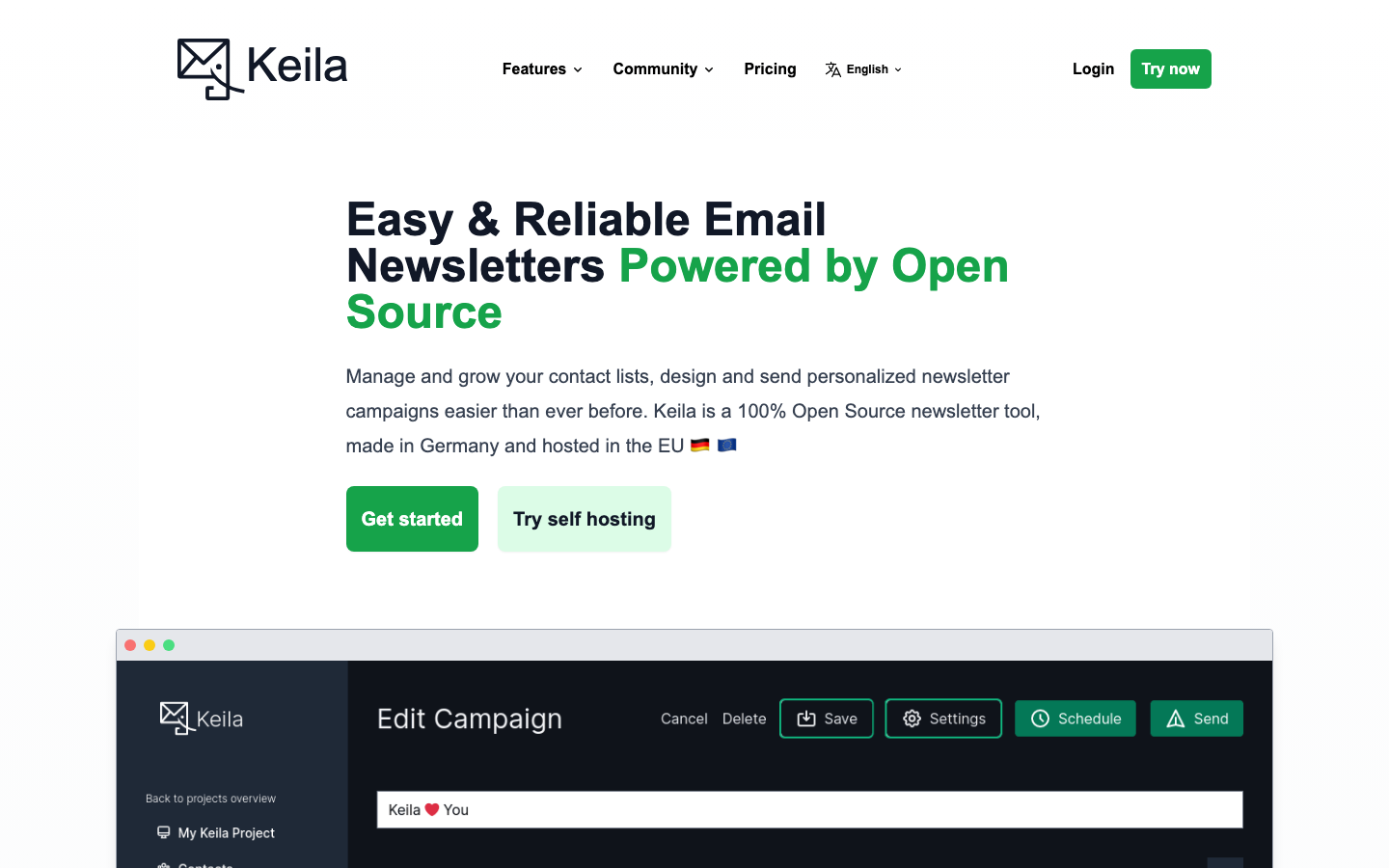
An open-source newsletter and email marketing tool built in Elixir. It focuses on privacy, simplicity, and self-hosting, with built-in campaign management, subscriber lists, and automation.
Pros:
- Privacy-first design; you own all subscriber data.
- Built-in campaign management and automation; no separate tools.
- No per-email fees; flat self-hosted cost.
Cons:
- Smaller community and ecosystem than Postal or BillionMail.
- Best suited to newsletter use cases; less flexible for custom transactional workflows.
cloudserver
An open-source Node.js implementation of the Amazon S3 protocol. It provides object storage capabilities, not email services.
Pros:
- S3-compatible API; easy migration from AWS S3.
- Self-hosted; no vendor lock-in.
Cons:
- Not an email platform. Included for completeness in our database, but not relevant to email sending or marketing.
How to choose
For transactional sends in Node.js: start with nodemailer or react-email if you're already building in React. Both let you avoid AWS lock-in and per-email metering.
For a complete, self-hosted mail platform: choose postal or BillionMail if you need inbound + outbound, list management, and webhooks. Postal is more mature; BillionMail adds marketing features.
For newsletters and campaigns: keila is purpose-built for privacy-conscious teams that want to own their subscriber data without monthly per-contact fees.
For advanced mail routing or filtering: Haraka is your foundation, but plan to invest in SMTP expertise and custom plugins.
In all cases, the trade-off is operational overhead—you manage deployment, scaling, and uptime—but you eliminate per-email pricing, AWS dependency, and sandbox approval delays.