





TL;DR
-
Need a drop-in replacement with better scaling and modern architecture: FreeSWITCH handles 500+ concurrent calls where Asterisk's single-threaded design hits limits, making it the natural upgrade path for growing deployments.
-
Building a SIP-native platform that prioritizes flexibility and developer experience: Routr brings TypeScript-first programmability to SIP routing, eliminating the config-file dialect learning curve that makes Asterisk maintenance expensive.
-
Running a multi-tenant hosted PBX or carrier-grade infrastructure: Kamailio and OpenSIPS are purpose-built SIP servers that scale horizontally and handle the session control layer with the performance guarantees Asterisk wasn't designed for.
Why teams leave Asterisk
Asterisk ships as a toolkit, not a finished product. That means no native GUI—you configure everything via dial-plan text files, a domain-specific language that requires dedicated developer time to learn, debug, and maintain. For organizations without full-time telecom engineering staff, this becomes a hidden cost that outweighs the "free" licensing.
The single-threaded architecture is the hard ceiling. Once you approach 500 concurrent calls, Asterisk's performance degrades sharply. If your deployment grows past that point, you're facing a rip-and-replace migration to a platform designed for scale—losing months of accumulated dial-plan logic in the process.
The third friction point is operational lock-in. Because Asterisk is so flexible and customization-heavy, each deployment becomes unique. Moving to another platform, or even to a managed Asterisk host, means rewriting your entire configuration. You own the code, but you're trapped by your own customizations. Competing cloud telephony services (Twilio, etc.) avoid this pain with APIs and hosted infrastructure—but at the cost of per-user pricing and vendor dependency. Open-source alternatives in this space let you escape that pricing model while still offering cleaner abstractions than raw Asterisk.
Quick comparison
| Name | License | Self-Hosted | Federation | E2E Encryption | Best For |
|---|---|---|---|---|---|
| FreeSWITCH | — | ✓ | — | — | High-concurrency deployments, scalable PBX |
| Kamailio | — | ✓ | ✓ | — | Carrier-grade SIP routing, large platforms |
| Routr | MIT | ✓ | — | — | Developer-friendly SIP programmability |
| OpenSIPS | GPL | ✓ | ✓ | — | High-performance SIP proxying, multi-tenant |
| FusionPBX | — | ✓ | — | — | Multi-tenant PBX, FreeSWITCH management layer |
Top open-source alternatives to Asterisk
FreeSWITCH
FreeSWITCH is a software-defined telecom stack designed from the ground up to run on any hardware, from embedded devices to multi-core servers. It replaces Asterisk's single-threaded core with a modern, scalable architecture that handles 500+ concurrent calls without degradation.
Pros
- Scales horizontally and handles high call volumes where Asterisk hits hard limits
- Modular design with clean APIs, reducing the config-file burden
- Runs on commodity hardware and embedded systems (Raspberry Pi to enterprise servers)
Cons
- Steeper learning curve than Asterisk for small deployments
- Requires operational expertise; not a turnkey PBX without additional layers
Kamailio
Kamailio is a production SIP server built for large-scale VoIP and real-time communication platforms. It focuses on the session control layer—routing, authentication, and policy enforcement—rather than trying to be a monolithic PBX.
Pros
- Proven at carrier scale; handles thousands of concurrent sessions
- Federation-ready and designed for multi-domain, multi-tenant architectures
- Highly modular; you compose only the features you need
Cons
- SIP-only; you must pair it with media servers (like FreeSWITCH) for a complete PBX
- Steeper operational learning curve than Asterisk for small teams
Routr
Routr is a programmable SIP server written in TypeScript, bringing modern language tooling and developer experience to SIP routing. It treats routing logic as code rather than configuration, making it accessible to teams comfortable with JavaScript/TypeScript.
Pros
- TypeScript-native; familiar to web developers, no domain-specific dialect to learn
- MIT licensed and designed for rapid iteration
- Cleaner abstractions than Asterisk dial plans
Cons
- Younger project with smaller production footprint than Kamailio or FreeSWITCH
- Not a full PBX; requires integration with media servers for calling features
OpenSIPS
OpenSIPS is a GPL SIP server optimized for high-performance session control in professional VoIP platforms. Like Kamailio, it focuses on routing and policy, but with a different architecture and tuning profile.
Pros
- Extremely fast and lightweight; designed for high-throughput SIP proxying
- Mature codebase with strong security and quality focus
- Federation and multi-domain support built in
Cons
- SIP server only; requires pairing with a media engine for a full PBX
- Configuration is still script-based; less accessible than Routr's TypeScript approach
FusionPBX
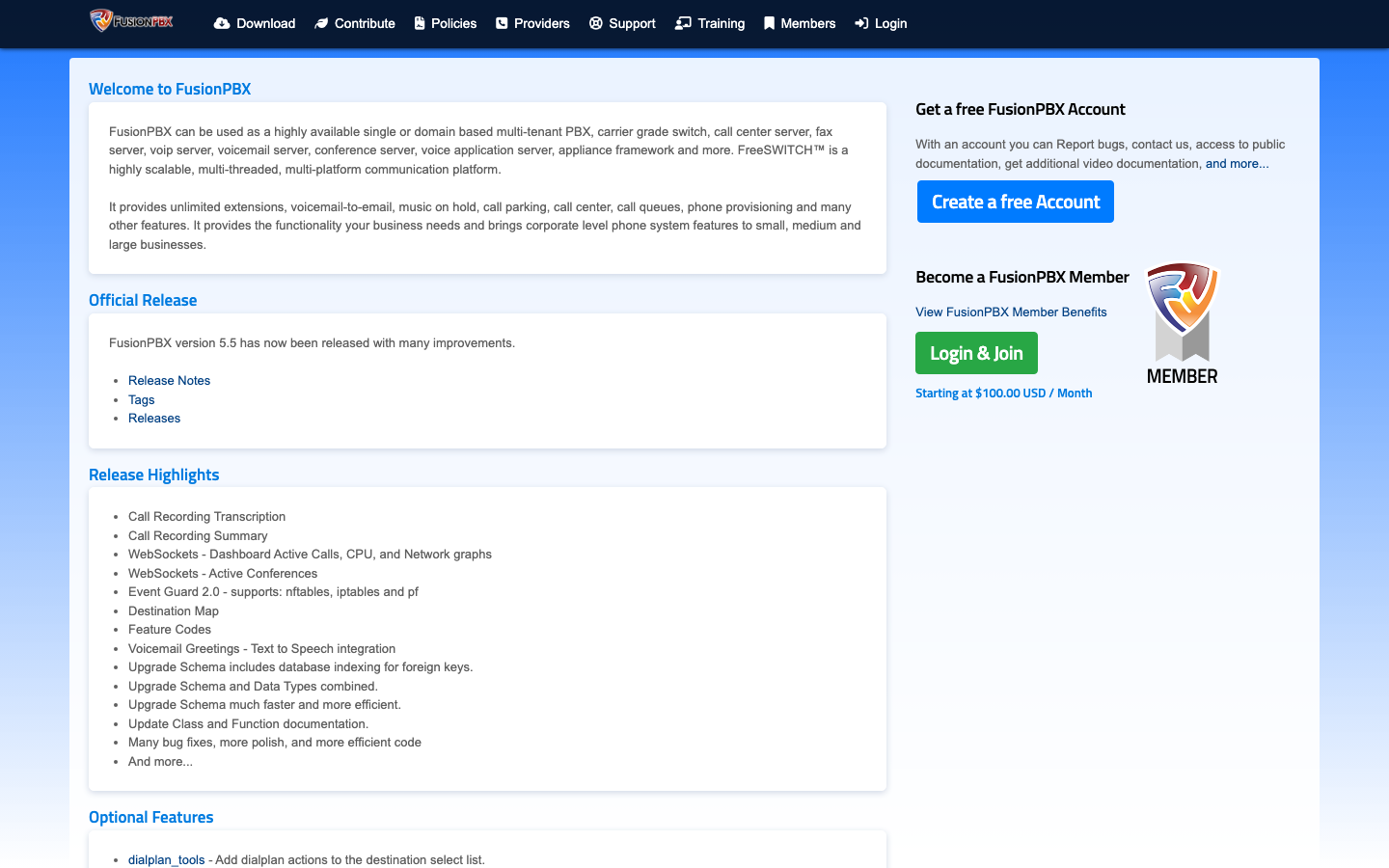
FusionPBX is a multi-tenant PBX and voice switch built as a management layer on top of FreeSWITCH. It provides the GUI and domain-based multi-tenancy that FreeSWITCH lacks out of the box.
Pros
- Full-featured, turnkey PBX experience with a web UI
- Multi-tenant architecture; ideal for hosted or reseller deployments
- Inherits FreeSWITCH's scalability and modern architecture
Cons
- Tightly coupled to FreeSWITCH; less flexible for custom integrations
- Smaller community than FreeSWITCH alone
How to choose
Small team, no dedicated telecom staff: FusionPBX gives you a GUI and managed experience without the Asterisk config-file burden. You trade flexibility for operational simplicity.
Growing deployment, scaling past 500 calls: Migrate to FreeSWITCH. It's the architectural upgrade Asterisk users hit when they outgrow single-threaded limits. If you need a management layer, layer FusionPBX on top.
Building a carrier or large multi-tenant platform: Choose Kamailio or OpenSIPS for the SIP control plane, paired with FreeSWITCH for media handling. This separation of concerns scales better than monolithic Asterisk.
Developer-first team with TypeScript experience: Routr eliminates the dialect-learning tax. Use it for SIP routing logic and compose it with other open-source media servers as needed.