















TL;DR
- Building a personal video library with zero subscription fees and full source transparency: Jellyfin strips away Emby's paywall entirely—every transcoding, sync, and offline feature is free and auditable.
- Managing comics, manga, or digital books across devices: Komga and Kavita each specialize in reading collections with built-in sync protocols (OPDS, Kobo Sync) that Emby doesn't target.
- Self-hosting game libraries or ROM collections without vendor lock-in: RomM and GameyFin provide dedicated media servers for gaming, whereas Emby's focus remains on film and TV.
Why teams leave Emby
The friction point is straightforward: Emby's most valuable features—hardware transcoding, mobile sync, offline downloads, and cinema mode—sit behind the Emby Premiere paywall. For self-hosters, this creates a recurring cost and a closed-source core that leaves no room for audit, modification, or long-term control.
Jellyfin, which forked directly from Emby's codebase, demonstrates the trade-off starkly. It offers every premium feature without subscription, without telemetry, and without requiring an account—all under GPL-2.0. For teams prioritizing true ownership and privacy by default, Emby's licensing model and source opacity become dealbreakers. The polished UI and Plex-like experience Emby provides are real strengths, but they come at the cost of vendor lock-in and the inability to self-audit your media server's behavior.
Beyond video, Emby's scope is narrow. If your library includes comics, manga, games, or specialized reading collections, Emby offers no native support. Open-source alternatives have grown to fill each niche—each with its own sync and API ecosystem—making Emby's generalist approach less relevant for teams with mixed media types.
Quick comparison
| Name | License | Self-Hosted | E2E Encryption | Mobile / Desktop Sync | Best For |
|---|---|---|---|---|---|
| Jellyfin | GPL-2.0 | ✓ | — | ✓ (built-in) | Video libraries; Emby replacement |
| Kavita | GPL-3.0 | ✓ | — | ✓ (cross-platform) | Books, manga, reading collections |
| RomM | AGPL-3.0 | ✓ | — | ✓ (web/desktop) | ROM and game library management |
| Komga | MIT | ✓ | — | ✓ (OPDS, Kobo Sync) | Comics, manga, magazines, eBooks |
| Stump | MIT | ✓ | — | ✓ (OPDS) | Comics and digital books (lightweight) |
| GameyFin | AGPL-3.0 | ✓ | — | — | Video game collection management |
Top open-source alternatives to Emby
Jellyfin
Jellyfin is the direct spiritual successor to Emby—a GPL-licensed media server that bundles every feature Emby charges for into a single free offering. It handles video, audio, and photos with hardware transcoding, mobile apps, offline sync, and no telemetry or account requirement.
Pros
- Every premium feature (transcoding, mobile sync, offline downloads) is free and open-source.
- No telemetry, no account requirement, no vendor lock-in.
- Mature ecosystem with stable clients across iOS, Android, web, and desktop.
Cons
- UI polish lags slightly behind Emby's refined interface.
- Community-driven development means feature velocity depends on volunteer contributions.
Kavita
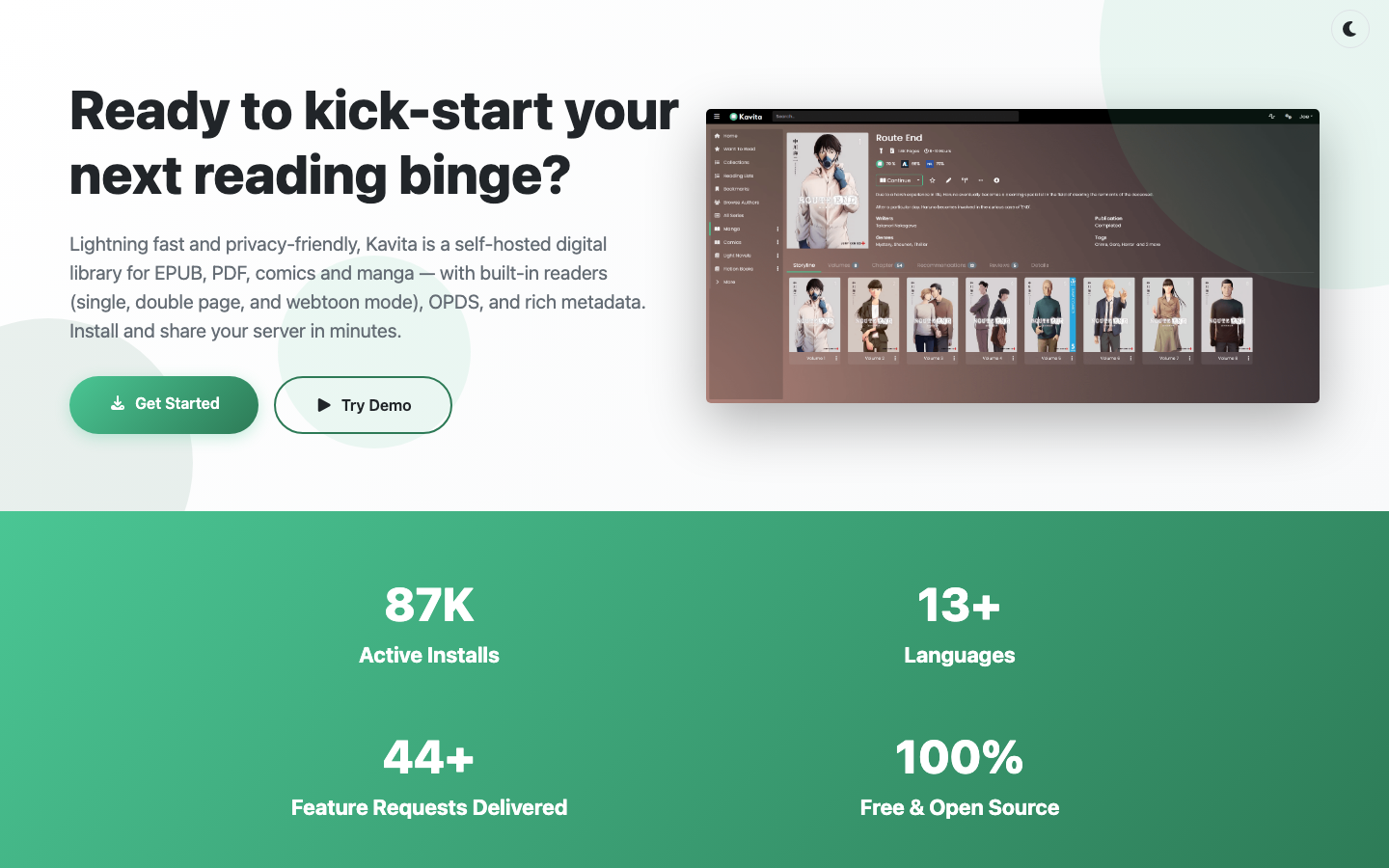
Kavita is a specialized reading server built for books, manga, comics, and graphic novels. It emphasizes speed and a full-featured reading experience with cross-platform sync, metadata management, and a native reader optimized for sequential art.
Pros
- Purpose-built for reading; far richer metadata and organization than Emby's generic approach.
- Cross-platform desktop and mobile support with synchronized reading progress.
- Lightweight and fast, even with large collections.
Cons
- Not a video server—only handles reading media.
- Smaller community than Jellyfin, so fewer third-party integrations.
RomM
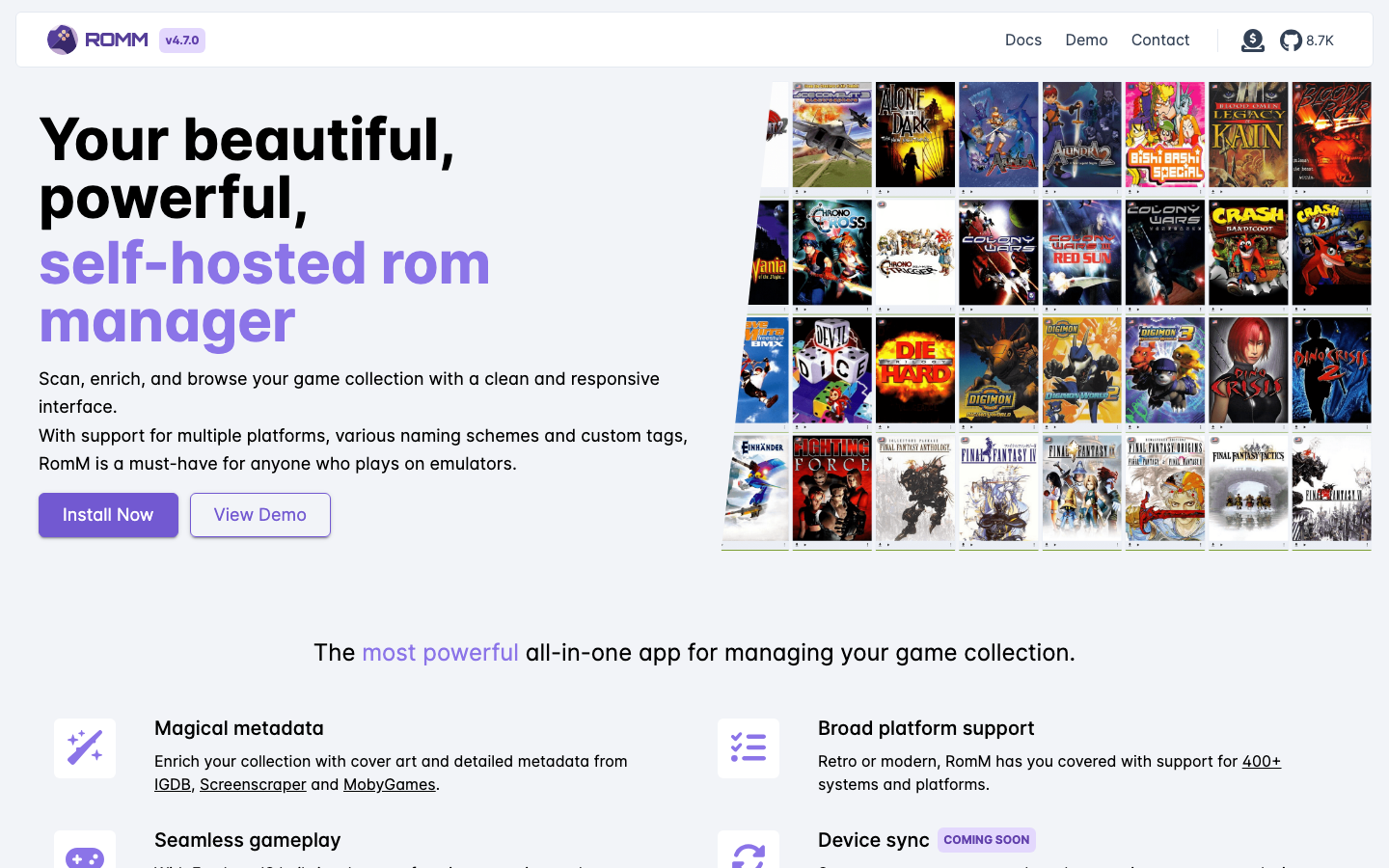
RomM is a self-hosted ROM manager and player designed for retro gaming collections. It provides a beautiful interface for browsing and playing emulated games, with web and desktop clients for remote access.
Pros
- Tailored UI and metadata handling for game libraries (box art, cover scans, emulator integration).
- Simple deployment and lightweight resource footprint.
- Web-based and desktop-friendly for remote play.
Cons
- Narrowly focused on ROMs and games; not a general-purpose media server.
- Emulator integration relies on external tools, not built-in transcoding.
Komga
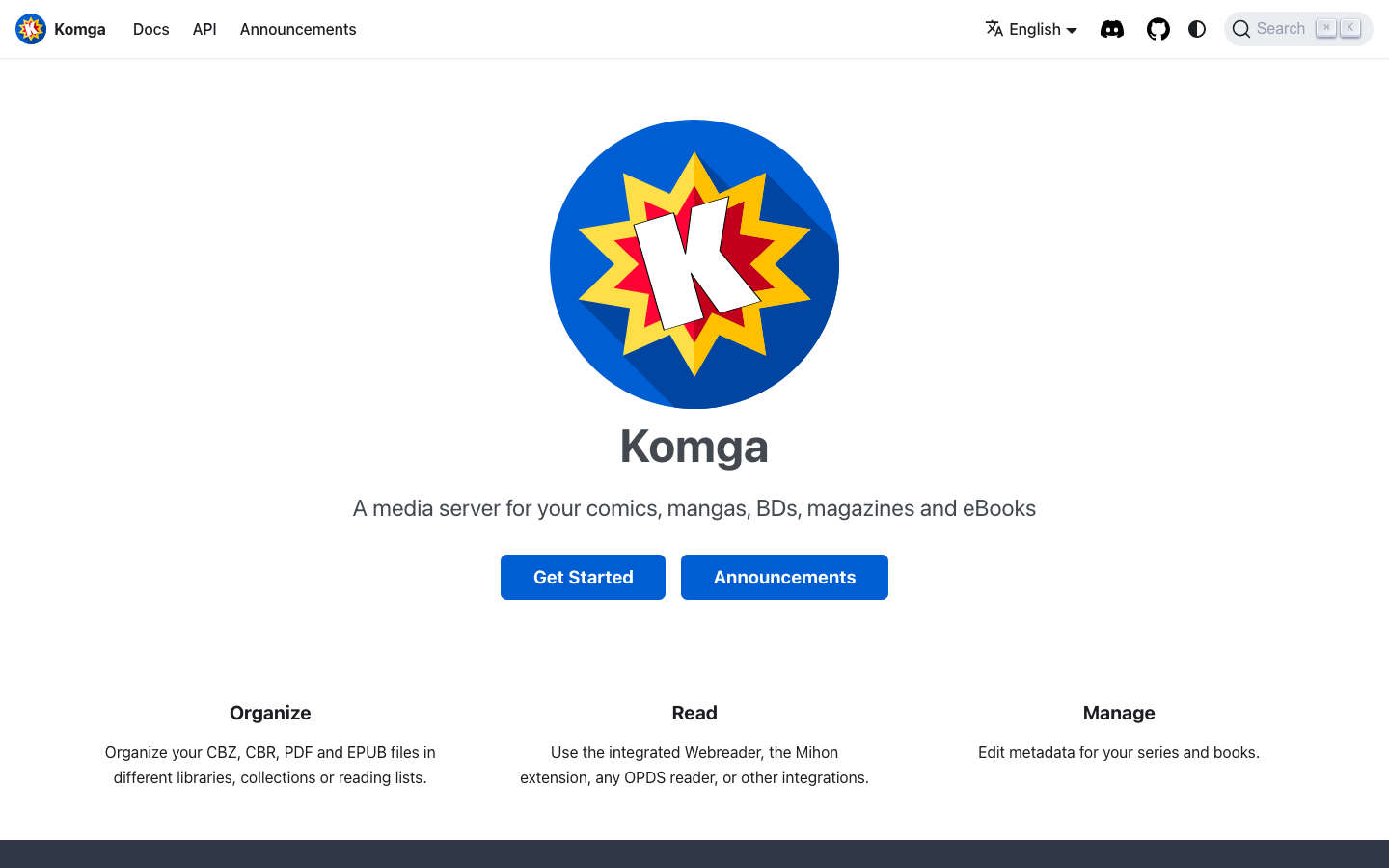
Komga is a media server for comics, manga, graphic novels, magazines, and eBooks with strong sync support via OPDS and Kobo Sync protocols. It's designed for reading collections and includes an API for custom integrations.
Pros
- Native support for OPDS and Kobo Sync, enabling sync with third-party e-readers and apps.
- MIT license offers maximum freedom for modification and redistribution.
- Handles diverse reading formats (CBZ, EPUB, PDF) with consistent metadata.
Cons
- No video support—reading-only.
- Smaller user base than Jellyfin; fewer pre-built client apps.
Stump
Stump is a lightweight, open-source server for comics, manga, and digital books with OPDS support (currently in development). It prioritizes simplicity and fast deployment for smaller reading libraries.
Pros
- Minimal resource overhead; fast to deploy and maintain.
- OPDS support for e-reader compatibility.
- MIT license.
Cons
- Early-stage project (WIP); feature set and stability still maturing.
- Limited ecosystem compared to established alternatives like Komga or Kavita.
GameyFin
GameyFin is a dedicated video game collection manager, offering a centralized way to organize, catalog, and browse your gaming library with rich metadata and cover art.
Pros
- Specialized UI and metadata for game libraries.
- AGPL-3.0 ensures community-driven development.
Cons
- No sync or remote-play features; primarily a local browsing and cataloging tool.
- Smaller project; limited integrations and third-party support.
How to choose
For a Plex or Emby replacement: Start with Jellyfin. It's the most mature open-source video server and directly addresses Emby's paywall and closed-source limitations.
For reading collections (books, manga, comics): Choose between Kavita (feature-rich, cross-platform) and Komga (lighter, strong e-reader sync). If you need both, run them side-by-side—they're lightweight enough.
For specialized media (games, ROMs): RomM and GameyFin are purpose-built. Emby never competed in these spaces, so this is where open-source shines.
For teams: Jellyfin scales best for shared household or small-group deployments. Specialized servers (Kavita, Komga, RomM) are ideal for teams with a single media type. All six are self-hosted and require no external accounts, so privacy and control are guaranteed regardless of scale.