






TL;DR
- Privacy & data ownership matter most: Discourse gives you the most mature, battle-tested platform where your community data stays entirely yours—no SaaS lock-in, no surprise policy changes.
- Minimal overhead and cheap hosting are priorities: phpBB or MyBB run on standard PHP hosting for pennies, letting you host a full forum without the operational weight of heavier stacks.
- You need both forum features and knowledge management: Apache Answer bridges the gap between discussion and searchable Q&A, ideal if your community doubles as a help center or knowledge base.
Why teams leave Flarum
Flarum wins on simplicity and cost—it's genuinely lightweight and runs on cheap shared PHP hosting. But that minimalism becomes a ceiling. As communities grow, they hit three walls.
First, the extension ecosystem is thin. Flarum's plugin marketplace is younger and smaller than heavier platforms. If you need specialized features—advanced moderation, custom workflows, deep analytics, or niche integrations—you'll either code them yourself or find they don't exist. That's friction when you're scaling.
Second, feature depth matters for retention. Communities that depend on rich discussion tools, sophisticated permissions, real-time notifications, or polished mobile experiences often outgrow Flarum's feature set. You don't notice this at launch; you notice it when your power users start asking "why can't we do X?"
Third, switching costs are real. Even though Flarum is open-source, migrating your community, user accounts, and discussion history to a different platform is non-trivial. That lock-in—whether data, user expectations, or custom extensions—makes early platform choice matter more than it appears.
The trade-off is honest: Flarum trades ecosystem maturity and feature depth for a lean footprint and low operational cost. If you need more, you're choosing between heavier self-hosted options (which cost more to run) or accepting that you'll build or wait for features yourself.
Quick comparison
| Name | License | Self-Hosted | Plugin Ecosystem | Headless / API | Best For |
|---|---|---|---|---|---|
| Discourse | GPL-2.0 | ✓ Full | Mature & extensive | ✓ REST API | Large communities, long-term growth |
| Apache Answer | Apache-2.0 | ✓ Full | Growing | ✓ REST API | Q&A, help centers, knowledge bases |
| NodeBB | GPL-3.0 | ✓ Full | Strong | ✓ REST API | Modern UX, real-time features, Node.js stacks |
| Misago | GPL-2.0 | ✓ Full | Moderate | ✓ REST API | High-traffic forums, scalability focus |
| phpBB | GPL-2.0 | ✓ Full | Extensive (legacy) | Limited | Established communities, PHP-only hosting |
| MyBB | LGPL-3.0 | ✓ Full | Moderate | Limited | Small to mid-size forums, PHP hosting |
Top open-source alternatives to Flarum
Discourse
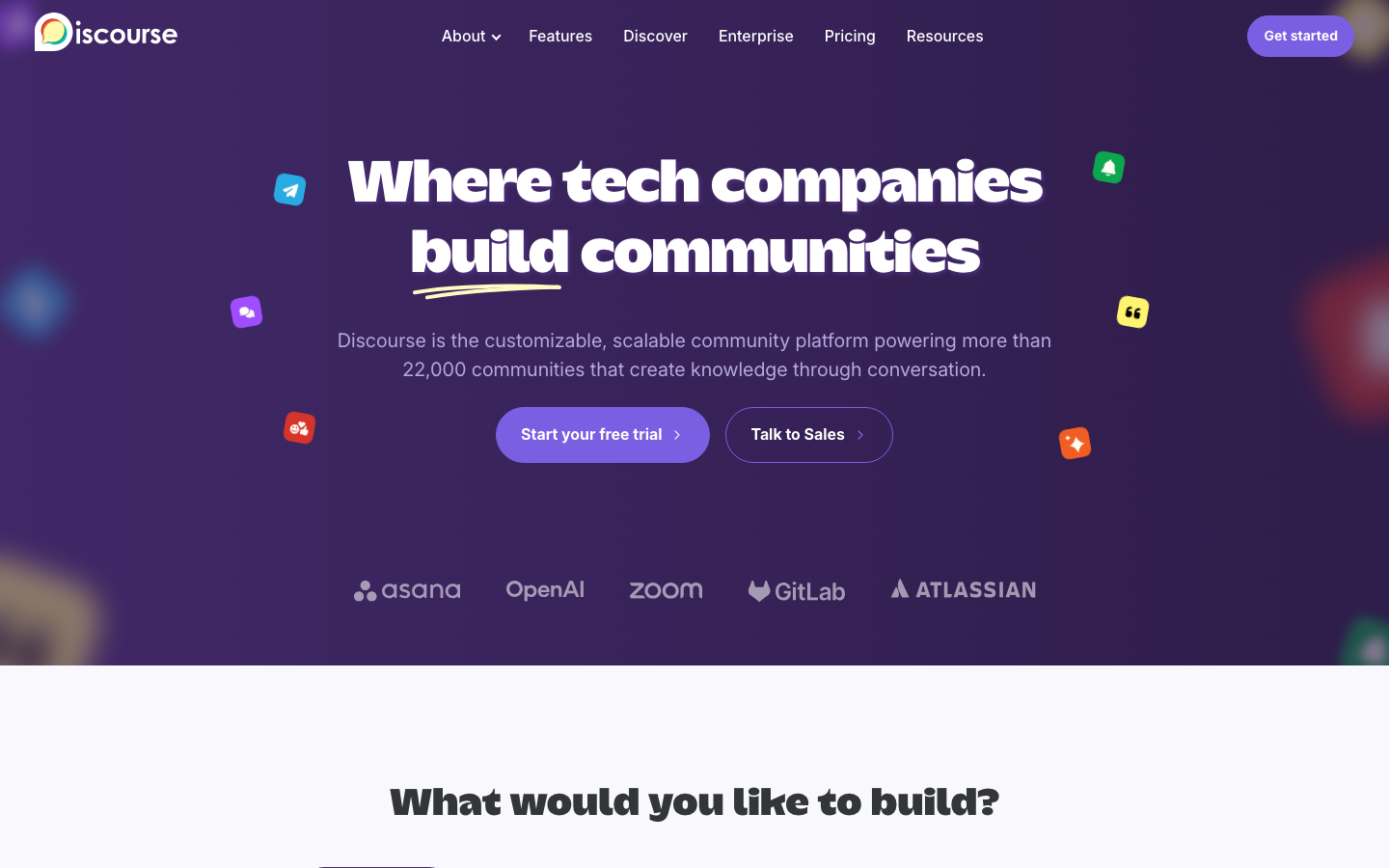
Discourse is the heavyweight champion of open-source forums—a full-featured platform built for modern community engagement with a strong emphasis on signal-to-noise ratio and user experience. It's written in Ruby and JavaScript, runs on its own stack, and has the largest ecosystem of plugins and themes of any open-source forum. ★46,880 on GitHub.
Pros:
- Mature plugin ecosystem and extensive third-party integrations; you'll find solutions for almost any use case.
- Excellent moderation tools, real-time notifications, and mobile experience; communities stay engaged longer.
- Strong API and webhooks; integrates well with external systems and supports headless use cases.
Cons:
- Requires more server resources (memory, CPU) than lightweight alternatives; hosting costs are higher.
- Steeper learning curve for self-hosted setup and customization compared to Flarum.
Apache Answer
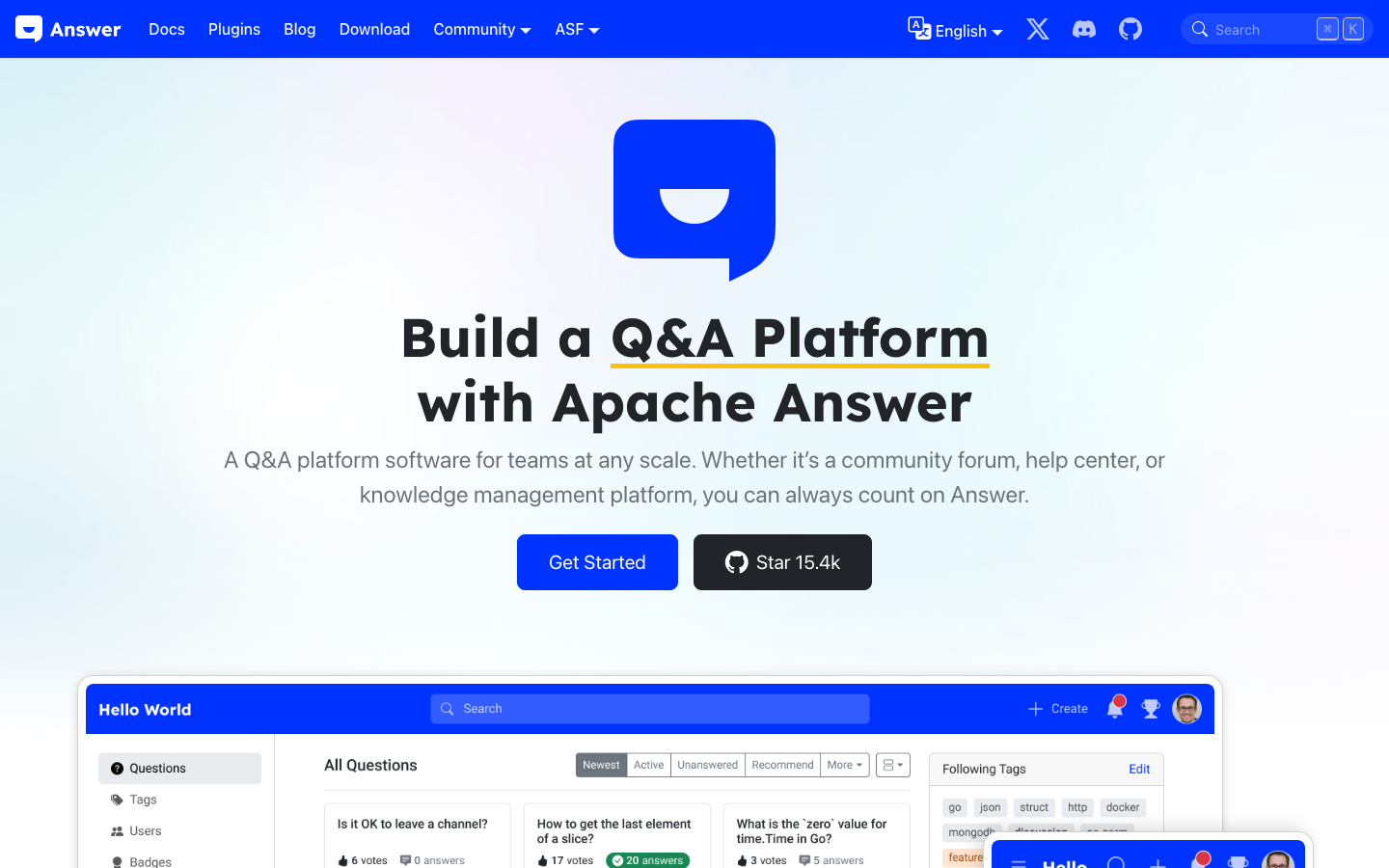
Apache Answer is a Q&A platform designed for teams and communities that blur the line between discussion and knowledge management. It works as a community forum, help center, or internal knowledge base—ideal if your community needs searchable answers alongside live discussion. Written in Go.
Pros:
- Bridges forums and Q&A; answers are indexed and discoverable, reducing duplicate questions.
- Clean, modern interface with strong search and categorization; knowledge compounds over time.
- Lightweight compared to Discourse; lower resource overhead while offering more structure than a pure forum.
Cons:
- Smaller ecosystem than Discourse; fewer third-party integrations and plugins available.
- Best suited to Q&A workflows; if you need pure discussion (like a general chat forum), it's less ideal.
NodeBB
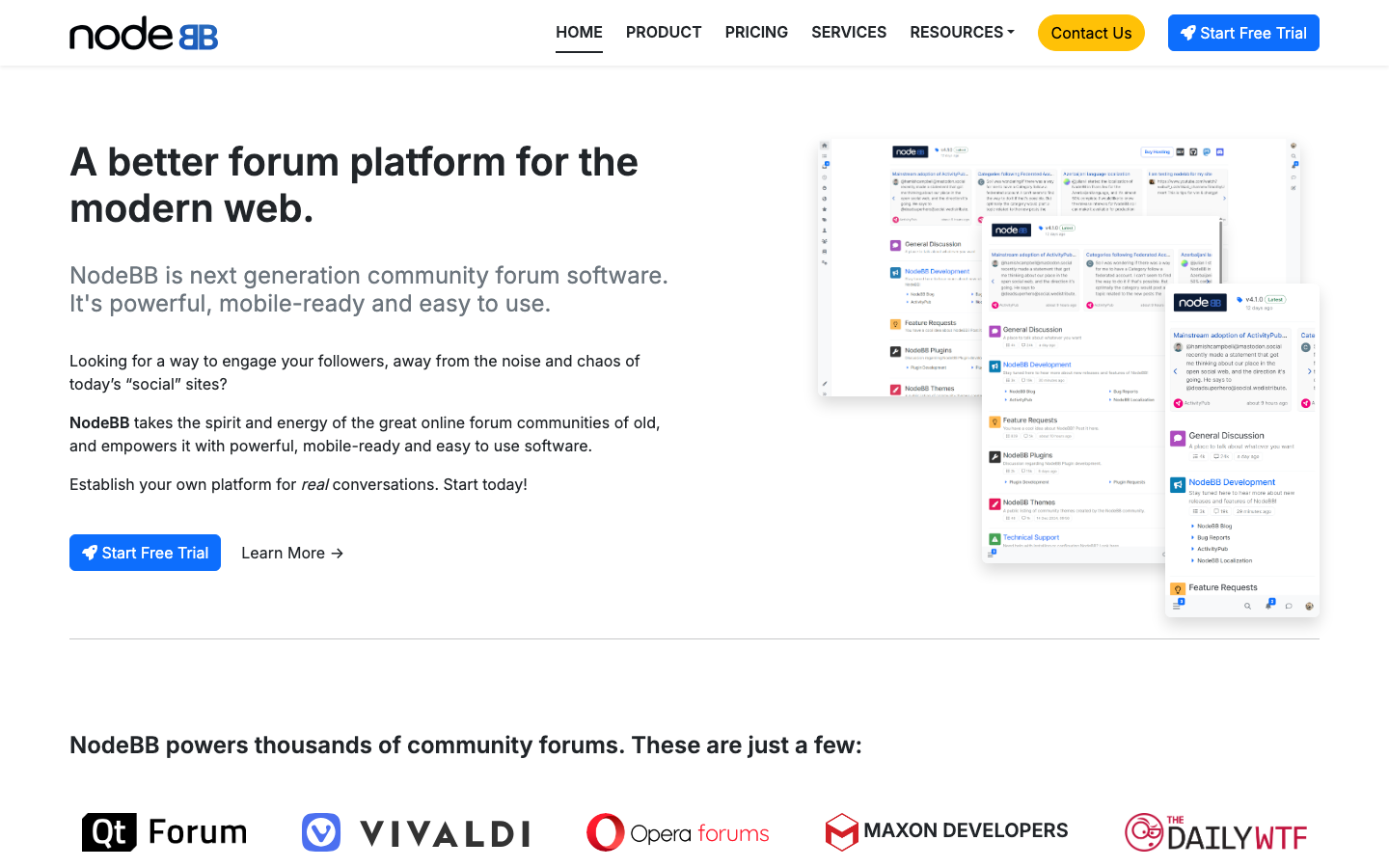
NodeBB is a modern forum platform built on Node.js, designed for real-time interaction and contemporary web standards. It emphasizes responsive design, real-time notifications, and a developer-friendly architecture. ★15,046 on GitHub.
Pros:
- Real-time features built in; notifications and live updates happen without polling or delay.
- Strong REST API and plugin system; fits naturally into JavaScript/Node.js stacks.
- Clean, modern UI out of the box; appeals to communities that value contemporary design.
Cons:
- Requires Node.js hosting; not compatible with cheap shared PHP hosts, raising operational overhead.
- Smaller plugin ecosystem than Discourse, though stronger than Flarum.
Misago
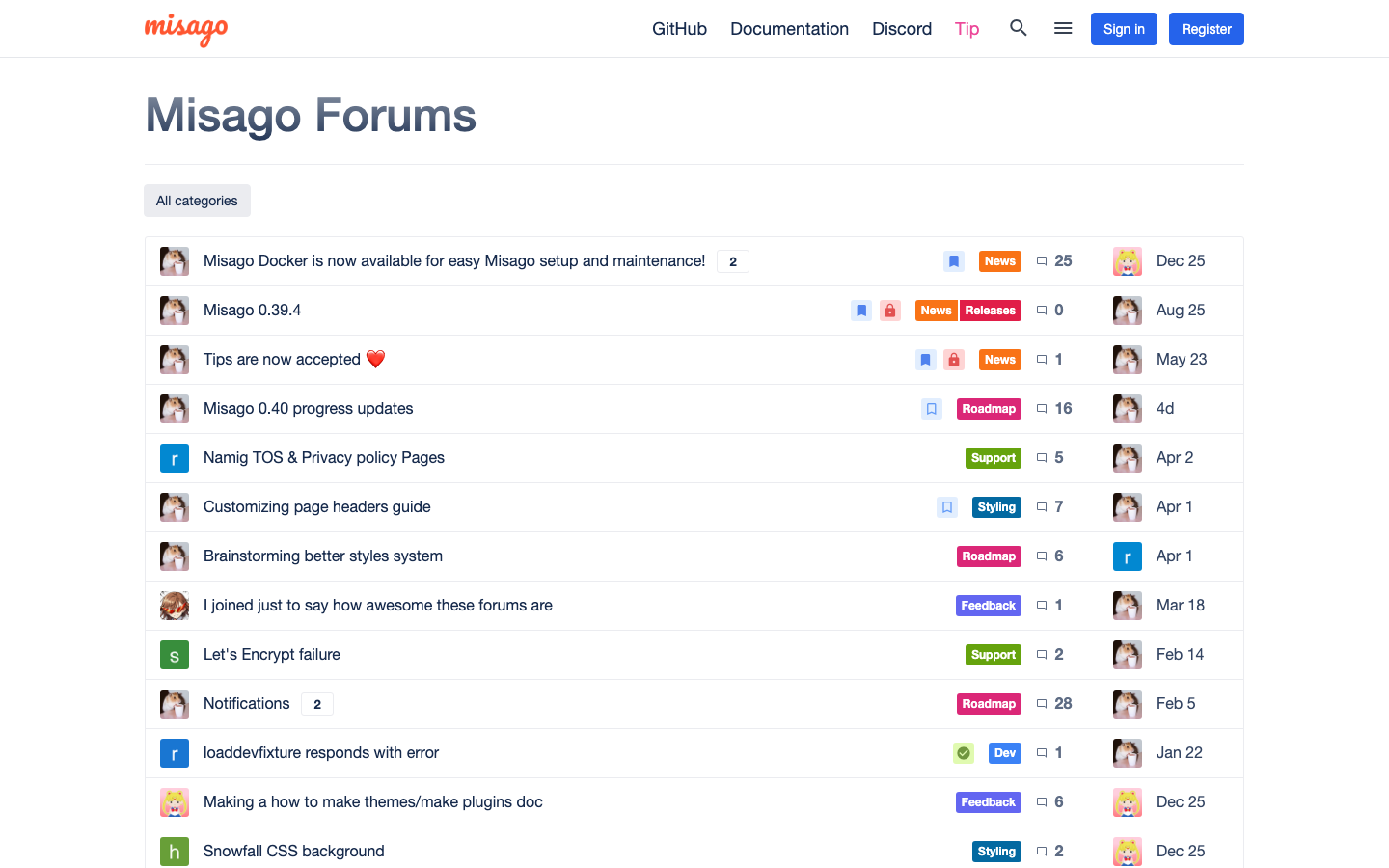
Misago is a full-featured forum application written in Python, built for performance and scalability. It's responsive, modern, and optimized for high-traffic communities that need to handle thousands of concurrent users without degradation. ★2,716 on GitHub.
Pros:
- Scalability focus; handles high traffic and large datasets efficiently.
- REST API and headless-ready; separates backend from frontend for flexible deployments.
- Modern codebase in Python; easier to customize and extend for teams with Python expertise.
Cons:
- Smaller community and ecosystem than Discourse or NodeBB; fewer plugins and themes.
- Requires Python hosting; not suitable for shared PHP hosting environments.
phpBB
phpBB is the granddaddy of open-source forums—a battle-tested, PHP-based bulletin board with decades of real-world use. It runs on any standard web host and powers countless established communities. ★2,062 on GitHub.
Pros:
- Runs on any PHP host; extremely cheap to operate and compatible with legacy hosting.
- Extensive legacy plugin ecosystem; if you need a feature, it likely exists.
- Proven stability; millions of sites have relied on phpBB for years without incident.
Cons:
- Older codebase; UI and UX feel dated compared to Discourse, NodeBB, or Misago.
- Smaller modern development velocity; new features come slowly compared to actively maintained alternatives.
MyBB
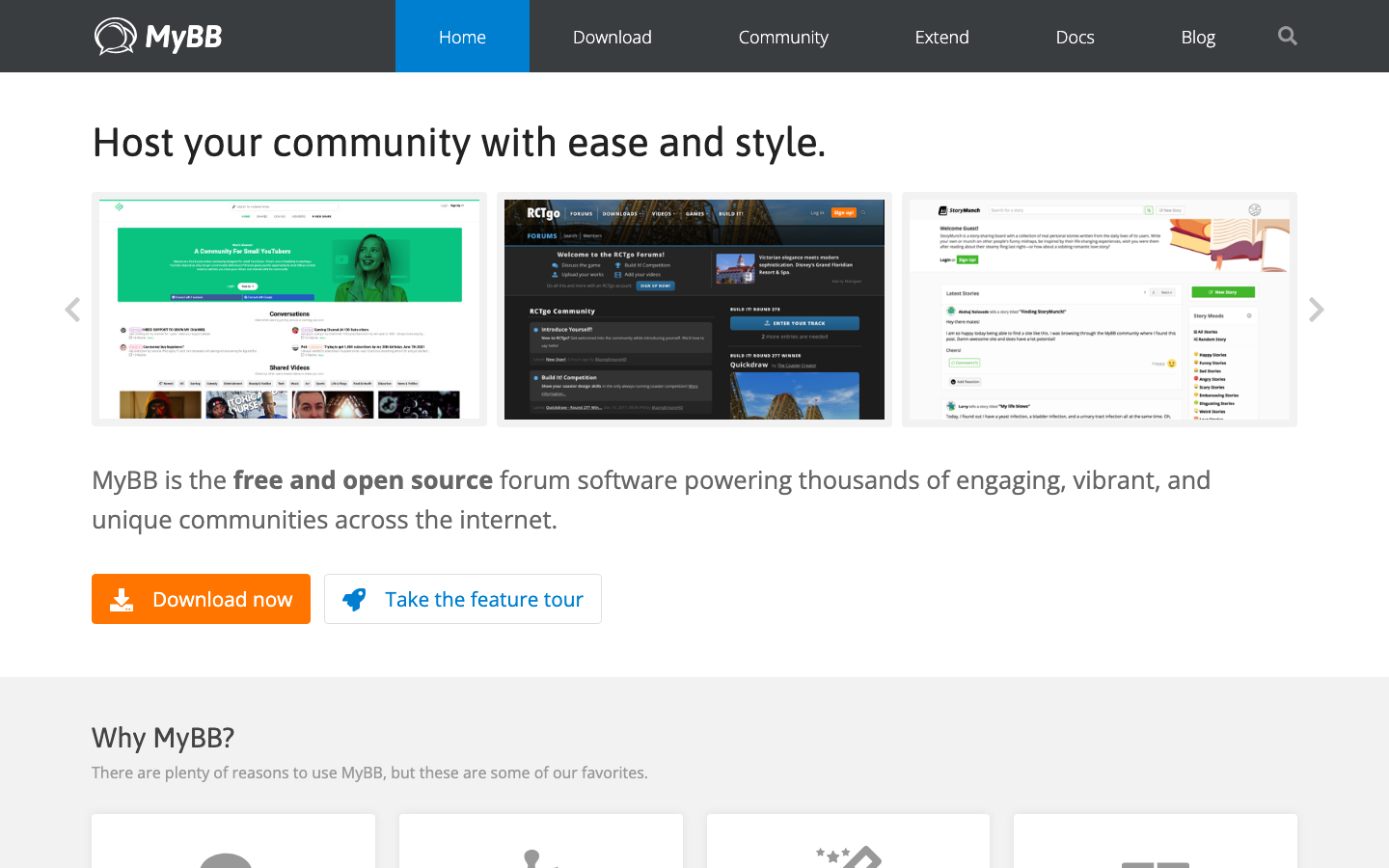
MyBB is a free, open-source forum software written in PHP, designed as a lightweight alternative to heavier platforms. It's smaller and simpler than phpBB while still offering solid core forum features. ★1,208 on GitHub.
Pros:
- Minimal resource footprint; runs well on cheap shared hosting like Flarum.
- Straightforward to install and customize; good for small to mid-size communities.
- Active maintenance and a helpful community; issues get addressed reasonably quickly.
Cons:
- Smaller plugin ecosystem than phpBB; fewer third-party extensions available.
- Limited modern features (real-time notifications, advanced APIs); best for traditional forum use cases only.
How to choose
If your community is growing fast or you expect it to scale, choose Discourse. Its ecosystem maturity and feature depth mean you won't outgrow it, and the operational cost is worth avoiding a painful migration later.
If you need a Q&A or help-center flavor, Apache Answer is purpose-built for that; it's lighter than Discourse but richer than a pure forum.
If you're locked into Node.js infrastructure or want real-time features, NodeBB is the natural fit.
If you have a PHP-only host and want to keep costs near-zero, phpBB or MyBB are your answer—accept that you're trading modern UX and ecosystem depth for maximum affordability.
If you anticipate massive traffic or need Python expertise in-house, Misago offers scalability and developer flexibility, though with a smaller ecosystem.
The core question: How much ecosystem maturity and feature depth do you need versus how cheap and simple do you want to run? Flarum sits at the "cheap and simple" end. These alternatives span the spectrum—pick based on where your community's needs and constraints actually land.