







TL;DR
- Monitoring and autonomous agents at scale: huginn lets you build standing agents that act on your behalf without the per-execution billing model, ideal for teams running dozens of lightweight, always-on automations.
- AI-first workflow orchestration: dify is purpose-built for agentic workflows and LLM pipelines, making it the natural choice if your automation layer needs to reason and decide, not just route data.
- Simple command exposure without complexity: OliveTin strips away workflow engine overhead entirely—use it when your team just needs safe, audited shell command access from a web UI, not a full automation platform.
Why teams leave n8n
The core issue is metering. At 10,000 tasks per month, Zapier's per-task pricing becomes prohibitively expensive compared to n8n's per-execution model—a 95%+ cost difference for identical work. But the real driver is deeper: teams hosting sensitive data (payments, customer records, internal processes) don't want that data transiting a proprietary SaaS, even one with strong security.
n8n's self-hosting option solves this. Run unlimited automations on your own infrastructure, pay zero per-execution fees, and keep data flows entirely internal. The trade-off is operational burden—you manage the server, backups, and scaling. For teams with infrastructure teams or strict data residency requirements, that's a fair exchange. For teams seeking similar control without building a full workflow engine, the alternatives below offer narrower scope but often lower operational overhead.
Quick comparison
| Name | License | Self-Hosted | API / Extensibility | Stack / Language | Best For |
|---|---|---|---|---|---|
| dify | — | Yes | LLM integrations, custom nodes, API-first | TypeScript | AI agents and LLM-powered workflows |
| Flowise | — | Yes | LLM chains, visual node builder, extensible | TypeScript | Low-code AI agent construction |
| huginn | MIT | Yes | Ruby scripting, webhook agents, HTTP API | Ruby | Autonomous agents and continuous monitoring |
| minds-platform | — | Yes | Python-based extensibility, model deployment | Python | Production AI systems with full control |
| OliveTin | AGPL-3.0 | Yes | Shell command execution, webhook triggers | Go | Safe command access and simple task triggering |
Top open-source alternatives to n8n
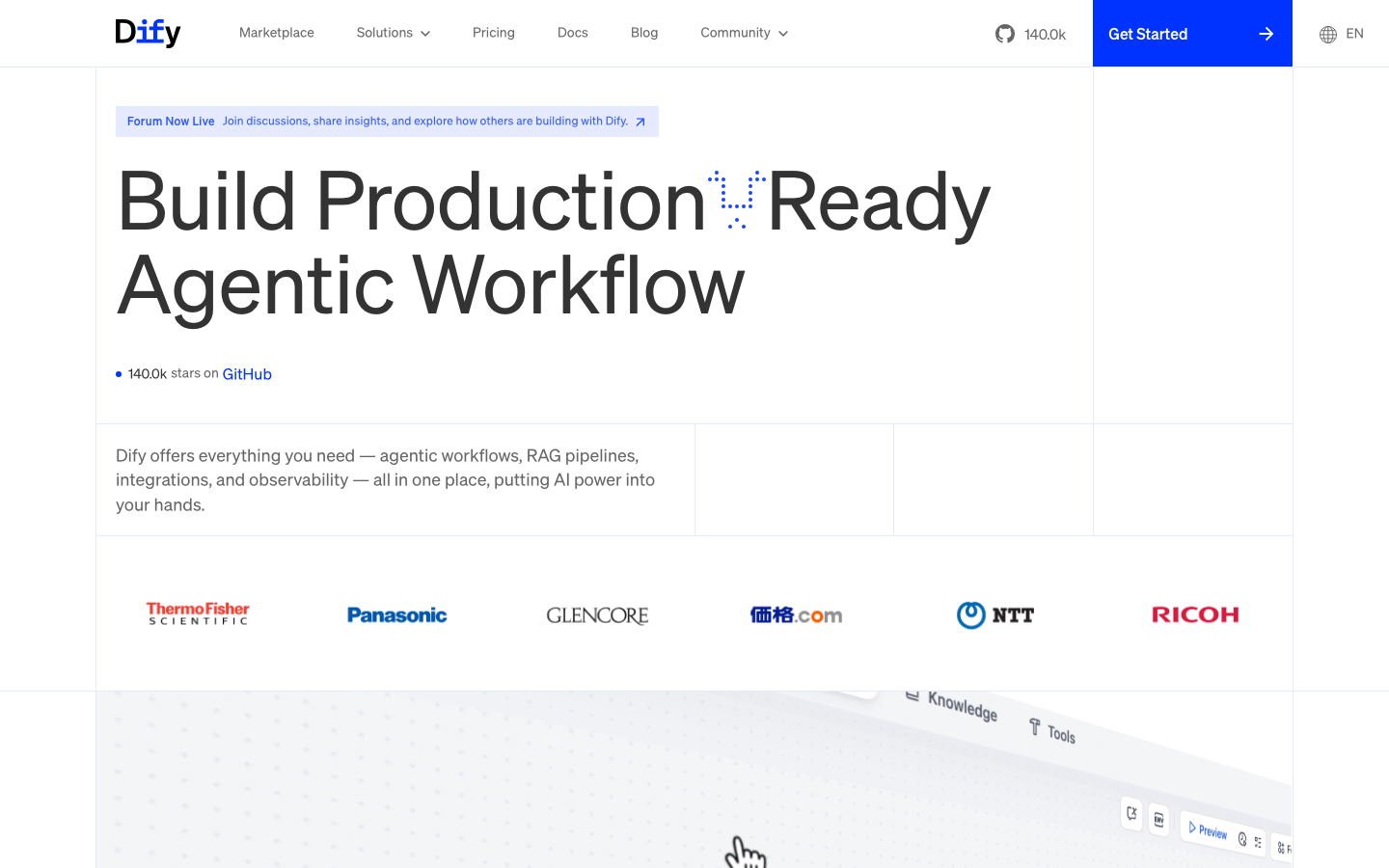
dify
A production-ready platform for building agentic workflows and LLM-powered automation. Dify abstracts the complexity of chaining LLMs, vector databases, and external tools into a visual builder, then executes those chains at scale. It's designed for teams building AI agents that need to reason about decisions, not just move data.
Pros
- Native LLM orchestration and prompt management; no need to hand-roll agent loops
- Self-hosted with full data control; integrates with your own LLM infrastructure
- Visual workflow builder lowers barrier for non-engineers to compose complex AI logic
Cons
- Steeper learning curve for teams unfamiliar with LLM concepts and prompt engineering
- Ecosystem smaller than n8n; fewer pre-built integrations with legacy SaaS tools
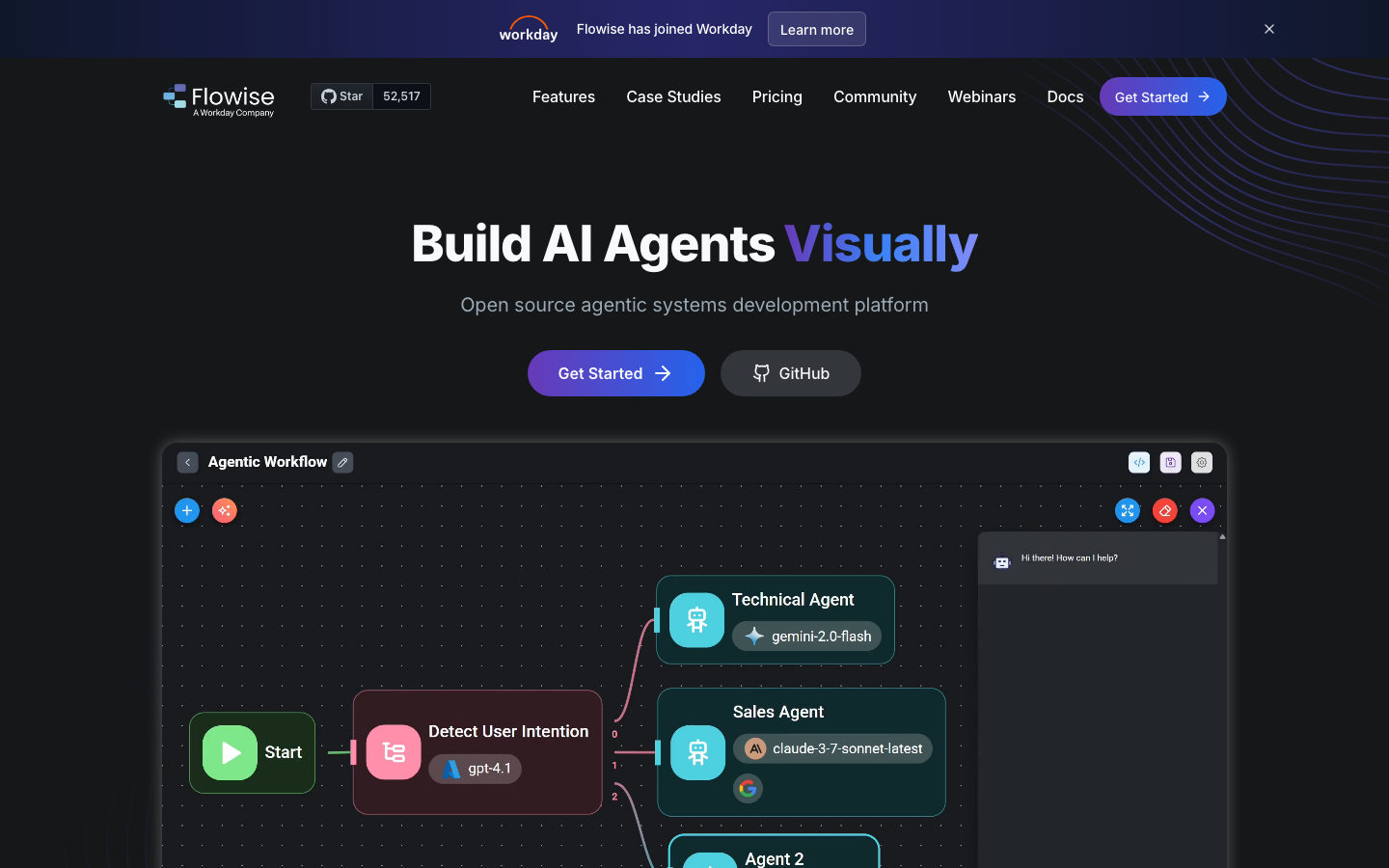
Flowise
A visual, low-code platform for building and deploying AI agents using LLM chains. Flowise emphasizes ease of use—drag nodes representing LLM calls, memory, tools, and data sources into a canvas, then deploy. Self-hosted or cloud, it keeps your data and model calls under your control.
Pros
- Intuitive drag-and-drop interface; fast time-to-value for AI agent prototypes
- Lightweight and easy to self-host; minimal infrastructure footprint
- Strong community focus and active development
Cons
- Less mature than n8n for non-AI automation; fewer connectors to business SaaS
- Limited built-in support for complex conditional logic outside the LLM chain context
huginn
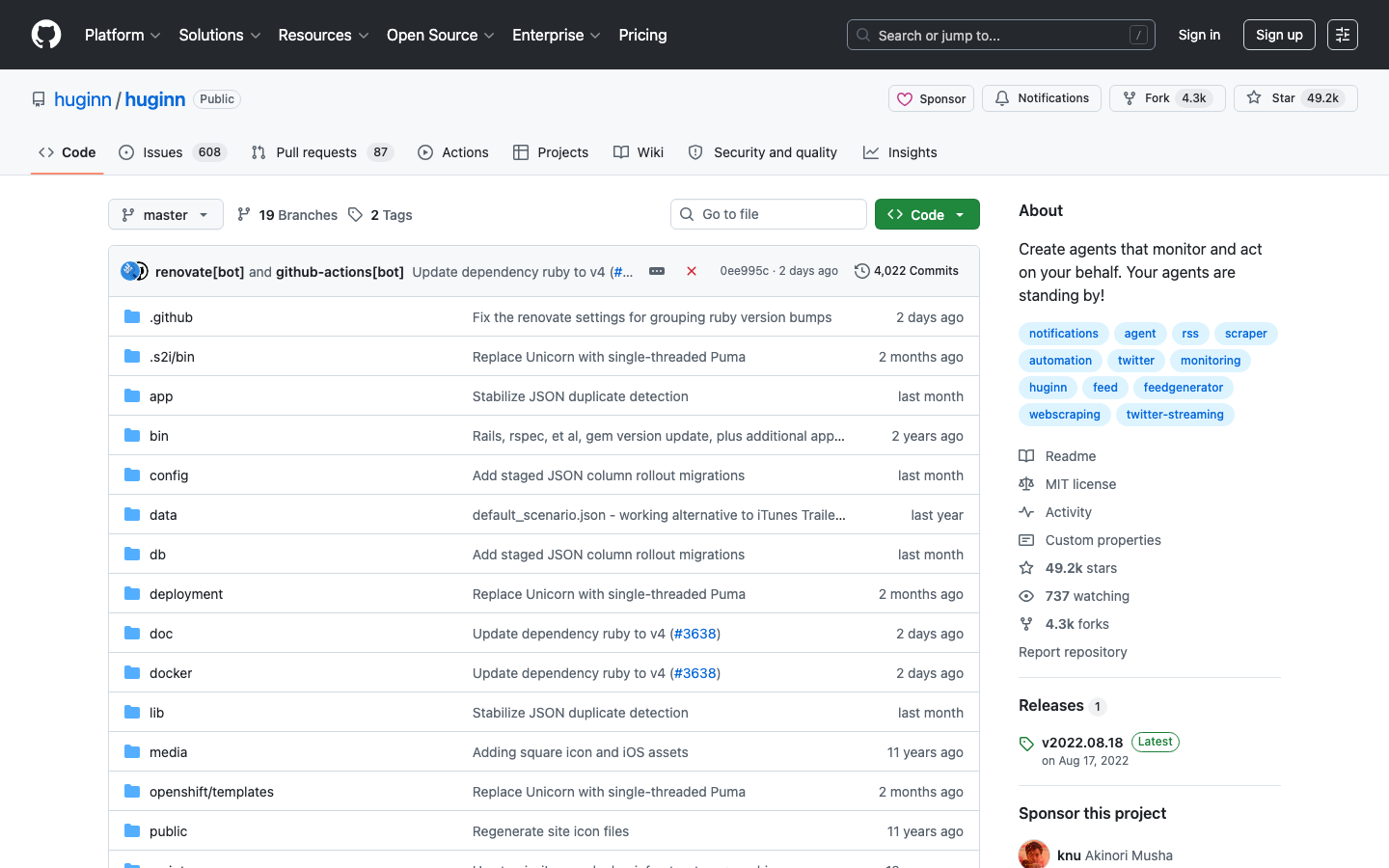
An open-source system for building agents that monitor websites, APIs, and services, then act autonomously on your behalf. Written in Ruby, Huginn lets you compose "agents" that trigger each other—one scrapes a page, another sends an alert, a third creates a ticket—without per-execution fees or usage metering.
Pros
- True agent autonomy; agents can trigger other agents, enabling complex multi-step workflows
- MIT licensed; zero licensing friction for commercial use
- Excellent for continuous monitoring and time-triggered tasks; no per-execution billing
Cons
- Smaller ecosystem of pre-built integrations compared to n8n or Make
- Requires more manual setup and Ruby knowledge for custom agent logic
minds-platform
A Python-based platform dedicated to deploying production-ready AI systems with full control and extensibility. Minds-platform is purpose-built for teams that need to train, fine-tune, and deploy AI models alongside orchestrated workflows—not just call external APIs.
Pros
- Deep Python ecosystem integration; native support for model training and fine-tuning
- Full transparency and control over model behavior and data lineage
- Designed for production AI systems, not just prototypes
Cons
- Highest operational overhead; assumes familiarity with ML infrastructure
- Narrower use case than n8n; best suited for AI-heavy workflows, not general integration work
OliveTin
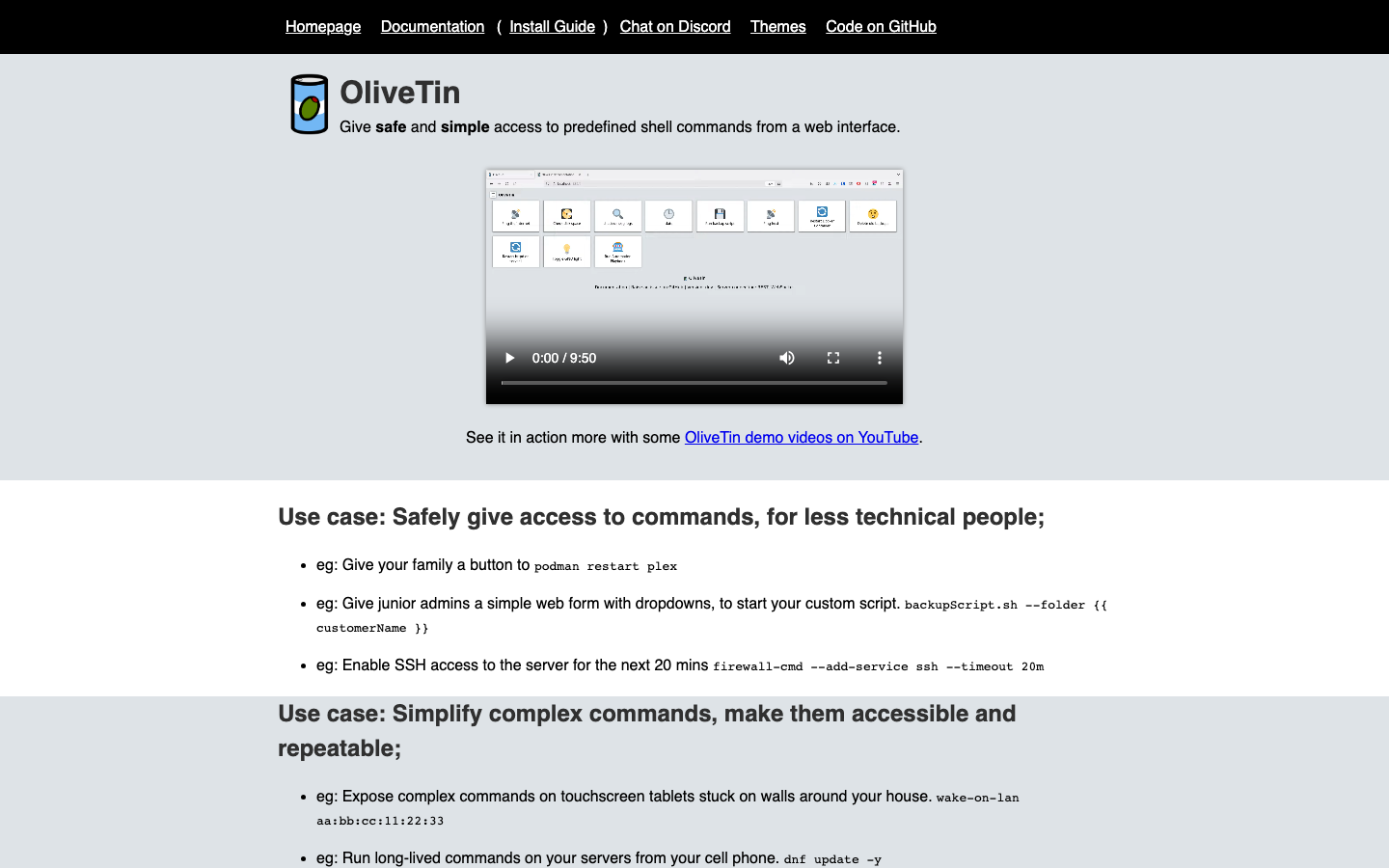
A minimal, single-purpose tool that exposes predefined shell commands through a clean web interface with access control and audit logging. No workflow engine, no integrations—just safe command execution. AGPL-3.0 licensed, written in Go.
Pros
- Extremely lightweight; runs on minimal hardware and deploys in minutes
- Perfect fit for teams that need command access without workflow complexity
- Strong audit trail and permission model for compliance-sensitive environments
Cons
- No workflow logic; you orchestrate outside OliveTin using cron, webhooks, or external tools
- Limited integration ecosystem; best paired with external schedulers or notification systems
How to choose
Start with your data and compliance needs. If sensitive data must stay internal and you have infrastructure capacity, any of these projects will self-host. Next, assess scope: do you need AI reasoning (pick dify or Flowise), continuous autonomous agents (huginn), production ML systems (minds-platform), or just safe command access (OliveTin)? For teams migrating from n8n specifically, huginn is the closest functional equivalent—same MIT licensing, same agent-based mental model, same zero per-execution cost. For teams building AI-first automation, dify or Flowise will feel more natural. Smaller teams or those with minimal ops budget should evaluate OliveTin if their use case is narrow enough to fit its scope.