






TL;DR
- Privacy-first teams should evaluate mox, which ships with modern encryption defaults and minimal external dependencies out of the box.
- Cost control matters most when you're running mail at scale—maddy and mox both eliminate per-message billing entirely, unlike cloud SMTP services.
- Organizations that value operational simplicity over bare-metal control often find iRedMail reduces the learning curve versus raw Postfix configuration.
Why teams leave Postfix
Postfix itself doesn't have a "leaving" problem—it's free and has no licensing trap. The real friction is operational burden. Running Postfix means you own the full stack: SPF, DKIM, DMARC, reverse DNS, TLS certificates, HELO hostname configuration, and IP-reputation management. A single VPS on an abused IP range can land your mail in spam folders regardless of DNS perfection. You also maintain spam filters (Rspamd, SpamAssassin) and blocklists yourself.
That operational weight is the trade-off. You pay zero per-message fees—unlike SendGrid or AWS SES—but you pay in expertise and monitoring time. Teams without mail infrastructure experience often underestimate the deliverability tax. Others simply need a mail server that bundles the common pieces (SMTP, IMAP, filtering, TLS) into one coherent product rather than a collection of separate tools. That's where modern alternatives step in.
Quick comparison
| Name | License | Self-Hosted | Deliverability Setup | API / Automation | Best For |
|---|---|---|---|---|---|
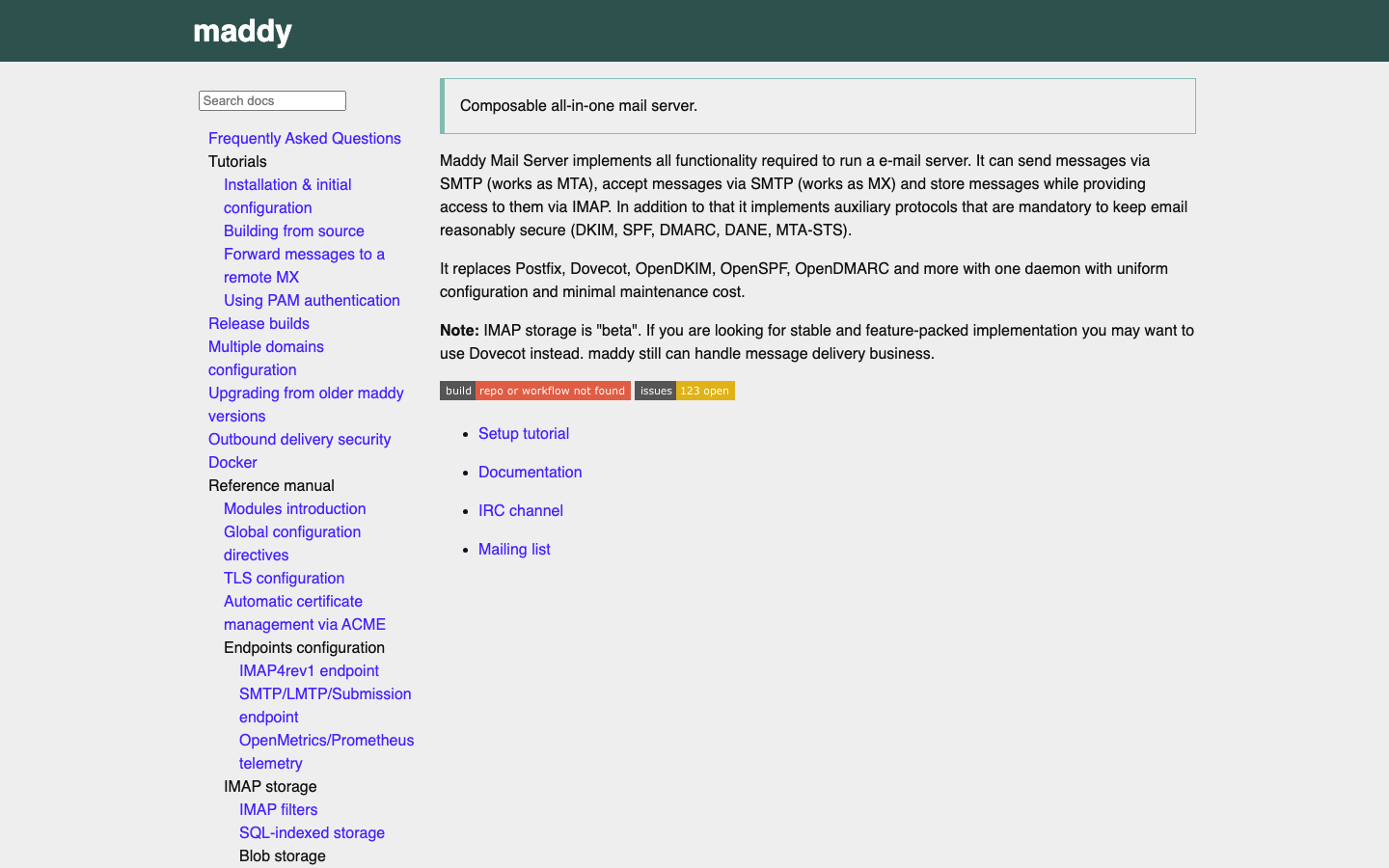
| maddy | GPL-3.0 | Yes | Built-in DKIM, DMARC, TLS | gRPC, REST | Composable stacks, developers |
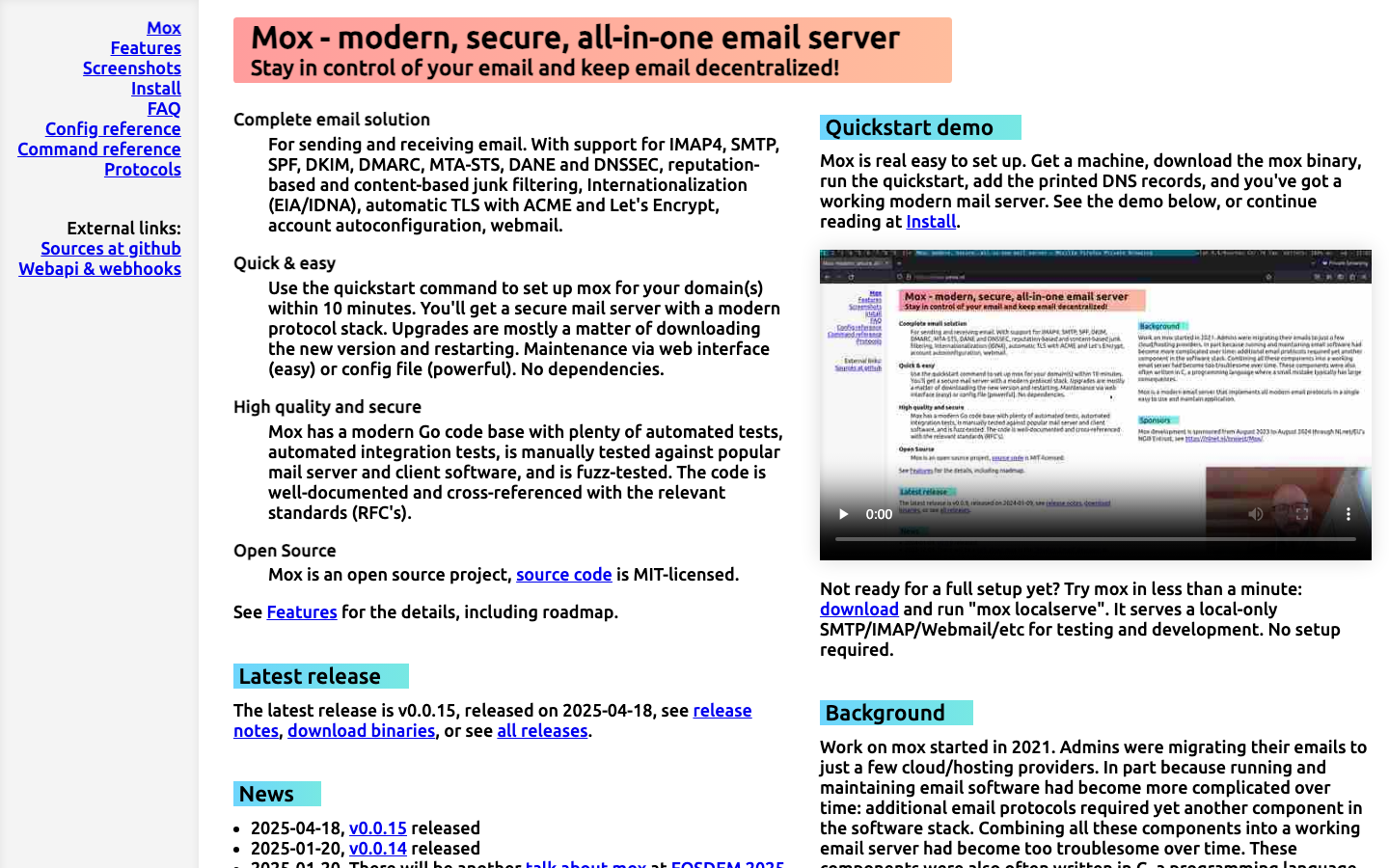
| mox | MIT | Yes | Modern defaults; DKIM, DMARC, TLS out of box | HTTP API | Low-maintenance self-hosted |
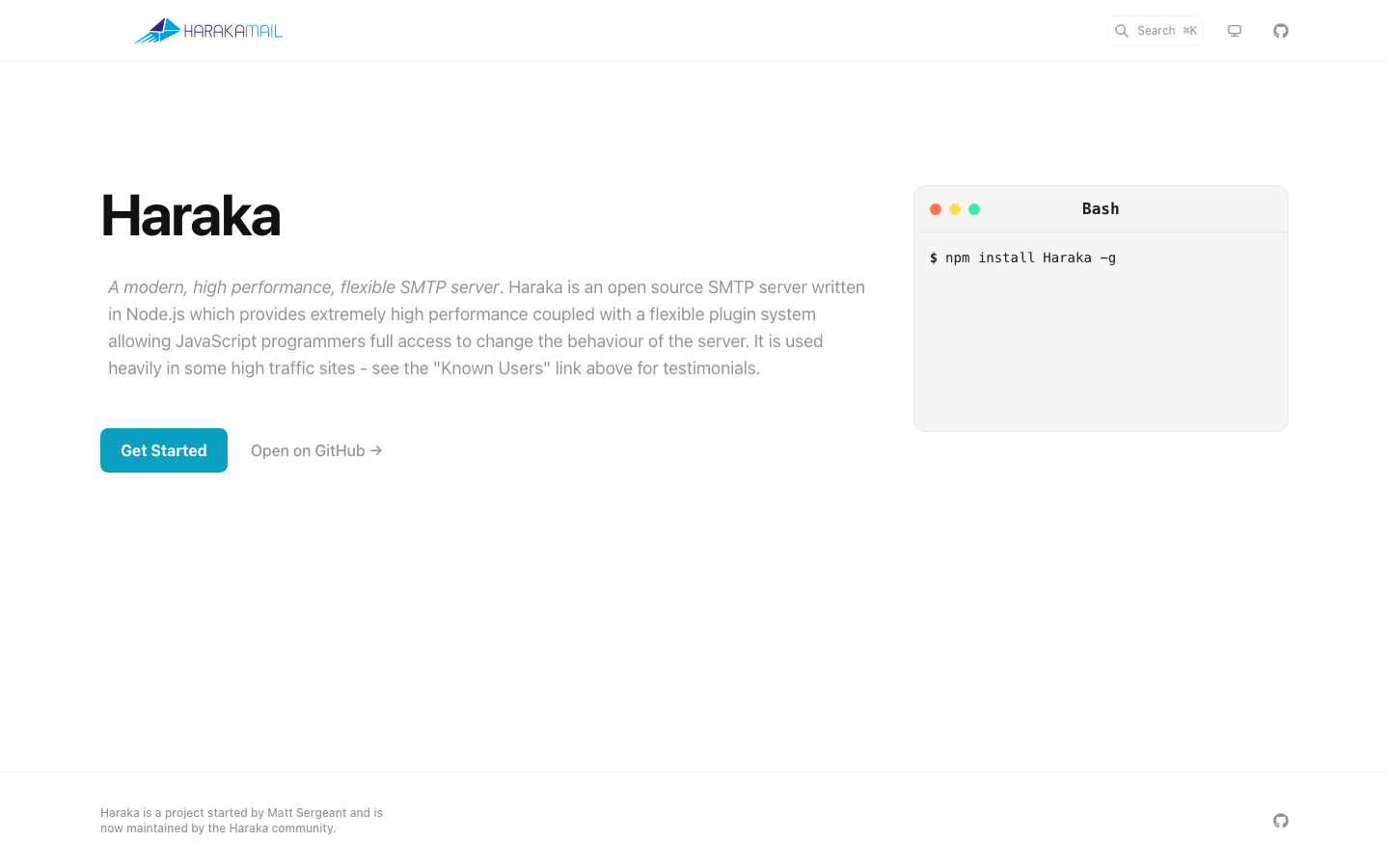
| Haraka | MIT | Yes | Plugin-based, customizable | Event-driven plugins | High-throughput, extensible setups |
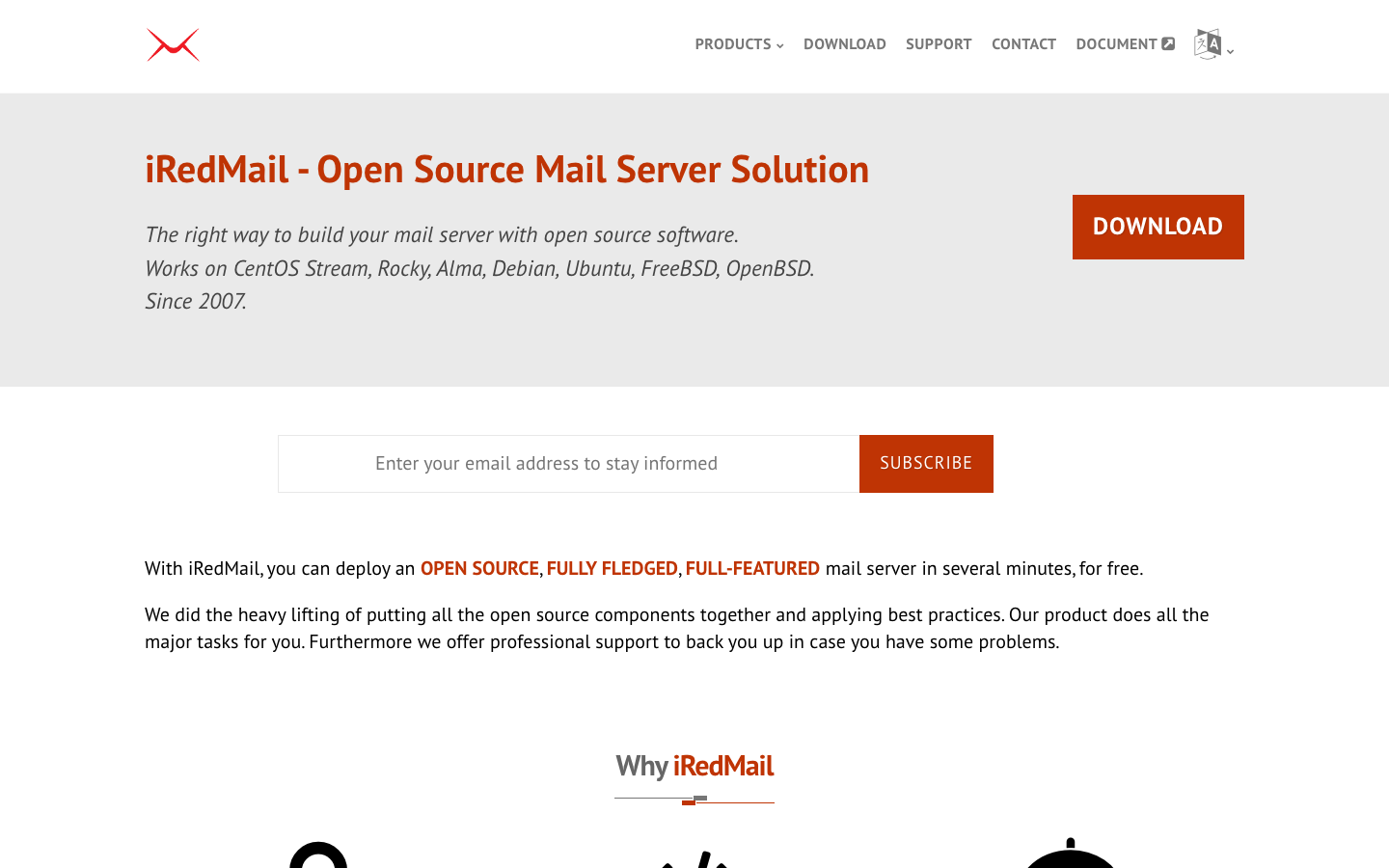
| iRedMail | GPL-3.0 | Yes | Guided setup; integrated filtering | Web admin UI | Linux/BSD admins, turnkey deployments |
| core | License not declared | Yes | IMAP/POP3 focus (not SMTP) | — | Storage backend, not mail server |
Top open-source alternatives to Postfix
maddy
A composable, all-in-one mail server written in Go, designed for operators who want modularity without complexity. It combines SMTP, IMAP, and filtering in a single binary with a clean configuration language. Maddy ships with built-in DKIM and DMARC support and exposes both gRPC and REST APIs for automation.
Pros
- Single binary, minimal dependencies—easier to deploy and update than a Postfix + Dovecot + filter stack.
- Modern crypto defaults and composable architecture suit custom mail workflows.
- Active development and clear configuration syntax reduce setup friction.
Cons
- Smaller community than Postfix; fewer battle-tested production deployments at very large scale.
- Learning curve if you're migrating from traditional Postfix+Dovecot setups.
mox
A modern, secure mail server that prioritizes low-maintenance operation and sensible defaults. Written in Go, mox bundles SMTP, IMAP, and filtering with TLS, DKIM, and DMARC enabled out of the box. It's designed for teams that want to self-host without becoming mail infrastructure experts.
Pros
- Zero per-message fees; full control over your mail without cloud vendor lock-in.
- TLS, DKIM, DMARC, and SPF support built in; reduces the "gotchas" of Postfix configuration.
- MIT license and clear, modern codebase appeal to privacy-conscious operators.
Cons
- Newer than Postfix; less historical production data in high-volume environments.
- Requires basic Linux/networking knowledge; not a web UI turnkey product.
Haraka
A fast, event-driven SMTP server written in JavaScript, built for extensibility. Haraka's plugin architecture lets you customize routing, filtering, and authentication without forking core code. It's ideal for high-throughput mail systems and teams comfortable with Node.js tooling.
Pros
- Exceptional extensibility; plugin ecosystem suits custom mail pipelines.
- High performance for transactional and bulk mail scenarios.
- MIT license and active community support.
Cons
- Requires Node.js operational knowledge; not a traditional sysadmin tool.
- Lacks integrated IMAP/POP3 (you still need Dovecot or similar for mailbox access).
iRedMail
A turnkey mail server installer for Linux and BSD that bundles Postfix, Dovecot, Rspamd, and other components into a guided deployment. iRedMail automates the SPF, DKIM, and DMARC configuration that would otherwise require manual setup.
Pros
- Fastest path from zero to running mail server; installation wizard handles DNS and TLS setup.
- Includes a web admin UI for user and domain management.
- Battle-tested on mainstream distributions; large user community.
Cons
- Less flexible than raw Postfix for highly custom workflows.
- GPL-3.0 licensing may constrain some commercial deployments.
core
Dovecot's mail server core, focused on IMAP and POP3 storage and retrieval. Not a standalone mail server; it's the mailbox backend typically paired with an SMTP server like Postfix or maddy.
Pros
- Best-in-class IMAP/POP3 performance and protocol compliance.
- Minimal resource footprint for storage-heavy workloads.
Cons
- Does not handle SMTP or mail routing; requires a separate MTA.
- Not a complete mail server solution on its own.
How to choose
Small team or first-time self-hosted? Start with iRedMail—it eliminates configuration decisions and gets you to a working mail server in hours.
Privacy-conscious and comfortable with Linux? mox or maddy both offer modern defaults, no per-message fees, and clean codebases. Choose mox for simplicity, maddy for flexibility.
High-volume or heavily customized mail flow? Haraka shines if you need plugin-driven routing and have Node.js expertise on staff.
Already running Postfix + Dovecot? You're not leaving—you're optimizing. iRedMail can simplify management; mox or maddy are rewrites, not migrations.