












TL;DR
- Need a fully self-hosted mail server with incoming + outgoing support? Postal replaces SendGrid's infrastructure entirely, eliminating per-email overage charges and giving you full control over IP reputation and deliverability.
- Building transactional email into a modern app stack? Nodemailer or React Email let you template and send without metering fees—pay only for your hosting, not per message.
- Want a complete marketing + notification platform without SendGrid's feature-gating? Novu unifies in-app, email, SMS, and Slack in one open-source layer, avoiding the separate API + Marketing subscription trap.
Why teams leave SendGrid
SendGrid's pricing has become a moving target. In early 2024, the Essentials plan jumped 33%—from $14.95 to $19.95/month—while the free tier became time-limited. By early 2025, SendGrid shifted from pure volume-based pricing to a hybrid model that layers feature access and AI tiers on top of send volume, raising enterprise costs unpredictably.
The real cost creep comes from hidden fees stacked on the headline price: separate subscriptions for API and Marketing features, $30/month per additional dedicated IP, overage charges up to ~$0.00133 per email, and $10 per 10K contacts for storage overages. At scale, you cannot predict your bill because costs are metered on send volume and gated behind feature tiers.
Beyond pricing, SendGrid locks you into its infrastructure. Your API integration, IP reputation, and deliverability are all tied to their platform. If you need to migrate, you rebuild from scratch. Self-hosted alternatives trade the recurring metered bill for owning your own SMTP stack—no per-email surcharges, no surprise feature gates, and full portability.
Quick comparison
| Name | License | Self-Hosted | Deliverability Setup | API / Automation | Best For |
|---|---|---|---|---|---|
| Novu | — | Yes | Managed or custom | REST API, SDKs, workflows | Multi-channel notifications at scale |
| React Email | MIT | Yes | Your SMTP | React components, programmatic | Modern templating & dev velocity |
| MJML | MIT | Yes | Your SMTP | Markup language, CLI, API | Responsive email templates |
| Nodemailer | — | Yes | Your SMTP | Node.js module, simple API | Lightweight transactional email |
| Postal | MIT | Yes | Full server control | REST API, webhooks, incoming mail | Complete mail server replacement |
| BillionMail | AGPL-3.0 | Yes | Full server control | REST API, newsletter UI | All-in-one marketing + server |
| Haraka | MIT | Yes | Full SMTP control | Plugin architecture, event-driven | High-performance SMTP routing |
| Keila | AGPL-3.0 | Yes | Your SMTP | Web UI, API, list management | Newsletter campaigns & subscriber lists |
Top open-source alternatives to SendGrid
Novu
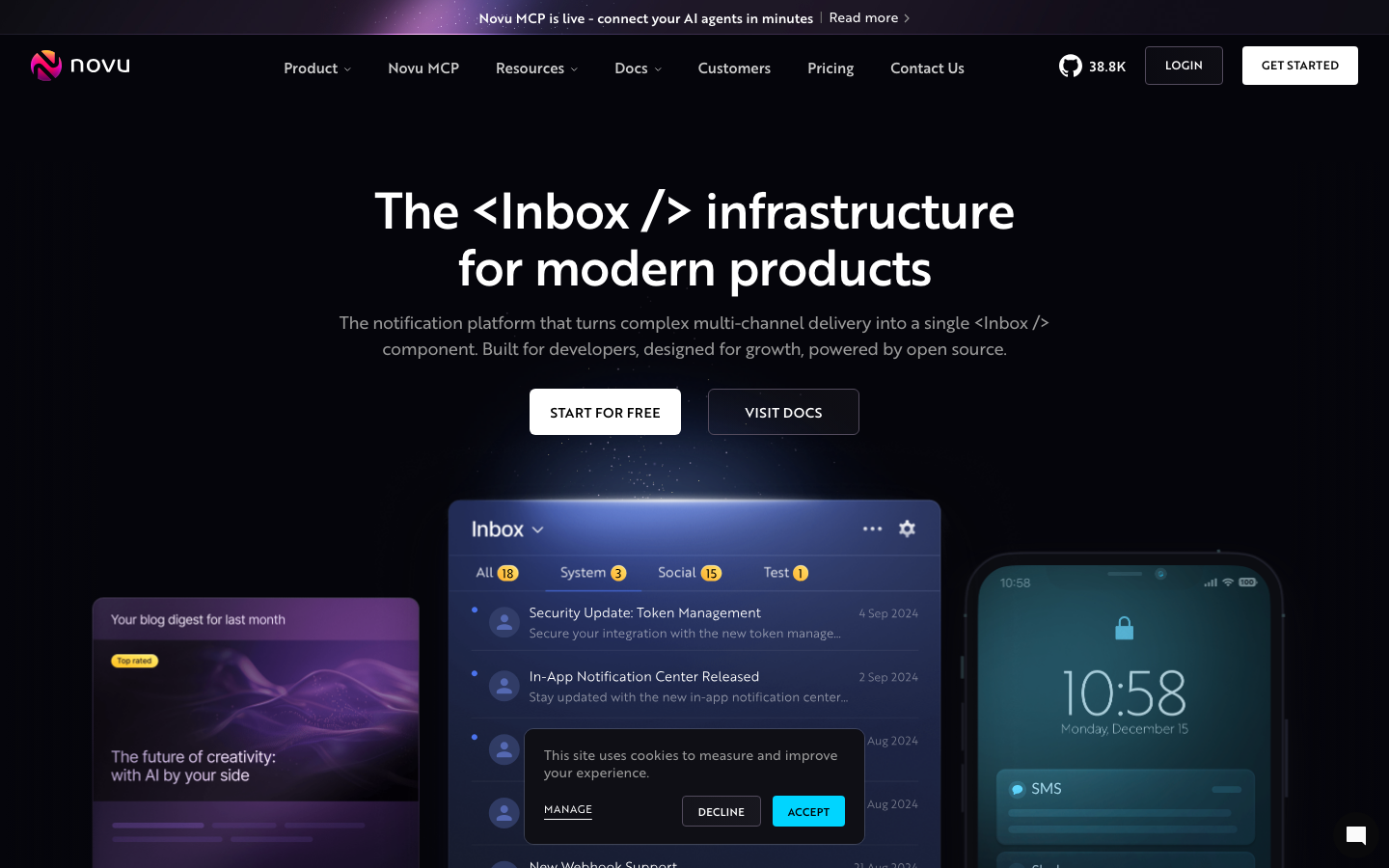
The most comprehensive notification infrastructure for developers. Novu unifies email, SMS, push notifications, and Slack into a single API and workflow engine, eliminating the need to juggle separate SendGrid (email) and other vendor subscriptions. Self-hosted on your own infrastructure.
Pros:
- Single API for email, SMS, push, and Slack—no feature-gating across separate products
- Visual workflow builder and multi-channel templates reduce dev overhead
- No per-message metering; costs scale with your infrastructure, not send volume
Cons:
- Requires operational overhead to run and maintain the service
- Smaller ecosystem compared to SendGrid's enterprise integrations
React Email
Build emails as React components. Write templates in JSX, version-control them alongside your app code, and render to HTML. Pairs with any SMTP backend (your own server, Nodemailer, Postal, etc.).
Pros:
- Component-driven templating eliminates email template language friction
- Full IDE support and type safety; preview in browser before sending
- Zero metering—send as many emails as your SMTP quota allows
Cons:
- Requires React familiarity and a Node.js build step
- Does not include SMTP delivery; you must pair it with a mail server
MJML
A responsive-email framework and markup language that compiles to bulletproof HTML. Handles mobile responsiveness, dark mode, and client compatibility without hand-coded media queries.
Pros:
- Dramatically simplifies responsive email authoring compared to raw HTML
- Standalone CLI and API; integrates into any pipeline
- MIT licensed; no vendor lock-in on template syntax
Cons:
- Learning curve for teams unfamiliar with the markup language
- Does not include SMTP or subscriber management; template-only
Nodemailer
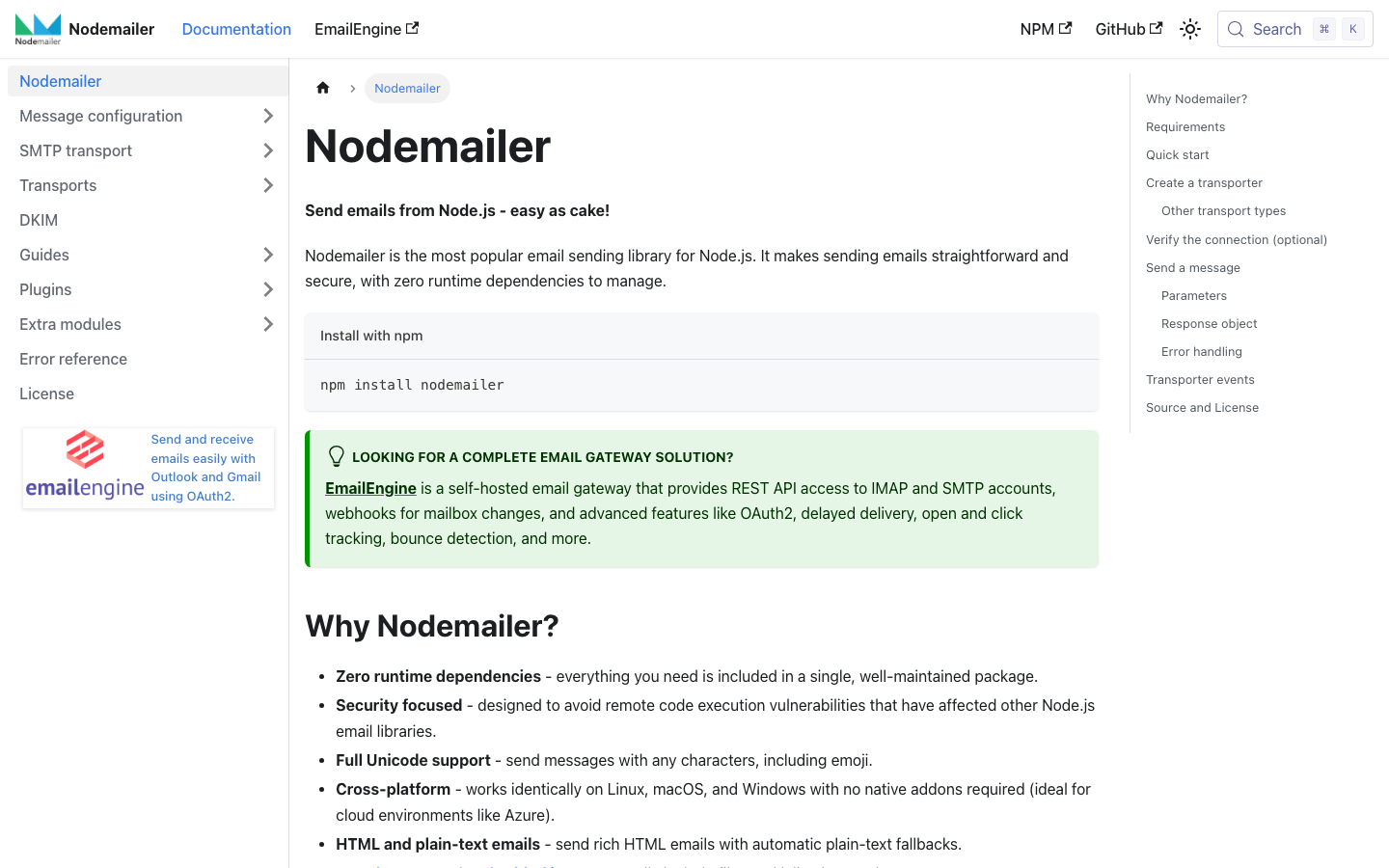
The Node.js standard for sending email. Simple, synchronous API; works with any SMTP server (yours, AWS SES, etc.). Handles attachments, HTML/plain-text, and custom headers.
Pros:
- Minimal API surface; nearly zero learning curve for Node developers
- Works with any SMTP backend; no vendor lock-in
- Lightweight and battle-tested in production for over a decade
Cons:
- No built-in templating; pair with React Email or MJML for that
- No UI; purely programmatic
Postal
A complete, fully featured open-source mail server for incoming and outgoing email. Replaces SendGrid's entire backend: SMTP delivery, bounce handling, webhook notifications, and IP reputation management.
Pros:
- Own your deliverability completely; no per-email surcharges or overage fees
- Incoming mail support; can receive and process inbound messages
- REST API and webhook architecture mirror SendGrid's interface, easing migration
Cons:
- Requires significant operational expertise to configure DNS, SPF/DKIM/DMARC, and server infrastructure
- Smaller community than SendGrid; fewer third-party integrations
BillionMail
All-in-one open-source mail server, newsletter, and email marketing platform. Self-hosted, fully free (AGPL), and designed to eliminate SendGrid's monthly fees entirely.
Pros:
- Includes mail server, newsletter UI, and marketing automation in one package
- No per-contact or per-email fees; costs fixed to your infrastructure
- Developer-friendly API and self-hosted philosophy
Cons:
- AGPL license requires you to open-source any modifications or derivative work
- Smaller ecosystem and community compared to more established projects
Haraka
A high-performance, event-driven SMTP server and mail router. Designed for throughput and extensibility via a rich plugin system.
Pros:
- Extremely fast and lightweight; handles high-volume routing efficiently
- Plugin architecture allows custom mail processing, filtering, and routing logic
- Suitable for building custom mail infrastructure from the ground up
Cons:
- Bare SMTP server; no built-in UI, webhooks, or subscriber management
- Requires significant glue code and operational knowledge to become a full platform
Keila
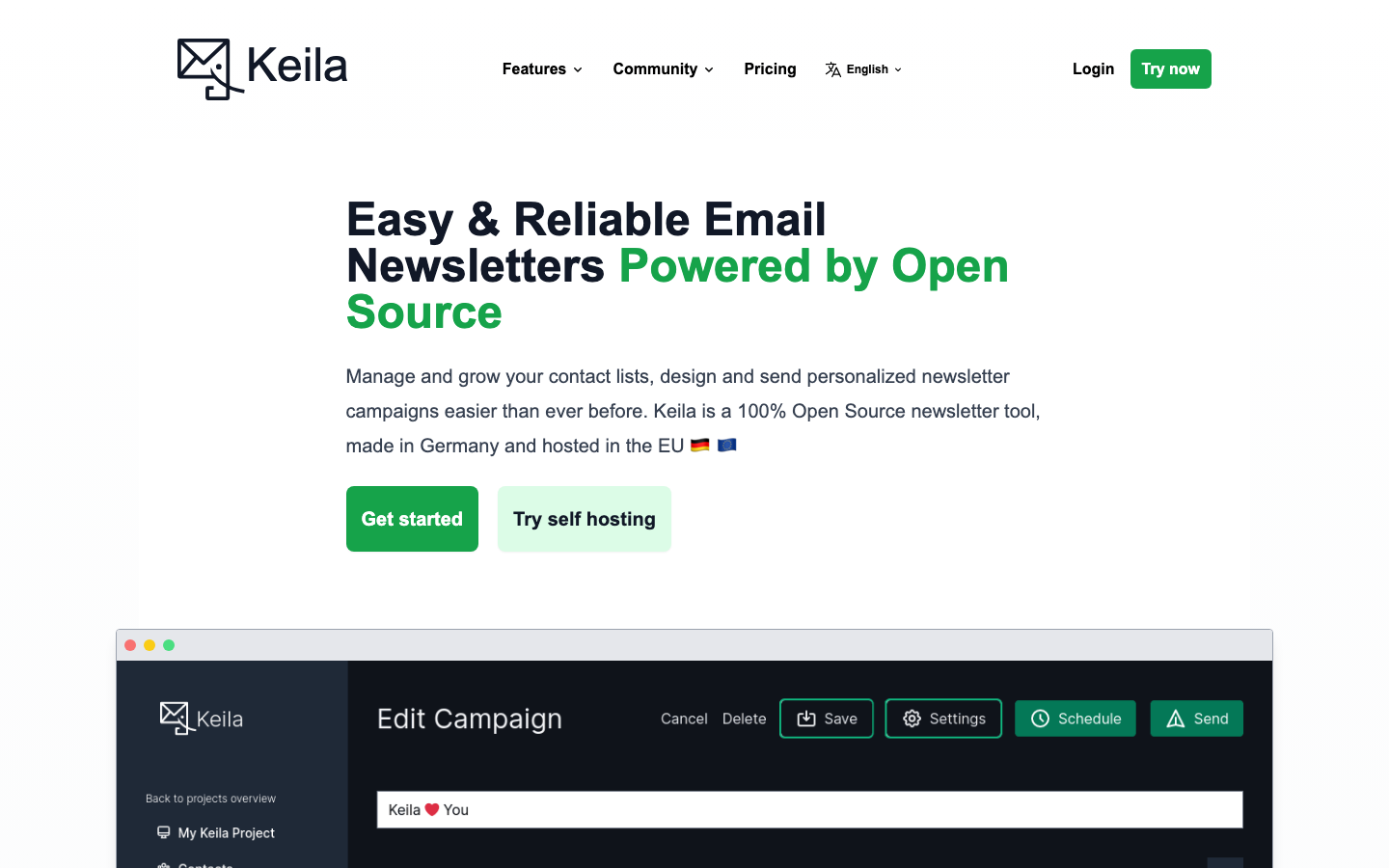
Open-source newsletter and email campaign tool. Web UI for list management, template editing, and campaign scheduling; self-hosted.
Pros:
- Purpose-built for newsletters and campaigns; simpler than a full mail server
- Web UI reduces friction for non-technical marketers
- No per-contact storage fees; unlimited subscribers on your infrastructure
Cons:
- Narrower scope than Postal or BillionMail; not a full transactional mail server
- Smaller community; fewer integrations with external services
How to choose
For transactional email at scale (password resets, order confirmations, alerts): Start with Nodemailer or React Email paired with your own SMTP server or Postal. You'll eliminate per-email overage charges immediately.
For marketing campaigns and newsletters: Keila or BillionMail give you a UI and subscriber management without SendGrid's per-contact storage fees.
For unified notifications (email + SMS + in-app + Slack): Novu replaces SendGrid's feature-gating model with a single API and workflow engine.
For complete mail server control and incoming email support: Postal or Haraka let you own deliverability, IP reputation, and routing logic—the only way to fully escape SendGrid's metering and lock-in.
For teams new to self-hosting: Start small with Nodemailer + a template tool (React Email or MJML) and a managed SMTP relay (AWS SES, Mailgun). Graduate to Postal once you need full server control.