











TL;DR
- You need predictable costs for high-volume workflows: n8n bills per execution (not per task), cutting costs by 95%+ versus Zapier's task-based model at scale.
- Building AI agents and agentic systems is your focus: dify and Flowise are production-ready platforms purpose-built for LLM-driven automation, not general integration.
- Avoiding vendor lock-in matters more than managed convenience: activepieces and automatisch let you export workflows and run them on your own infrastructure, eliminating Zapier's proprietary trap.
Why teams leave Zapier
The math is brutal: Zapier's Pro plan includes 750 tasks/month at $19.99. A moderately complex workflow—say, 10 steps triggered 1,000 times monthly—consumes 10,000 tasks. At Zapier's rate, that's $266/month minimum. The same 10,000 executions on self-hosted n8n costs nearly zero beyond your infrastructure. Usage-based billing on actions, not workflows, means costs scale unpredictably and often outpace the business value generated.
Beyond cost, there's lock-in. Zapier owns your automation logic, connection credentials, and workflow definitions. Migrating to another platform means rebuilding everything from scratch—no export, no portability. For teams serious about automation as infrastructure, this proprietary cage becomes untenable. Open-source alternatives let you own your workflows, run them on infrastructure you control, and avoid the negotiation table when Zapier raises prices or deprecates a feature.
Quick comparison
| Name | License | Self-Hosted | API / Extensibility | Stack / Language | Best For |
|---|---|---|---|---|---|
| n8n | Fair-code | ✓ Yes | Native code nodes, 400+ integrations, REST API | TypeScript | General workflow automation at scale |
| dify | — | ✓ Yes | LLM-native, agentic workflows, API-first | TypeScript | Production AI agents and LLM orchestration |
| Flowise | — | ✓ Yes | Visual agent builder, LangChain integration | TypeScript | Low-code AI agent creation |
| huginn | MIT | ✓ Yes | Custom agent scripts, event-driven | Ruby | Lightweight personal automation agents |
| minds-platform | — | ✓ Yes | AI system control, extensible architecture | Python | Enterprise AI system deployment |
| activepieces | — | ✓ Yes | MCP servers, AI agent support, workflow export | TypeScript | AI workflows with modern agent frameworks |
| automatisch | — | ✓ Yes | Zapier-like UI, self-hosted focus | JavaScript | Teams migrating directly from Zapier |
| nango | — | ✓ Yes | AI-assisted integration building, API SDK | TypeScript | Building product integrations programmatically |
Top open-source alternatives to Zapier
n8n
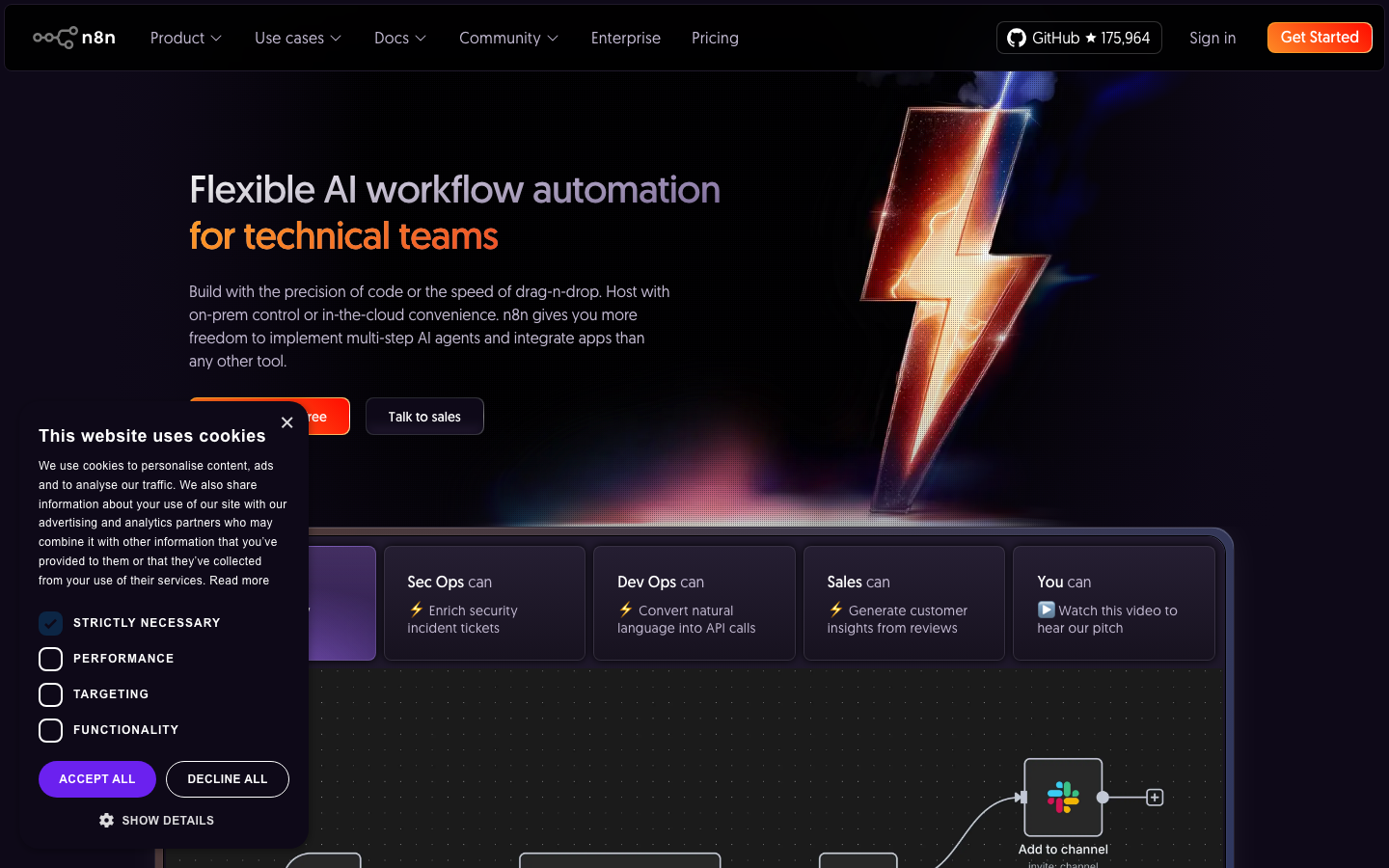
Fair-code workflow automation platform with 186k GitHub stars. Combines visual workflow building with custom JavaScript/TypeScript code nodes, supports 400+ integrations, and runs on your infrastructure or their managed cloud. Execution-based pricing (not task-based) makes cost predictable even at 10K+ monthly runs.
Pros
- Dramatically cheaper at scale (95%+ savings vs. Zapier for high-volume workflows)
- Full code access for complex logic without leaving the platform
- Self-hosted option eliminates vendor lock-in entirely
Cons
- Steeper learning curve than Zapier's pure visual approach
- Fair-code license (not fully open) may restrict commercial redistribution
dify
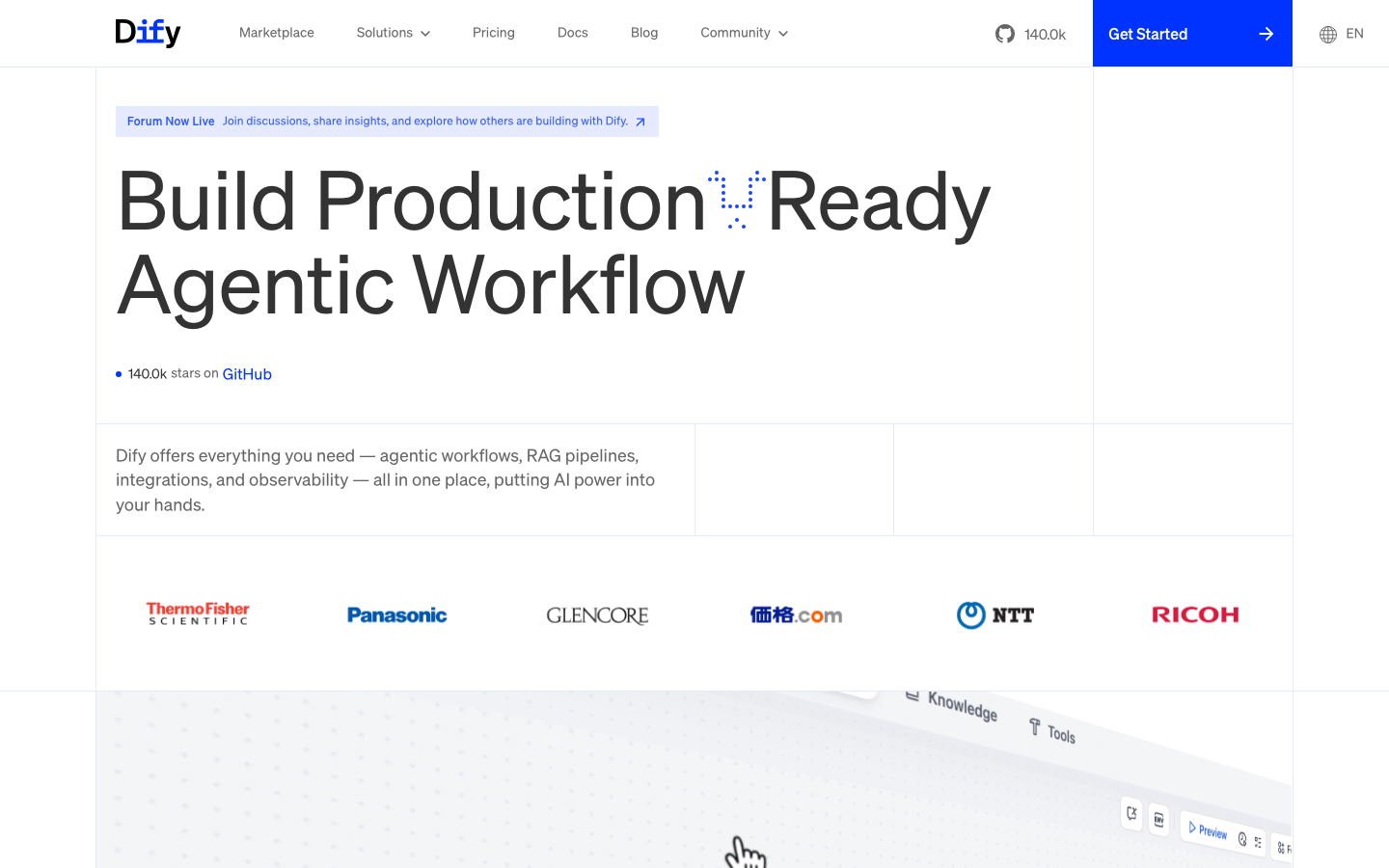
Production-ready platform for agentic workflow development with 139k stars. Focuses on LLM-driven automation, prompt chaining, and AI agent orchestration rather than general app integration. TypeScript-based, self-hostable, and built for teams deploying AI systems into production.
Pros
- Purpose-built for LLM workflows; Zapier treats AI as an afterthought
- Production-grade reliability and observability for agent systems
- Self-hosted deployment on your infrastructure
Cons
- Narrower integration library than general-purpose automation platforms
- Steeper onboarding if your team lacks LLM experience
Flowise
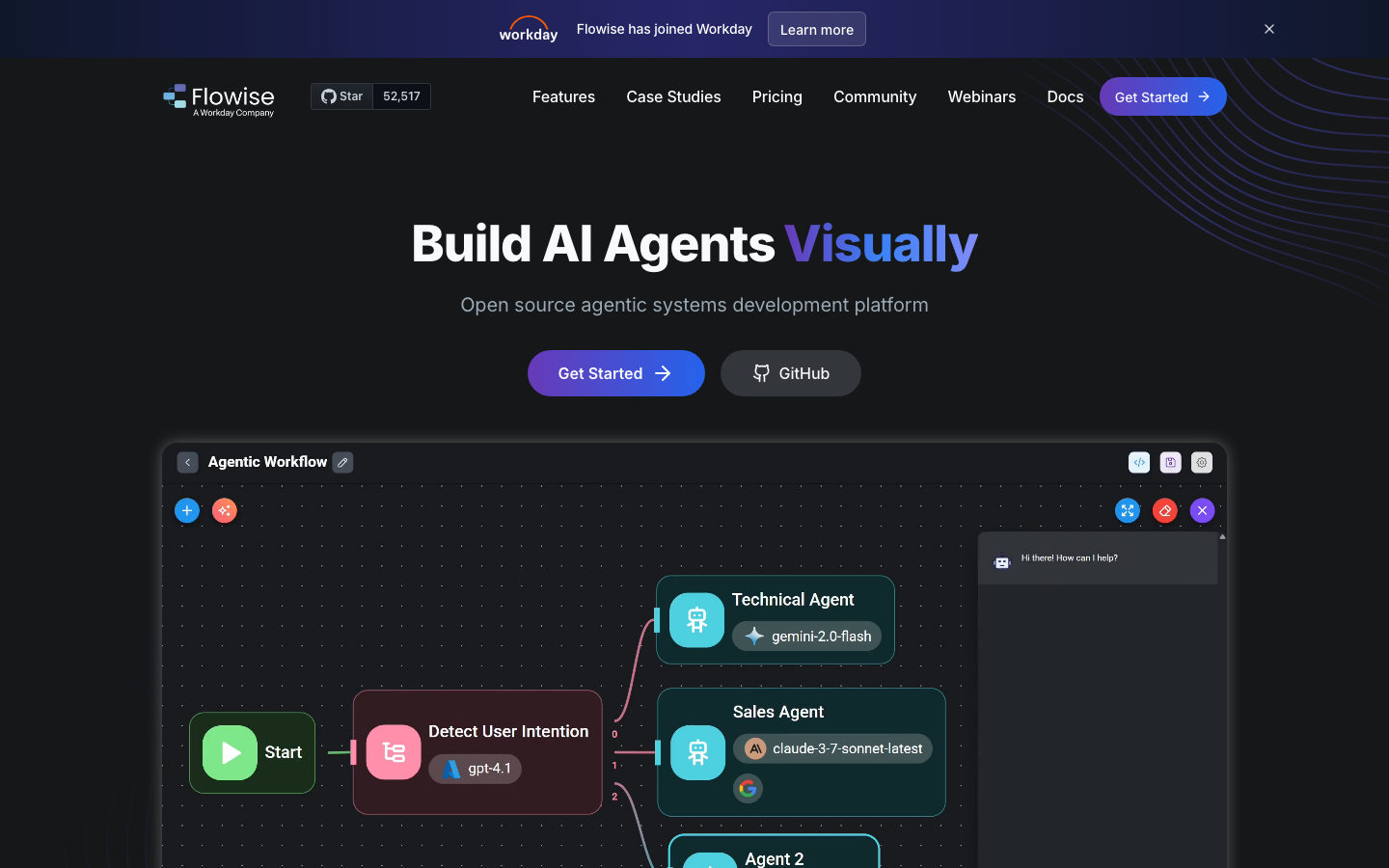
Visual AI agent builder with 52k stars. Abstracts LangChain and other LLM frameworks into a drag-and-drop interface, letting non-engineers compose AI workflows without writing code.
Pros
- Lowest barrier to entry for AI agent creation
- No-code visual builder reduces development time
- Self-hosted and lightweight
Cons
- Limited to AI/LLM workflows; not a general automation platform
- Smaller ecosystem than n8n for non-AI integrations
huginn
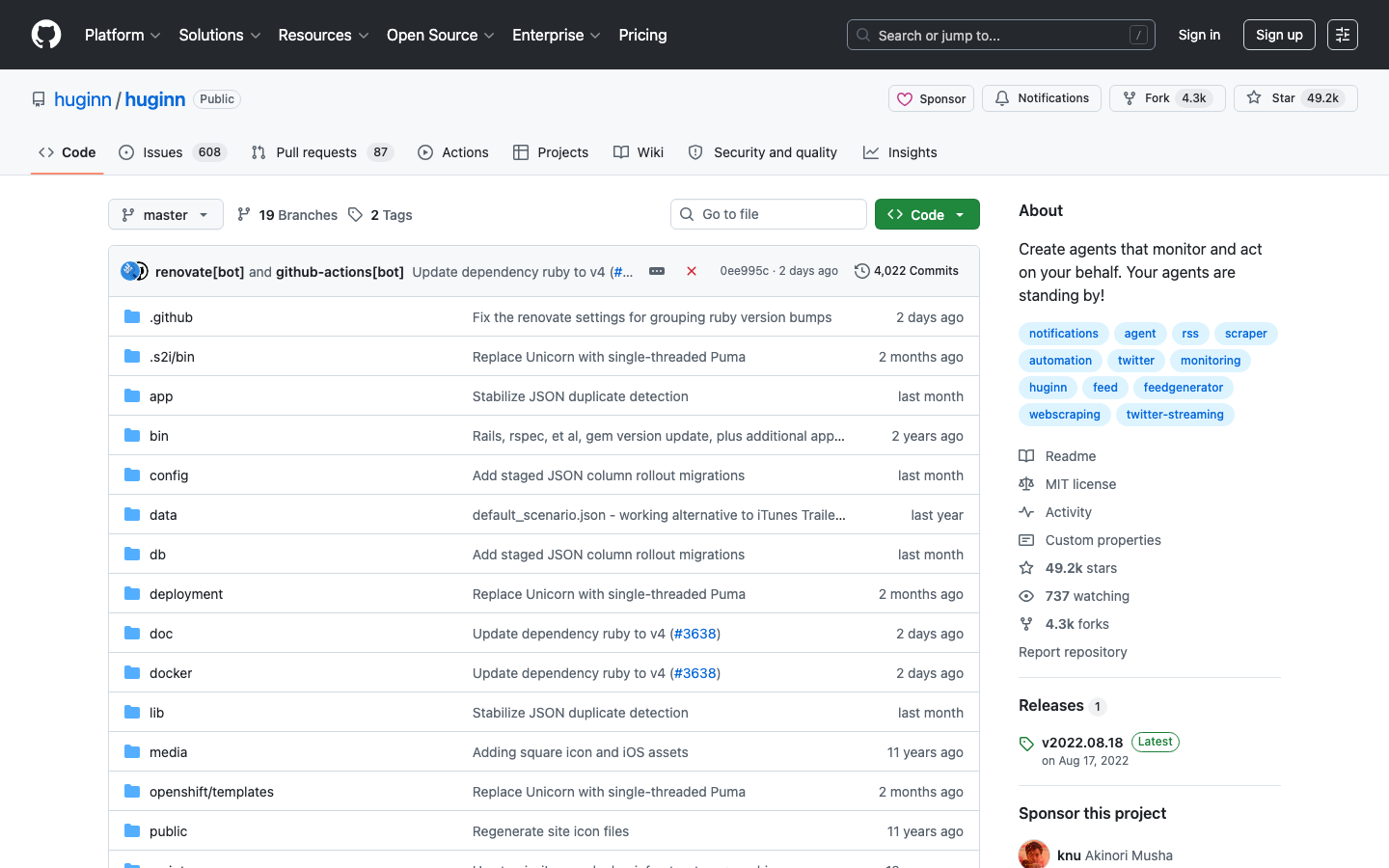
MIT-licensed agent platform with 49k stars. Written in Ruby, it creates autonomous agents that monitor conditions and trigger actions on your behalf—ideal for personal automation, monitoring, and event-driven workflows.
Pros
- Lightweight and easy to deploy
- MIT license provides full legal clarity
- Event-driven architecture suits monitoring workflows
Cons
- Smaller integration library than n8n
- Ruby stack may require more DevOps familiarity
minds-platform
Platform for building production-ready AI systems with 39k stars. Python-based and designed for teams deploying applied AI at scale while maintaining control, extensibility, and on-premises deployment.
Pros
- Enterprise-grade AI system architecture
- Full control over model deployment and data
- Python ecosystem enables deep customization
Cons
- Steeper learning curve; requires AI/ML infrastructure knowledge
- Smaller user community than n8n or dify
activepieces
AI workflow automation and MCP (Model Context Protocol) server platform with 22k stars. Supports ~400 MCP servers for AI agents, combines workflow automation with modern AI agent frameworks, and emphasizes workflow portability.
Pros
- Native AI agent and MCP support built in from the start
- Workflows export cleanly, reducing lock-in
- Active development and modern architecture
Cons
- Younger project with smaller community than n8n
- Fewer non-AI integrations than mature platforms
automatisch
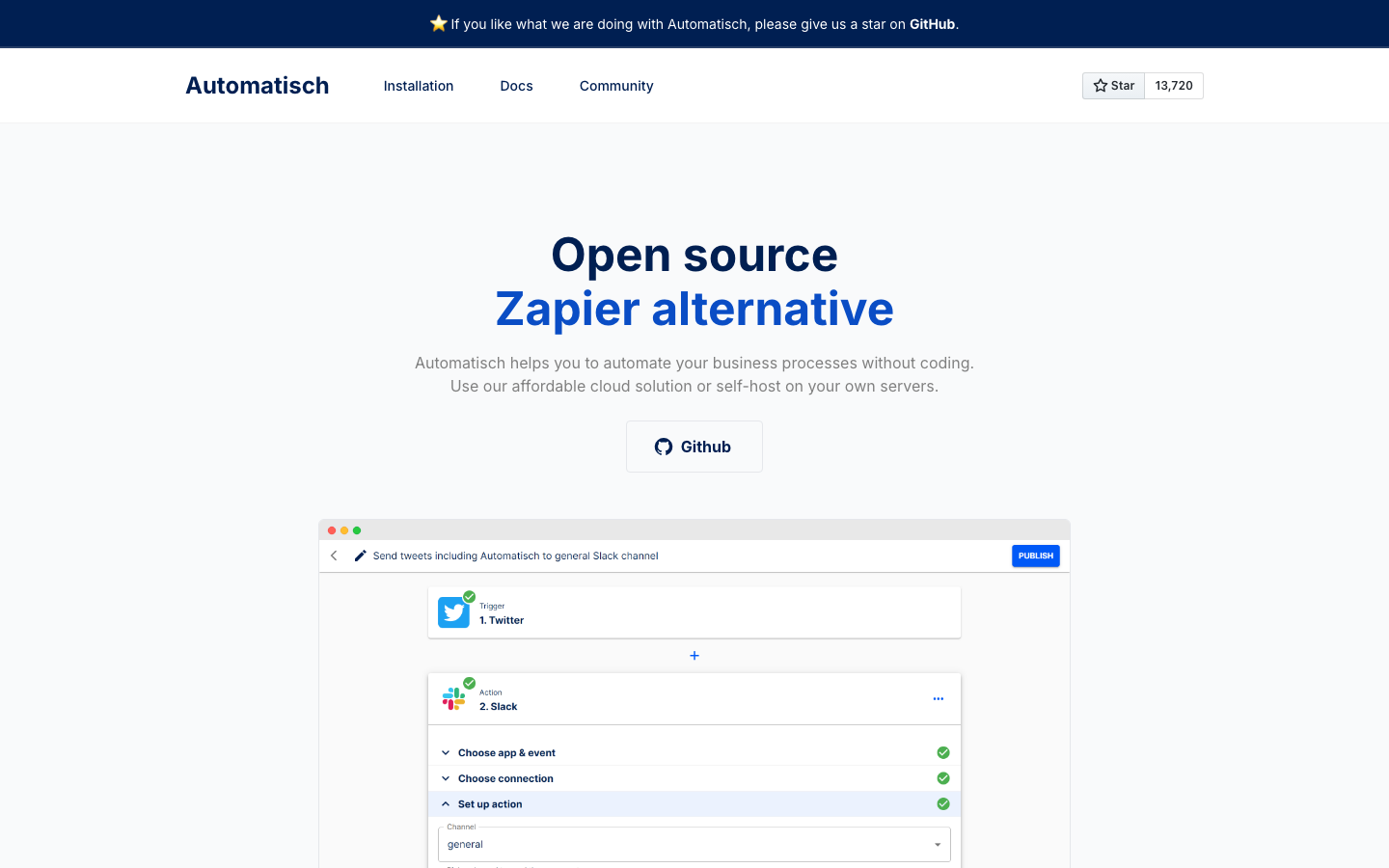
Explicitly positioned as the open-source Zapier alternative with 13k stars. JavaScript-based, self-hosted, and designed to feel familiar to Zapier users migrating away.
Pros
- Zapier-like UI lowers switching costs for existing users
- Self-hosted by default, no SaaS lock-in
- Straightforward deployment
Cons
- Smaller integration library than n8n
- Less mature codebase and smaller community
nango
AI-assisted integration building platform with 7k stars. Focuses on programmatic integration development rather than visual workflow building—best for teams building integrations into their own products.
Pros
- AI-powered integration scaffolding reduces boilerplate
- SDK-first approach integrates cleanly into applications
- Handles OAuth and credential management well
Cons
- Requires developer involvement; not a no-code tool
- Narrower scope than full workflow platforms like n8n
How to choose
For cost-sensitive, high-volume automation: Start with n8n. Its execution-based pricing and self-host option deliver the clearest ROI against Zapier's task-based model.
For AI agent and LLM workflows: Choose between dify (production systems, full control) and Flowise (visual simplicity, fastest time-to-value).
For Zapier users seeking a drop-in replacement: automatisch minimizes migration friction with a familiar interface.
For teams building integrations into their product: nango provides SDKs and AI scaffolding; it's not a workflow platform but a developer tool.
For enterprise AI deployment: minds-platform suits organizations needing on-premises AI systems with full extensibility.