











TL;DR
- Sales-first teams wanting a modern, community-driven Salesforce alternative should evaluate Twenty, which combines CRM fundamentals with an open architecture and the largest developer community (45k+ stars).
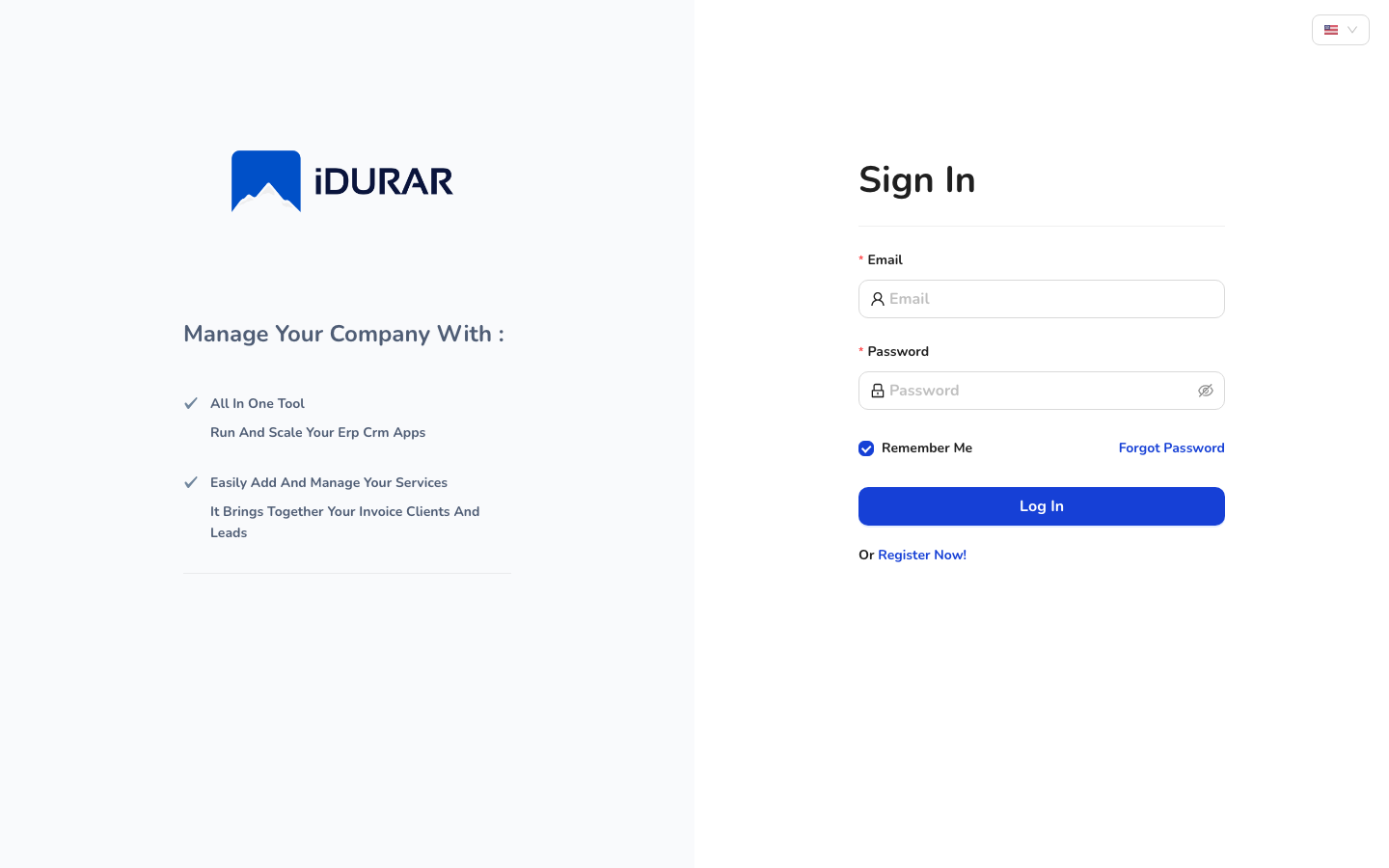
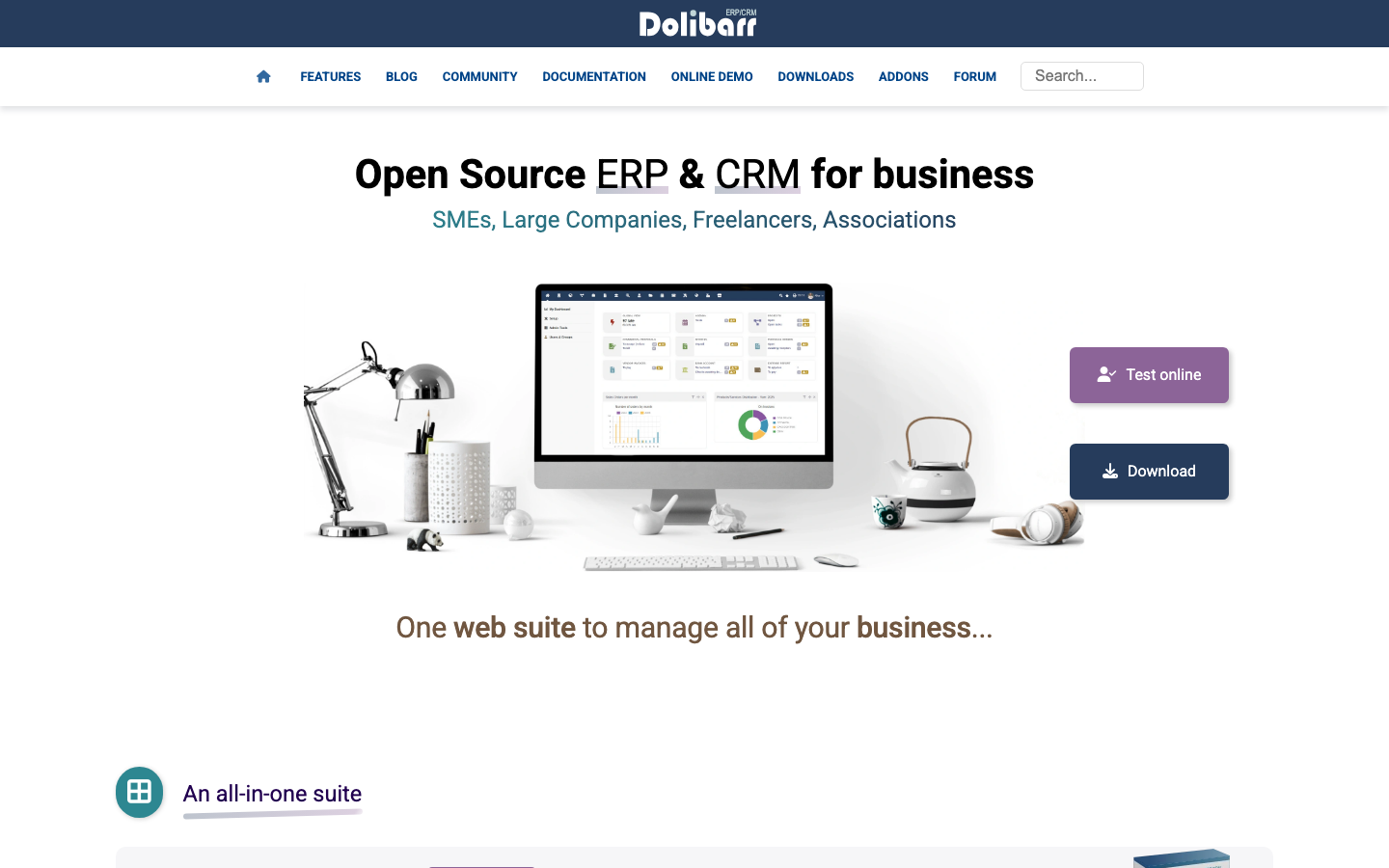
- All-in-one operations teams running invoicing, inventory, and customer management together benefit from Dolibarr or Idurar ERP CRM, which bundle accounting and CRM without per-seat licensing.
- Support and marketing teams seeking to replace HubSpot's service and email tools can layer Erxes (unified XOS) or dedicated projects like Monica (relationship intelligence) and EspoCRM (lightweight CRM) for predictable costs.
Why teams leave HubSpot
A sales ops manager opens the month's invoice. Contact count is up 15%, two new team members joined, and a marketing automation workflow triggered a per-resolution AI billing event. The total is 40% higher than last quarter—and there's no obvious way to trim it without losing functionality. The real problem isn't any single feature; it's the stack of costs: per-contact, per-seat, per-feature-tier, and now per-AI-action. Worse, all that customer data—contacts, email history, custom fields, workflows—lives in HubSpot's proprietary system. Moving to a competitor means months of export, mapping, and re-setup.
This is why teams leave. HubSpot's early pricing is friendly, but as you grow, costs compound. Seat-based licensing means every new sales rep or marketer adds a line item. Contact-based fees penalize you for success. And the platform's integration with your workflows creates a switching cost so high that even expensive bills feel cheaper than migration. For teams with data sovereignty concerns, compliance requirements, or simply a need to control their own infrastructure, the proprietary model becomes untenable.
Open-source alternatives flip the equation. You own the data. You pay for hosting, not per-user or per-contact. You can extend the platform via APIs and code instead of waiting for HubSpot's roadmap. The trade-off is real—you lose HubSpot's out-of-the-box polish and integrated ecosystem—but for teams that have hit the scaling wall, that trade is worth it.
Quick comparison
| Name | License | Self-Hosted | API / Extensibility | Stack / Language | Best For |
|---|---|---|---|---|---|
| Twenty | — | Yes | GraphQL API, webhooks, extensible schema | TypeScript | Modern CRM alternative to Salesforce |
| Huly Platform | EPL-2.0 | Yes | Plugin architecture, open APIs | TypeScript | All-in-one project & ops (Linear, Jira, Slack alternative) |
| Monica | AGPL-3.0 | Yes | REST API, contact-centric | PHP | Personal & SMB relationship management |
| Laravel CRM | MIT | Yes | Laravel framework extensibility | Blade/PHP | SMEs and enterprises using Laravel stack |
| Idurar ERP CRM | AGPL-3.0 | Yes | REST API, modular | JavaScript/React | Invoicing, accounting, and CRM in one |
| Dolibarr | GPL-3.0 | Yes | REST API, module system | PHP | Businesses of any size: invoicing, inventory, CRM |
| Erxes | — | Yes | Plugin system, integrations | TypeScript | Marketing, sales, ops, support unified (HubSpot + Zendesk replacement) |
| EspoCRM | AGPL-3.0 | Yes | REST API, custom entities | PHP | Lightweight, modular CRM |
Top open-source alternatives to HubSpot
Twenty
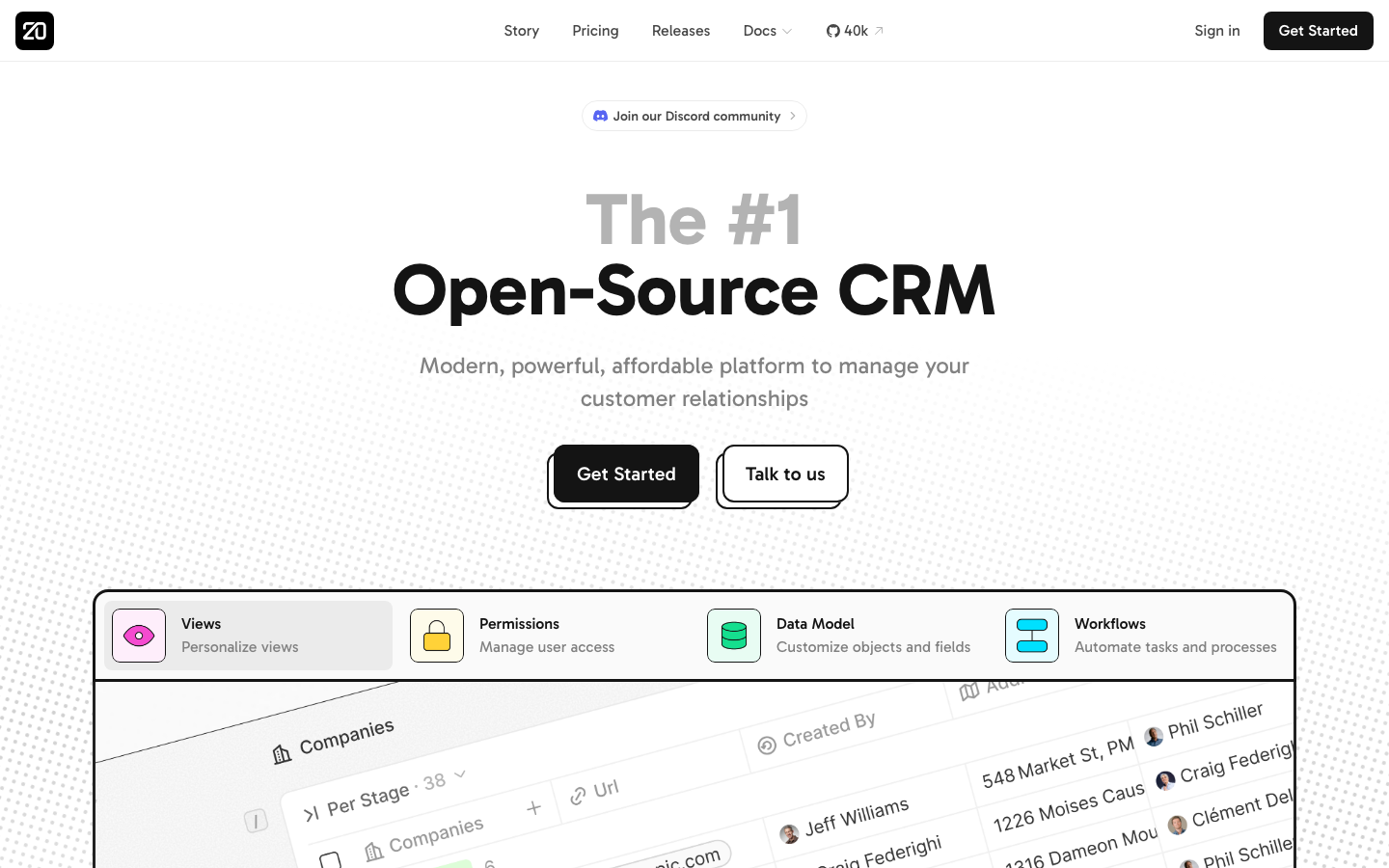
Twenty is a modern, community-driven CRM built to challenge Salesforce with a clean GraphQL API and extensible data model. It's the most-starred project in this list (45k+), reflecting strong developer adoption and active maintenance. Use it if you want a Salesforce-like experience without the cost or lock-in.
Pros
- GraphQL API and webhook system make custom integrations straightforward
- Modern TypeScript codebase; easier to extend and customize than legacy PHP CRMs
- Large, active community means faster issue resolution and feature requests
Cons
- Smaller feature set than HubSpot; you'll need to integrate separate tools for email, marketing automation, and support
- Newer project; less battle-tested in enterprise deployments than Dolibarr or EspoCRM
Huly Platform
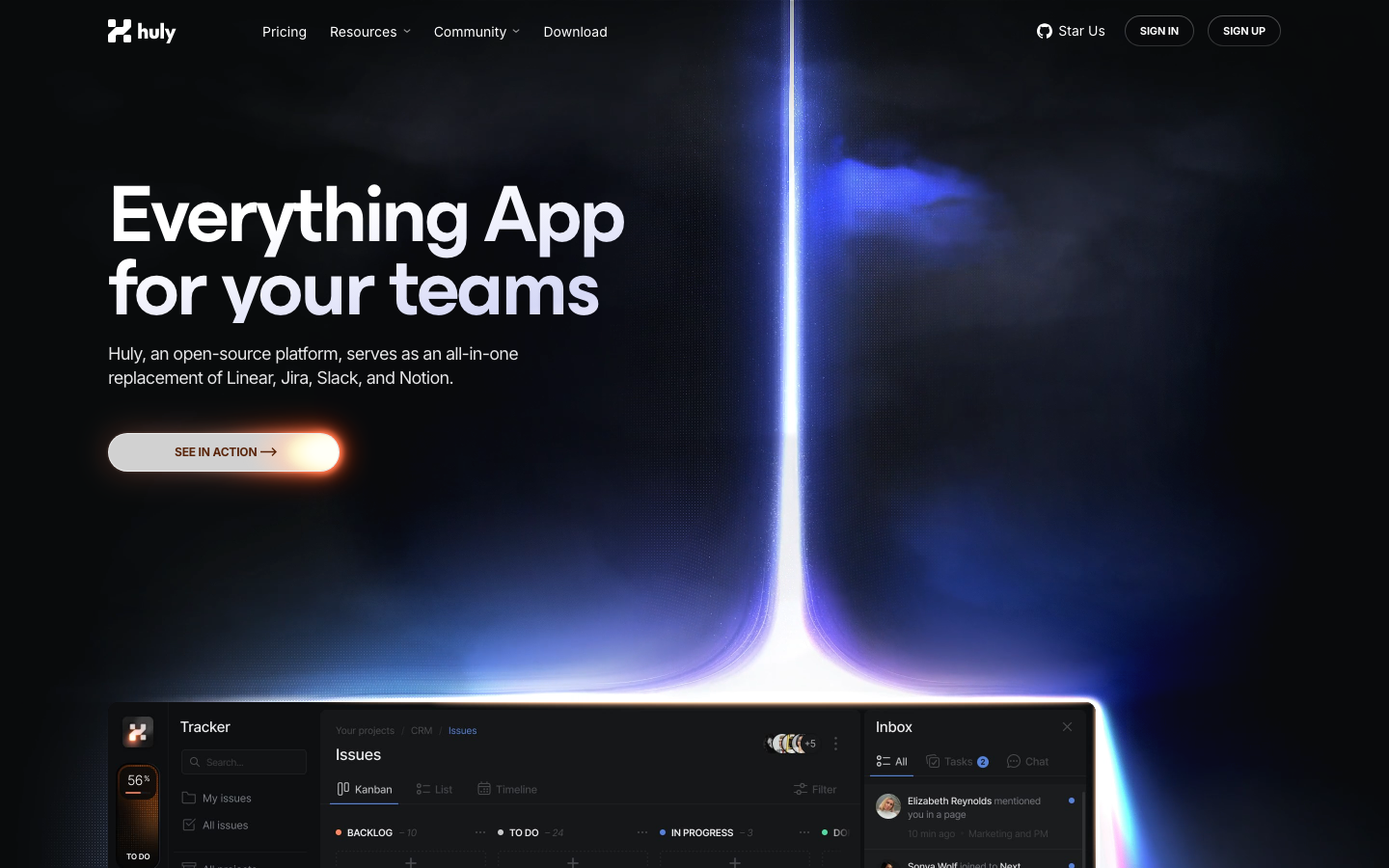
Huly (Platform) is an all-in-one workspace combining project management, CRM, and team communication—positioning itself as a replacement for Linear, Jira, Slack, and Notion in one self-hosted environment. It's especially valuable if you want to consolidate multiple tools under one roof.
Pros
- Unified interface for projects, CRM, and team chat reduces tool switching
- EPL-2.0 license is permissive for self-hosted deployments
- Plugin architecture allows deep customization
Cons
- Less mature than specialized CRM tools; may lack depth in sales-specific workflows
- Smaller ecosystem compared to Twenty; fewer third-party integrations
Monica
Monica is a personal and small-business CRM focused on relationship intelligence—remembering details about contacts, interactions, and follow-ups. It's ideal for freelancers, agencies, and teams managing smaller contact bases where relationship context matters more than pipeline automation.
Pros
- Lightweight, fast, and easy to self-host
- REST API enables custom workflows and integrations
- AGPL-3.0 license is clear and community-friendly
Cons
- Not designed for large sales teams or high-volume contact management
- Limited built-in marketing automation or reporting features
Laravel CRM
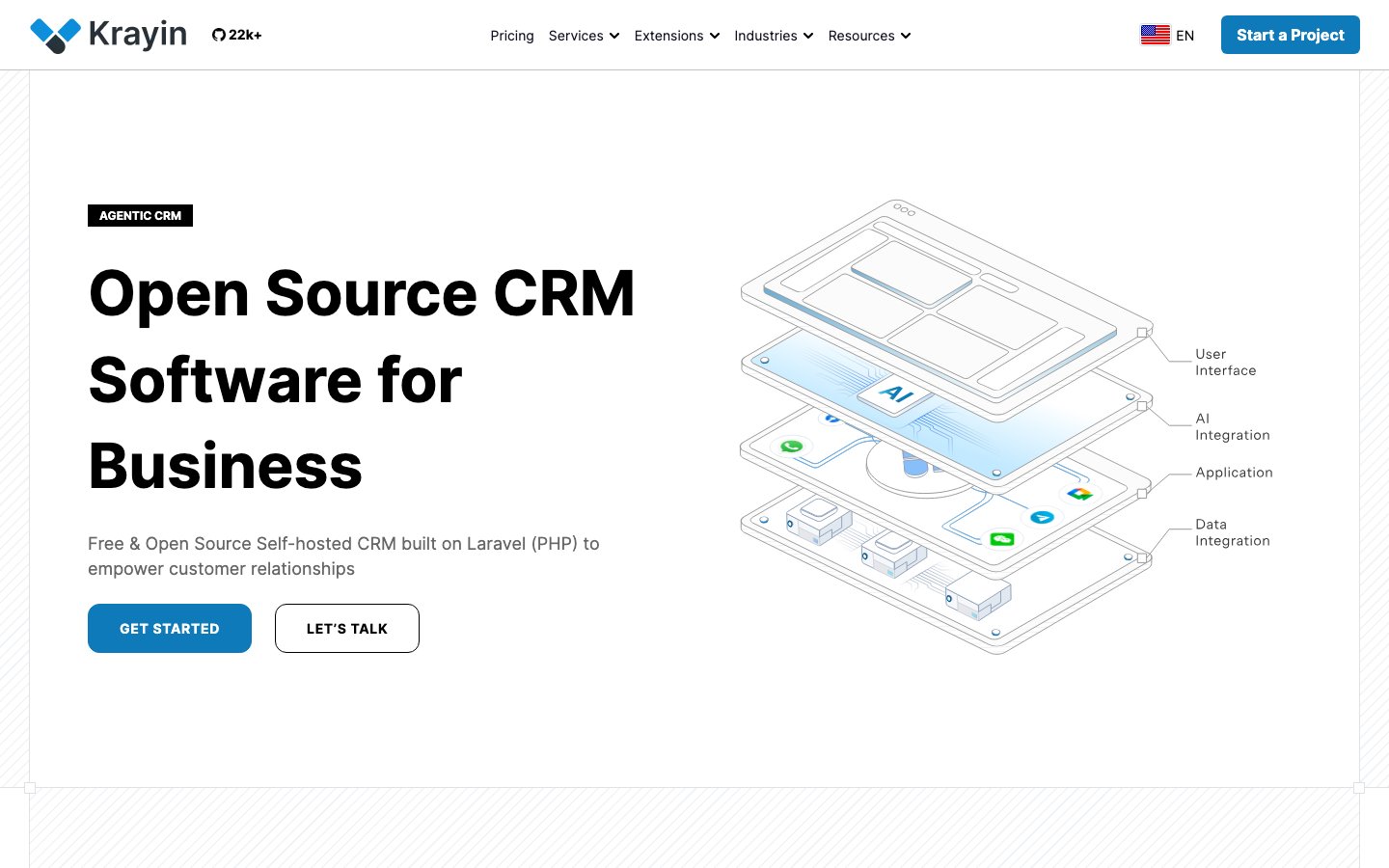
Laravel CRM is purpose-built for teams already invested in the Laravel ecosystem, offering a full customer lifecycle management solution with invoicing, support, and sales pipelines. It's the right choice if your tech stack is already Laravel and you want a CRM that integrates natively.
Pros
- Deep Laravel integration; no impedance mismatch if you're a Laravel shop
- MIT license allows commercial use and modification
- Covers full lifecycle: sales, invoicing, support
Cons
- Smaller community than Twenty or Dolibarr
- Requires Laravel expertise to extend effectively
Idurar ERP CRM
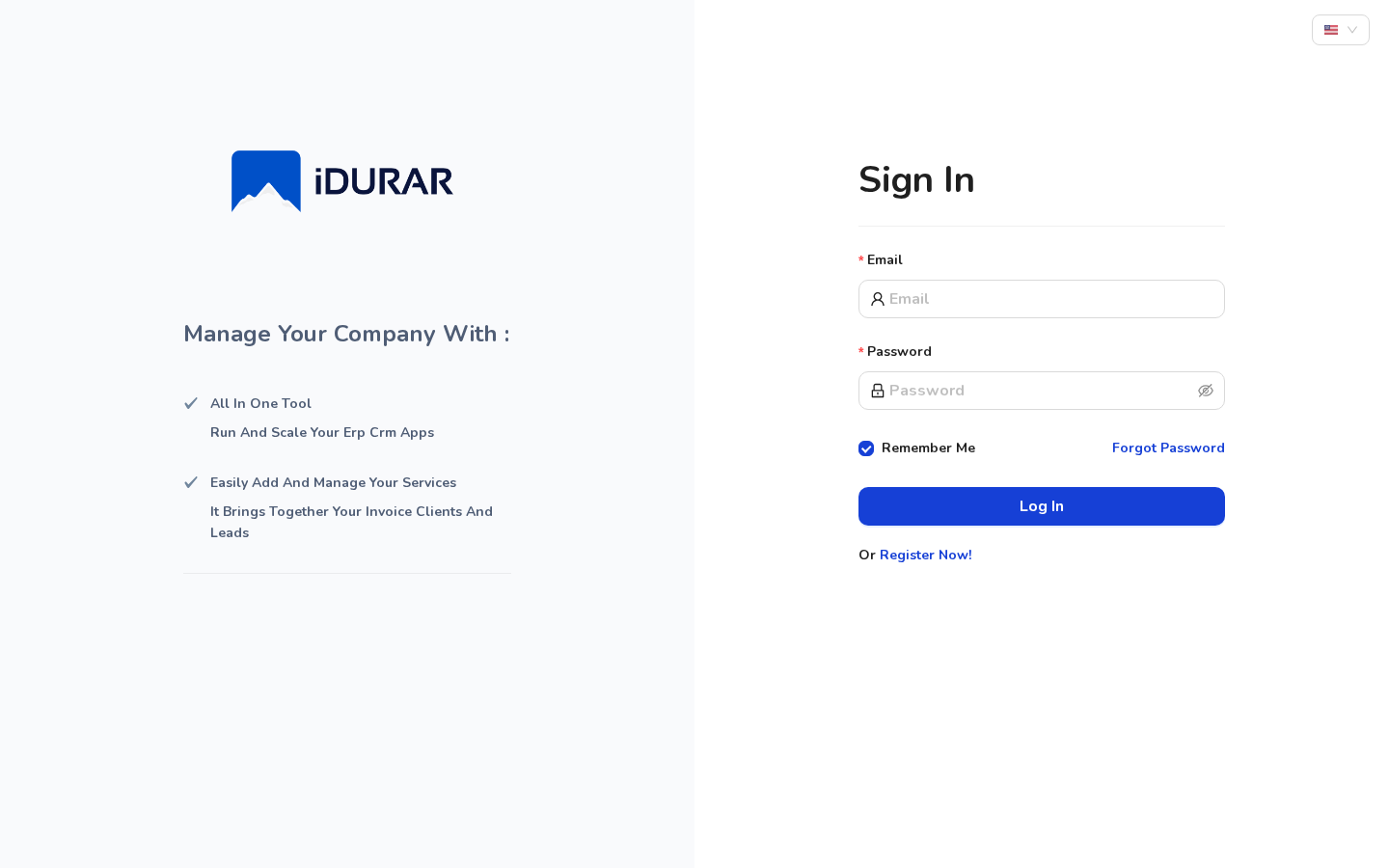
Idurar ERP CRM combines CRM, invoicing, accounting, and inventory in a single Node.js/React application. It's built for small to mid-sized businesses that need CRM and financial management without separate subscriptions.
Pros
- Unified invoicing and CRM eliminates data silos between sales and accounting
- Modern JavaScript stack (Node + React) is easier for many developers to extend
- AGPL-3.0 license is clear
Cons
- Smaller feature set than enterprise ERPs like Dolibarr
- Less mature; fewer case studies in large deployments
Dolibarr
Dolibarr is a mature, PHP-based open-source ERP/CRM with 20+ years of development. It covers invoicing, inventory, accounting, CRM, and more—making it the most complete all-in-one alternative to HubSpot for businesses that need financial and operational management alongside customer relationships.
Pros
- Most feature-complete; handles invoicing, inventory, accounting, and CRM in one platform
- Stable, battle-tested codebase with large user base
- Modular architecture lets you enable only what you need
Cons
- Older PHP codebase; less modern developer experience than TypeScript alternatives
- Steeper learning curve due to breadth of features
Erxes
Erxes is an Experience Operating System (XOS) unifying marketing, sales, operations, and support. It's explicitly positioned as a HubSpot, Zendesk, and Linear alternative, making it the most direct all-in-one replacement if you want to move away from HubSpot's ecosystem entirely.
Pros
- Purpose-built to replace HubSpot + Zendesk; integrated workflows across marketing, sales, and support
- Plugin system allows deep customization
- Unified interface reduces tool sprawl
Cons
- Smaller community and fewer integrations than Twenty
- Less documentation and fewer public case studies
EspoCRM
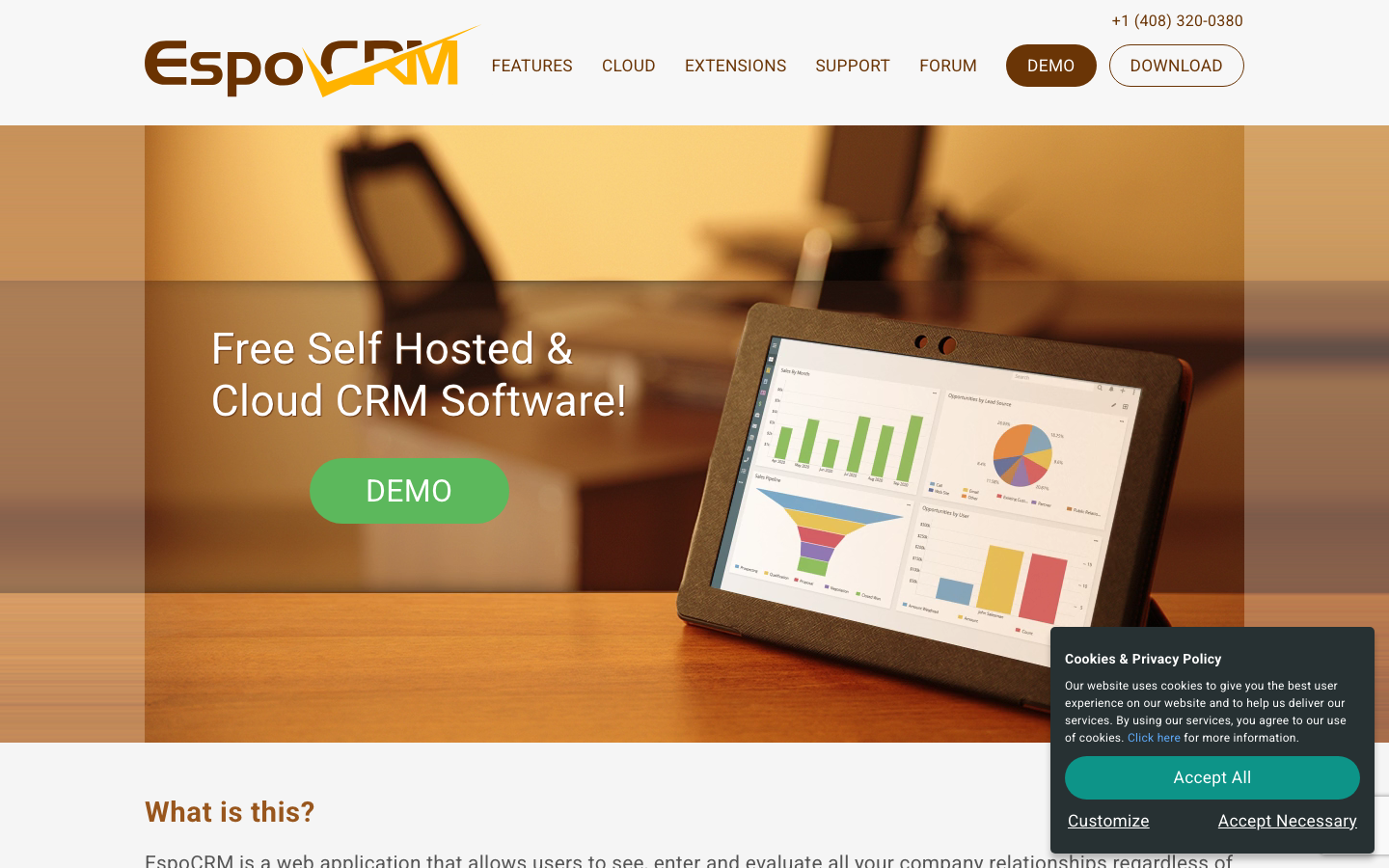
EspoCRM is a lightweight, modular CRM built in PHP with a focus on flexibility and ease of deployment. It's a solid middle ground: more mature than Twenty, more focused than Dolibarr, and easier to customize than legacy systems.
Pros
- Clean REST API and custom entity support make extensions straightforward
- Lightweight footprint; quick to self-host and maintain
- AGPL-3.0 license is well-understood
Cons
- No built-in invoicing, accounting, or inventory (unlike Dolibarr)
- Smaller community than Twenty; fewer third-party integrations
How to choose
For pure CRM, start with Twenty if you want a modern, extensible platform with strong developer momentum, or EspoCRM if you prefer a lighter, proven codebase.
For all-in-one operations (CRM + invoicing + inventory), Dolibarr is the most feature-complete and battle-tested; Idurar ERP CRM is a lighter alternative if you prefer a modern JavaScript stack.
For teams replacing HubSpot's entire suite (marketing, sales, service), Erxes is the closest drop-in replacement; otherwise, plan to integrate specialized tools (e.g., CRM + separate email/marketing + helpdesk).
For Laravel shops, Laravel CRM is the natural choice. For relationship-focused, smaller teams, Monica excels. For all-in-one workspace (projects + CRM + chat), Huly Platform consolidates tools.
The key decision: do you need one platform or are you comfortable integrating 2–3 specialized open-source tools? HubSpot's value is integration; open-source's value is cost and control. Choose accordingly.