









TL;DR
- Cost control matters most? listmonk strips away per-contact billing entirely—you own the infrastructure, pay only for sending, and never watch your bill climb as your audience grows.
- Privacy and data ownership are non-negotiable. Self-host BillionMail or mautic to keep subscriber data off third-party servers and eliminate tracking lock-in.
- Building custom workflows and templates? react-email and mjml let developers write campaigns as code, sidestep Mailchimp's template jail, and integrate into your own pipeline.
Why teams leave Mailchimp
Mailchimp's pricing model has become its biggest liability. You pay per contact, not per email—meaning your bill grows automatically as your list expands, regardless of how often you send. Inactive or unsubscribed contacts still count against your tier, creating a hidden cost spiral that makes budget forecasting nearly impossible. Repeated pricing restructures (including a 2025 overhaul) have left customers chasing moving targets, unsure what they'll pay next quarter.
Beyond cost, there's the ownership problem. Your templates, automation rules, and contact data live inside Mailchimp's walled garden. Exporting and migrating to another platform is a time-consuming project—you're not just leaving a tool, you're untangling months or years of campaign logic. For teams handling sensitive subscriber data or operating in regulated industries, the privacy trade-off of storing everything on Mailchimp's servers (and subject to their tracking and analytics practices) becomes harder to justify.
Open-source, self-hosted alternatives flip the model: you control your sending infrastructure, pay only for the SMTP relay or mail server you use, and own your data completely. There's no per-contact tax, no surprise price hikes, and no vendor lock-in on your campaign logic.
Quick comparison
| Name | License | Self-Hosted | Deliverability Setup | API / Automation | Best For |
|---|---|---|---|---|---|
| listmonk | AGPL-3.0 | ✓ Single binary | Bring your own SMTP or relay | REST API, subscriber management, segmentation | High-volume newsletters, cost-conscious teams |
| BillionMail | AGPL-3.0 | ✓ Full stack | Built-in mail server + relay options | Full email marketing suite, API-driven | All-in-one self-hosted email + marketing |
| mautic | License not declared | ✓ Full stack | SMTP configuration, multi-channel | Advanced automation, lead scoring, CRM integration | Marketing automation, lead nurturing workflows |
| react-email | MIT | ✓ (as library) | Developer-owned (no platform) | Component-based email building, React-native | Dev teams, custom transactional & campaign email |
| mjml | MIT | ✓ (as framework) | Developer-owned (no platform) | Markup language for responsive email | Designers and developers, template-heavy workflows |
| keila | AGPL-3.0 | ✓ Full stack | Bring your own SMTP | Automation, subscriber management, API | Small to mid-size newsletters, simplicity-first teams |
| phplist3 | AGPL-3.0 | ✓ Full stack | SMTP configuration | Campaign management, segmentation, API | Legacy PHP environments, long-running deployments |
| postiz-app | AGPL-3.0 | ✓ Full stack | Multi-channel (social + email) | Social scheduling, AI-assisted composition | Teams managing social + email together |
Top open-source alternatives to Mailchimp
listmonk
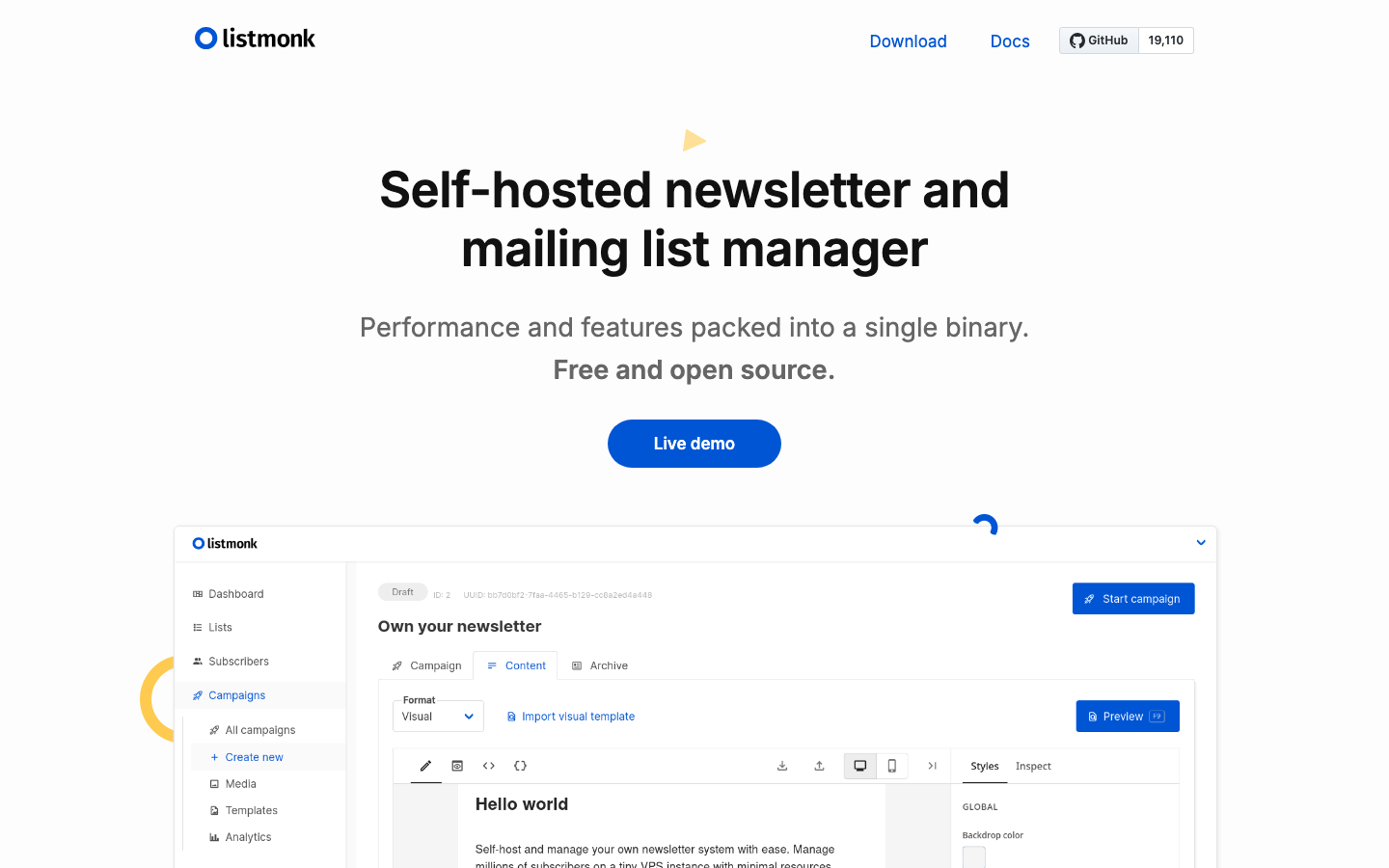
A lightweight, high-performance newsletter and mailing list manager that runs as a single binary—no dependencies, no database bloat. Built in Go for speed and simplicity, listmonk gives you a modern dashboard and full REST API without the Mailchimp price-per-contact model. You bring your own SMTP relay (SendGrid, AWS SES, or any standard provider) and pay only for what you send.
Pros
- Minimal resource footprint; runs on modest VPS or even a Raspberry Pi
- Full subscriber segmentation, automation, and campaign analytics without per-contact fees
- Single-binary deployment makes upgrades and backups trivial
Cons
- You must configure and manage your own SMTP relay or mail server
- Dashboard is functional but less visually polished than Mailchimp's
BillionMail
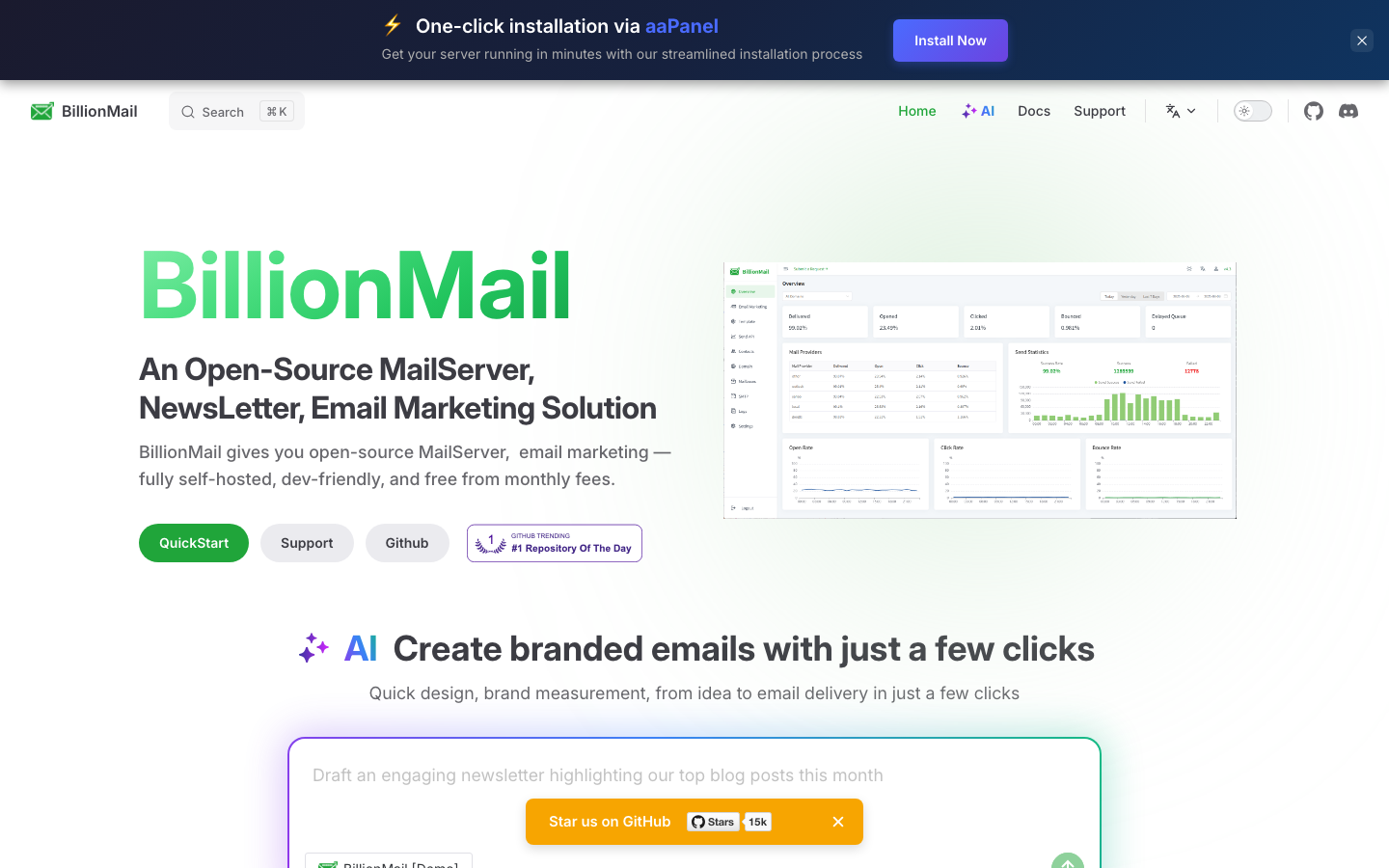
A fully self-hosted email marketing and mail server suite that bundles newsletter management, marketing automation, and SMTP delivery into one open-source package. Designed to be developer-friendly and free from monthly SaaS fees, it's built in Go and includes everything you need to run campaigns without external dependencies.
Pros
- All-in-one: mail server, newsletter, and marketing automation in a single deployment
- No per-contact pricing; no relay fees if you run your own mail server
- Active community (Discord) and dev-friendly architecture
Cons
- Requires more infrastructure knowledge than a managed SaaS; mail server setup and reputation management fall on you
- Smaller ecosystem compared to Mailchimp; fewer third-party integrations out of the box
mautic
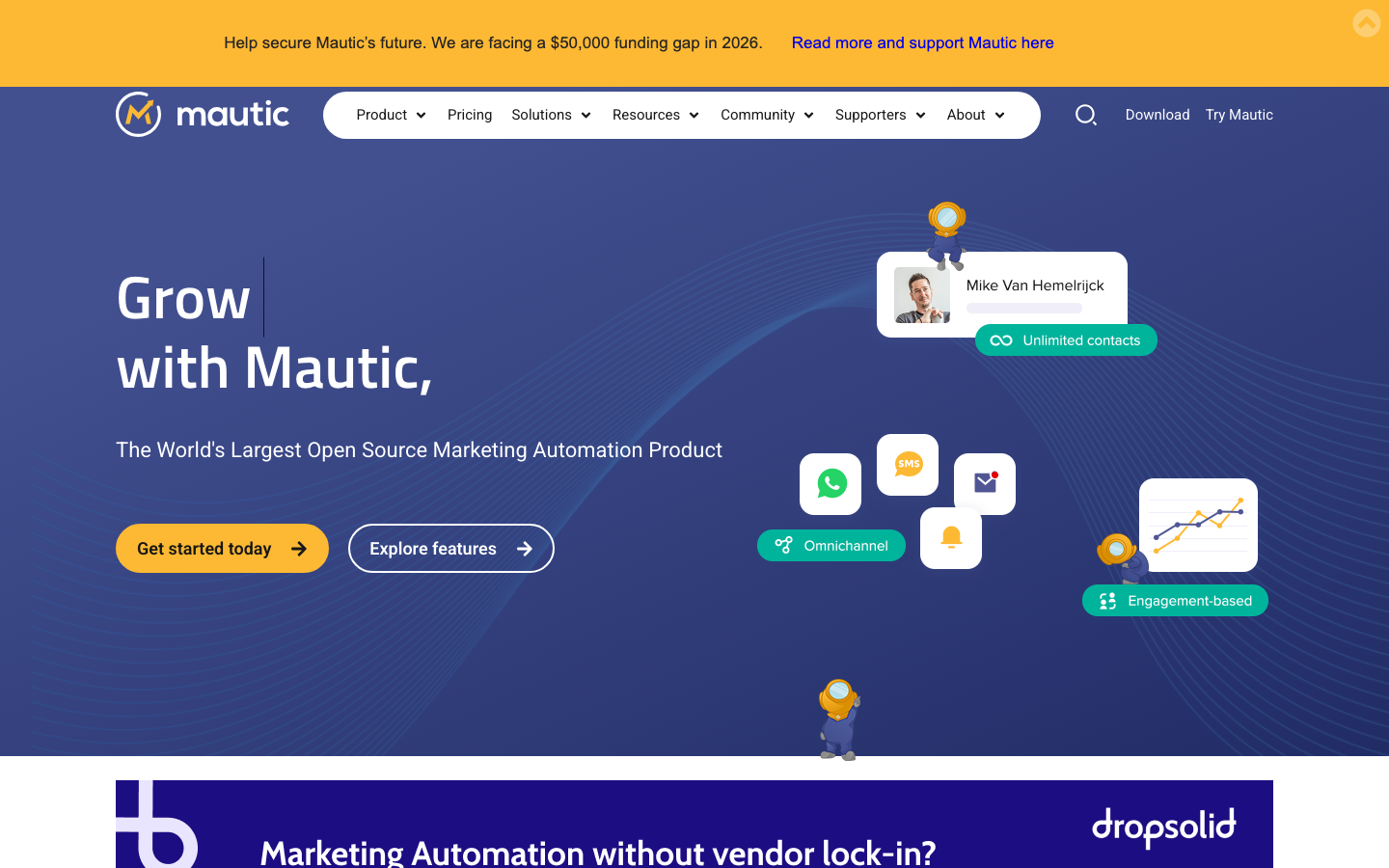
An open-source marketing automation platform with lead scoring, CRM integration, and multi-channel campaign orchestration. Mautic goes beyond email to cover SMS, push notifications, and landing pages, making it ideal for teams that need sophisticated nurture workflows and behavioral automation.
Pros
- Advanced automation: conditional logic, lead scoring, and customer journey mapping rival enterprise platforms
- Multi-channel (email, SMS, push, web); not email-only
- Strong API and webhook support for custom integrations
Cons
- Steeper learning curve and more resource-intensive than lightweight alternatives
- Self-hosting requires ongoing maintenance and database tuning for large contact bases
react-email
A developer-first library for building email templates using React components. Write emails as JSX, preview them in a browser, and render them to HTML—no drag-and-drop editor, no vendor lock-in. Perfect for teams that version-control their email templates and integrate campaigns into CI/CD pipelines.
Pros
- Treat email templates as code; use Git, testing, and component reuse like any web app
- MIT license; zero platform lock-in
- Integrates seamlessly into Node.js backends for transactional and bulk email
Cons
- Requires developer expertise; not suitable for non-technical marketers
- Handles template building only; you still need a separate service or infrastructure for sending and list management
mjml
A markup language and framework that makes responsive email design simple and predictable. MJML abstracts away the complexity of email client quirks (Outlook, Gmail, Apple Mail) so you can write clean, semantic markup and get pixel-perfect results across devices.
Pros
- Dramatically reduces boilerplate for responsive email; compiles to bulletproof HTML
- Open-source and language-agnostic; integrates into any build pipeline
- Large community and extensive documentation
Cons
- Template markup only; doesn't handle list management, sending, or automation
- Learning curve for teams unfamiliar with template languages
keila
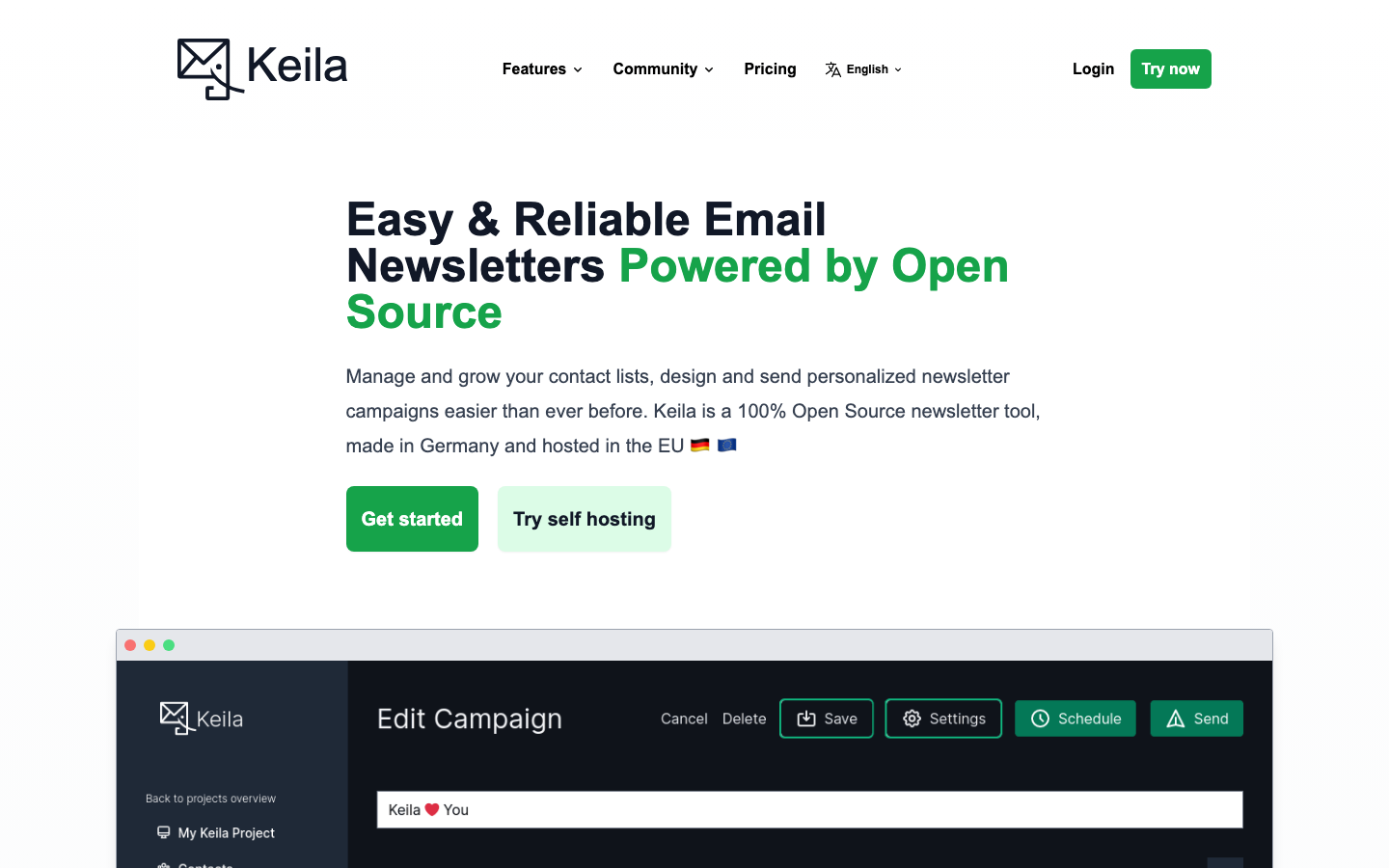
A lightweight, open-source newsletter tool built in Elixir with a focus on simplicity and speed. Keila handles subscriber management, automation, and campaign sending with a clean web interface, and lets you bring your own SMTP for deliverability.
Pros
- Minimal and fast; Elixir runtime is efficient and reliable
- Simple, intuitive UI—easier onboarding than mautic or Mailchimp for small teams
- Affordable self-hosting; low resource requirements
Cons
- Smaller feature set than mautic; no lead scoring or advanced CRM integration
- Smaller community means fewer third-party integrations and add-ons
phplist3
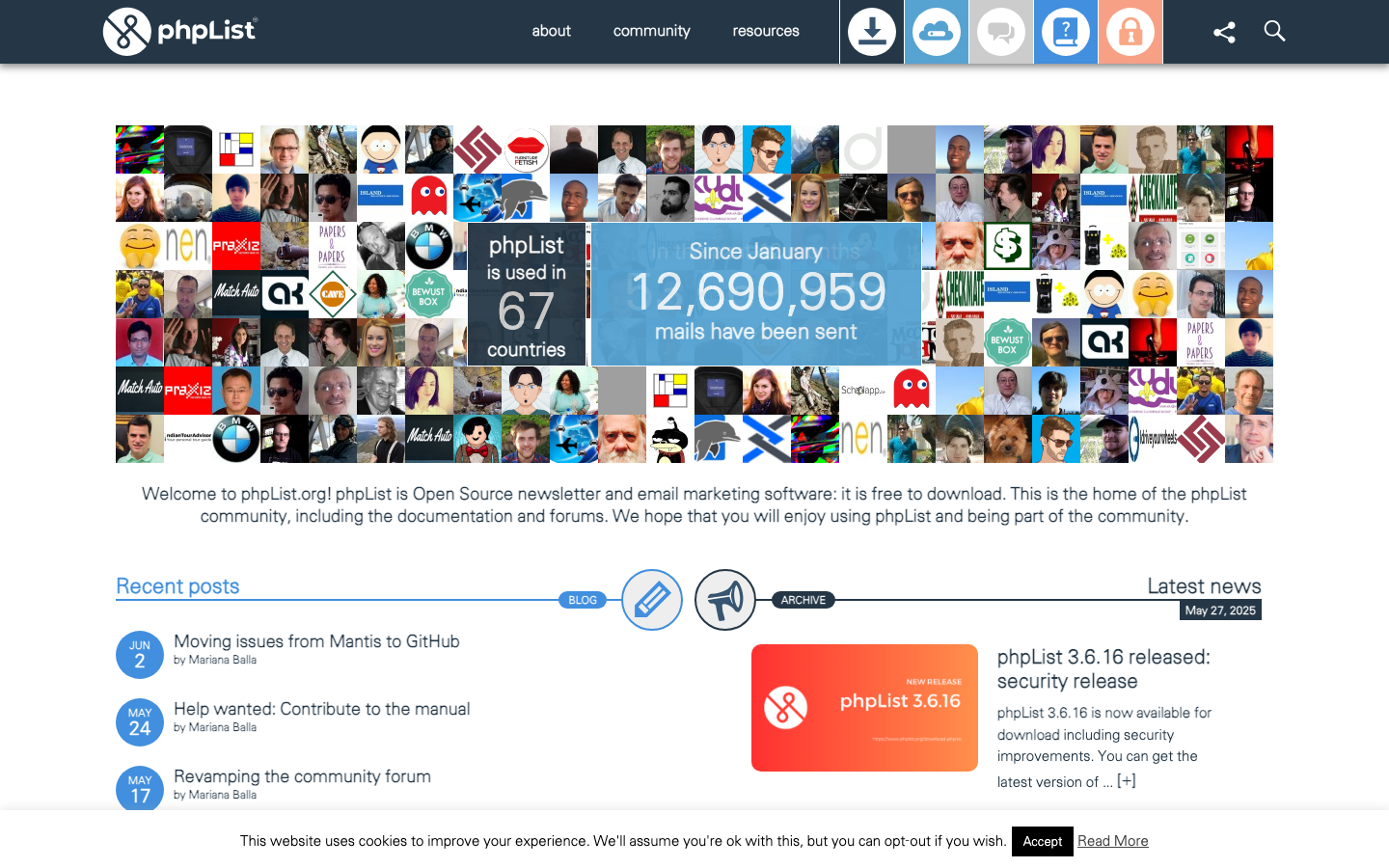
A mature, fully-featured open-source email marketing manager written in PHP. It handles campaign creation, sending, segmentation, and analytics, and has been deployed in production for over a decade. Ideal if your infrastructure is already PHP-based or you need a battle-tested legacy solution.
Pros
- Comprehensive feature set: campaigns, automation, segmentation, bounce handling, and detailed reporting
- Runs on standard PHP hosting (cPanel, shared servers, VPS)
- Long track record; stable and well-documented
Cons
- UI and codebase feel dated compared to modern alternatives
- PHP-only; harder to scale horizontally or integrate with modern microservice architectures
postiz-app
A social media scheduling and email marketing tool with AI-assisted content composition. Postiz combines campaign management with multi-channel publishing (social platforms and email), making it valuable for teams that need unified scheduling across channels.
Pros
- AI-powered content suggestions and scheduling automation save time on campaign prep
- Multi-channel: manage social and email campaigns from one dashboard
- Active development and strong GitHub community (29k+ stars)
Cons
- Social-first positioning means email features may lag behind dedicated newsletter tools
- Requires more infrastructure and dependencies than lightweight alternatives like listmonk
How to choose
For cost control and simplicity, choose listmonk if you're sending newsletters at scale and want to eliminate per-contact fees. For all-in-one self-hosting, BillionMail bundles everything (mail server, campaigns, automation) in one package. For advanced marketing automation, mautic is the heavyweight champion, but expect higher operational overhead. For developer teams, react-email and mjml are template frameworks—pair them with a separate sending service or list manager. For small, fast deployments, keila offers a sweet spot of simplicity and features. For legacy PHP stacks, phplist3 is battle-tested. For social + email, postiz-app unifies scheduling across channels. Start by asking: Do I need automation, multi-channel support, or just fast, cheap newsletters? That answer narrows the field quickly.