








TL;DR
- Community-driven discussion over microblogging? Lemmy replaces Reddit-like forums with a federated model where communities own their space without algorithmic ranking.
- Privacy-first social networking for closed groups? Diaspora lets teams share selectively across a distributed graph without corporate surveillance or timeline manipulation.
- Lightweight personal publishing without infrastructure overhead? Ech0 is a self-hosted alternative for individuals or small teams who want to write and share ideas without managing a full social server.
Why teams leave Mastodon
The headline problem is stark: Mastodon peaked at 2.6M monthly active users after Twitter's 2022 upheaval, but has since stalled at under 1M MAU despite 10.5M registered accounts. That gap—9M dormant accounts—reflects a real friction: the federated model's strength is also its friction. Choosing a server, maintaining federation trust, and dealing with per-instance moderation inconsistency create cognitive load that centralized platforms don't impose.
Beyond adoption curves, Mastodon's decentralized architecture creates operational lock-in of a different kind. Self-hosting your own instance gives you data ownership, but requires ongoing DevOps work—patching, backups, federation debugging. Smaller instances face moderation burden and defederation politics. And the network effect remains fragmented: a user on one server may have limited visibility into conversations on others, or find their instance siloed if moderation disputes arise. For teams seeking reliable, auditable communication infrastructure, Mastodon's "pick your own server" promise often becomes "maintain your own server or trust someone else's judgment."
Quick comparison
| Name | License | Self-Hosted | Federation | E2E Encryption | Best For |
|---|---|---|---|---|---|
| Lemmy | AGPL-3.0 | ✓ | ✓ | — | Community discussions & knowledge sharing |
| Diaspora | AGPL-3.0 | ✓ | ✓ | — | Privacy-conscious social networking |
| Misskey | AGPL-3.0 | ✓ | ✓ | — | Feature-rich microblogging & customization |
| Movim | AGPL-3.0 | ✓ | ✓ | — | Decentralized social chat & blogging |
| Ech0 | AGPL-3.0 | ✓ | — | — | Personal publishing & lightweight sharing |
| Elgg | License not declared | ✓ | — | — | Social networking engine & community platforms |
| Friendica | AGPL-3.0 | ✓ | ✓ | — | Multi-protocol social communication |
Top open-source alternatives to Mastodon
Lemmy
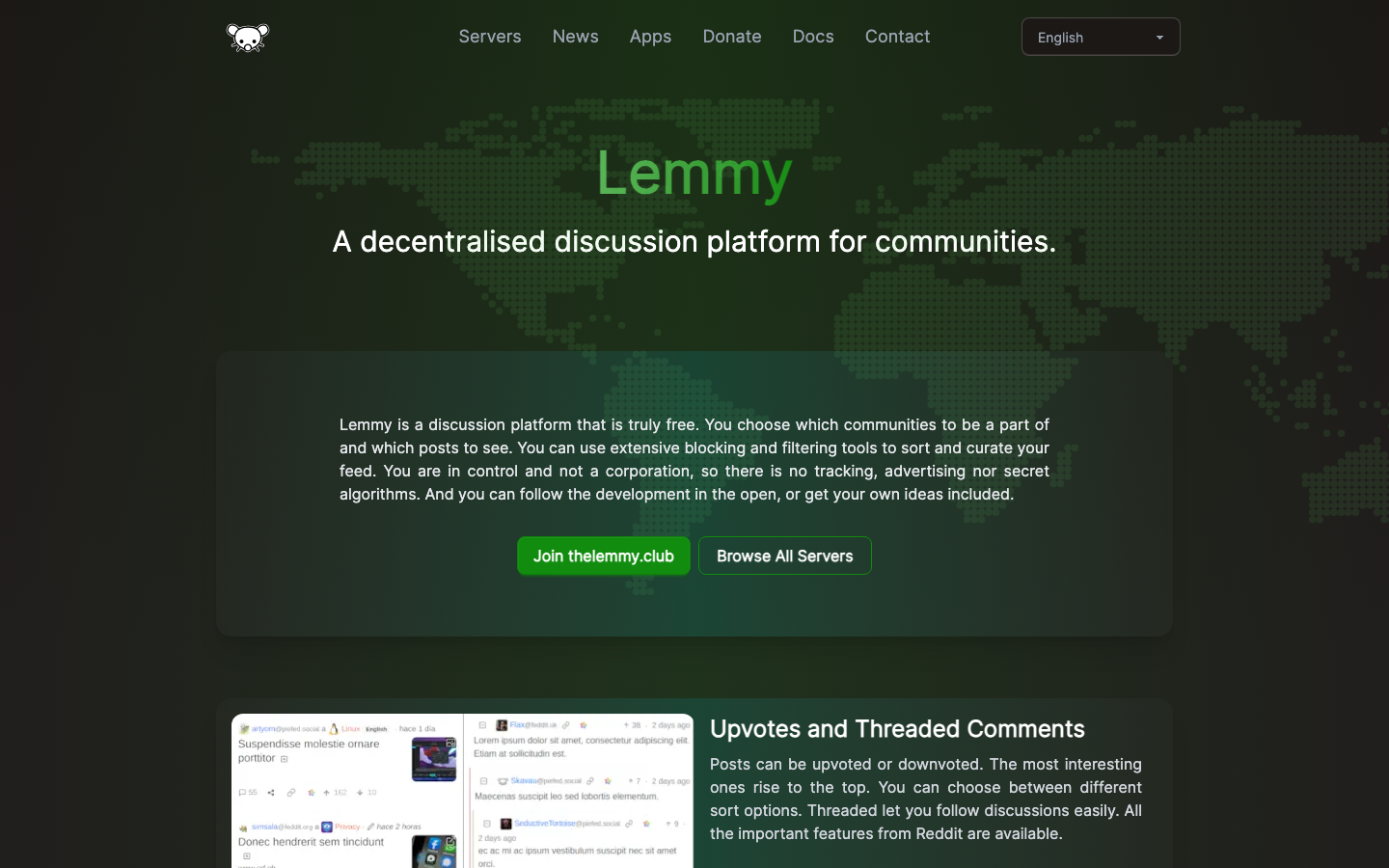
A federated discussion platform modeled on Reddit but without central ownership. Communities create their own instances and moderate independently, while federation allows cross-instance subscriptions and voting. Built in Rust for performance and memory efficiency.
Pros
- Forum structure scales better than timeline models for knowledge retention and searchability
- Community-first design reduces algorithmic manipulation and engagement-bait incentives
- Strong federation support; communities remain discoverable across instances
Cons
- Smaller user base than Mastodon; community network effects still building
- Moderation at instance level can fragment communities if defederation occurs
Diaspora
A distributed social network emphasizing privacy and user control, predating Mastodon's rise. Users create pods (personal or shared servers), share selectively with aspects (friend groups), and communicate without corporate intermediaries. Built on Ruby.
Pros
- Aspect-based sharing model gives fine-grained privacy control without relying on instance-level moderation
- Older, battle-tested federation protocol with established pod ecosystem
- Transparent data model; users understand exactly who sees what
Cons
- Smaller active community than Mastodon; lower network effects for discoverability
- Ruby stack can be resource-heavy compared to newer implementations; fewer deployment options
Misskey
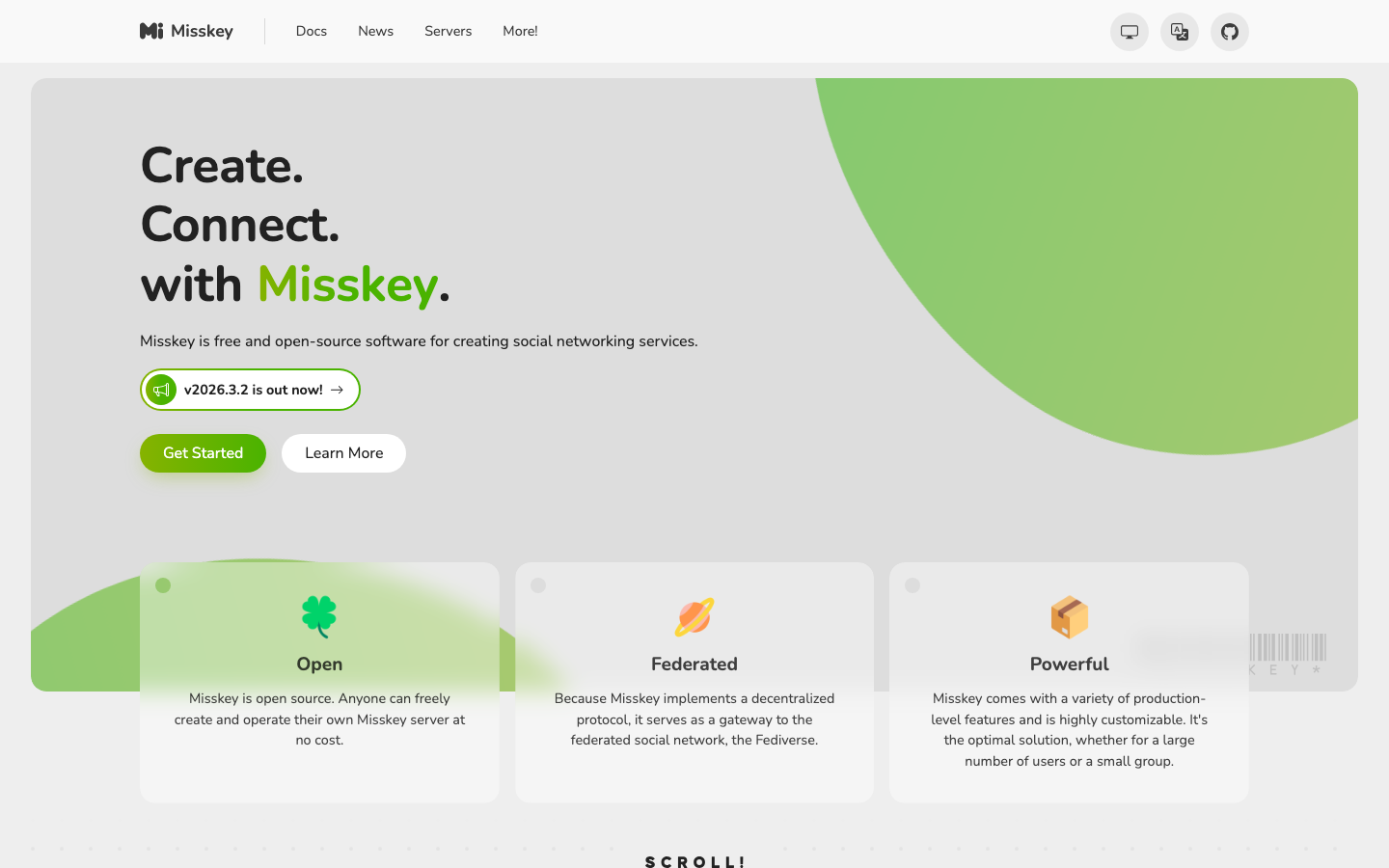
A feature-rich microblogging platform comparable to Mastodon but with heavier emphasis on user customization and emoji reactions. Supports federation via ActivityPub and includes built-in support for rich media, custom reactions, and theming. Written in TypeScript.
Pros
- More granular UI customization and emoji-based interaction model than Mastodon
- Active development with regular feature additions
- Strong federation support; compatible with Mastodon and other ActivityPub servers
Cons
- Smaller user base than Mastodon; federation benefits limited by adoption
- Higher resource overhead for self-hosting due to TypeScript/Node.js stack
Movim
A decentralized social platform built on the XMPP protocol, combining chat, blogging, and community features. Emphasizes real-time messaging alongside asynchronous publishing. Written in PHP.
Pros
- Combines instant messaging and social publishing in one federated system
- XMPP protocol is mature and interoperable with other XMPP clients
- Lightweight PHP implementation; low deployment overhead
Cons
- Very small user base and limited network effects
- XMPP federation less commonly understood than ActivityPub; adoption barrier for new users
Ech0
A lightweight, self-hosted publishing platform for personal idea sharing without the overhead of a full social server. Designed for individuals or small teams to write and distribute content simply. Built in Go.
Pros
- Minimal resource footprint; runs efficiently on modest hardware
- Simple, focused feature set; no algorithmic feed or social graph complexity
- Written in Go; fast deployment and maintenance
Cons
- No federation; designed as standalone publishing tool, not a network
- Limited community features; better for personal blogs than collaborative spaces
Elgg
A PHP-based social networking engine that powers white-label community platforms. Provides core social features (profiles, activity streams, messaging, groups) and is widely customized for enterprise and educational deployments.
Pros
- Mature, battle-tested platform with large customization ecosystem
- Flexible plugin architecture; adaptable to many use cases
- Self-hosted; no vendor lock-in
Cons
- No federation; isolated networks require custom bridges for inter-community communication
- PHP stack can require more maintenance overhead than modern alternatives
Friendica
A decentralized social platform that bridges multiple protocols—ActivityPub, Diaspora, and OStatus—allowing users to interact across different federated networks. Supports both personal profiles and group channels. Built in PHP.
Pros
- Multi-protocol support creates bridges between Mastodon, Diaspora, and other networks
- Flexible model supports both individual and group communication
- Mature federation implementation; stable for long-term deployment
Cons
- Small user base; network effects limited by fragmentation across protocols
- PHP stack requires ongoing maintenance; fewer deployment options than compiled alternatives
How to choose
For community-driven knowledge sharing, choose Lemmy—its forum structure and federation model outperform timeline-based platforms for discoverability and archival. For privacy-first teams or closed networks, Diaspora or Friendica offer aspect-based sharing and multi-protocol bridges without relying on instance-level moderation. For solo publishers or lightweight team communication, Ech0 minimizes operational burden. For feature-rich microblogging with customization, Misskey matches Mastodon's scope while offering deeper UI control. For enterprise community platforms, Elgg provides a mature, extensible foundation. In all cases, audit federation support, instance resource requirements, and your team's tolerance for DevOps overhead before committing.