


TL;DR
- Need a fully local, encrypted knowledge base that syncs across your devices without cloud lock-in? Siyuan is a privacy-first, self-hosted alternative where your data stays under your control.
- Looking to archive and index documents with full-text search while keeping everything offline and owned? Paperless-ngx turns document chaos into an organized, searchable system you run yourself.
- Want lightweight, offline document management with tagging and zero account requirements? TagSpaces keeps your files local and lets you organize them your way, without vendor dependencies.
Why teams leave Microsoft OneNote
Microsoft's shift toward cloud-only storage has created a real problem: OneNote no longer lets you keep notebooks purely local. All notes sync to Microsoft's servers tied to a Microsoft account, and you cannot opt out. This creates vendor lock-in at the storage layer—your data lives in OneDrive, gated behind a single account.
The risk is concrete. Documented cases show users being abruptly locked out of their Microsoft accounts and losing access to years of notes with no recovery path. Beyond account lockout, OneNote stores notes without end-to-end encryption, meaning Microsoft's infrastructure can technically read your content. For teams handling sensitive information—research data, internal documentation, or personal knowledge—this is a material compliance and privacy gap.
For organizations that need local backups, the ability to self-host, encryption they control, and independence from account-based cloud infrastructure, OneNote's trajectory is untenable. The open-source alternatives below offer a different model: data lives on your device or your own server, encrypted or not at your choice, and backed up on your terms.
Quick comparison
| Name | License | Self-Hosted | API / Extensibility | Stack / Language | Best For |
|---|---|---|---|---|---|
| Siyuan | AGPL-3.0 | Yes | Plugin system, REST API | TypeScript, Go | Privacy-first knowledge management; local-first sync |
| Paperless-ngx | GPL-3.0 | Yes | REST API, extensible backends | Python | Document archiving, indexing, full-text search |
| TagSpaces | AGPL-3.0 | Yes | Plugin architecture | TypeScript | Lightweight offline file tagging and organization |
| Papra | AGPL-3.0 | Yes | — | TypeScript | Minimalist document archiving and retrieval |
| eLabFTW | AGPL-3.0 | Yes | REST API | PHP | Research lab notebooks, structured experiment logging |
Top open-source alternatives to Microsoft OneNote
Siyuan
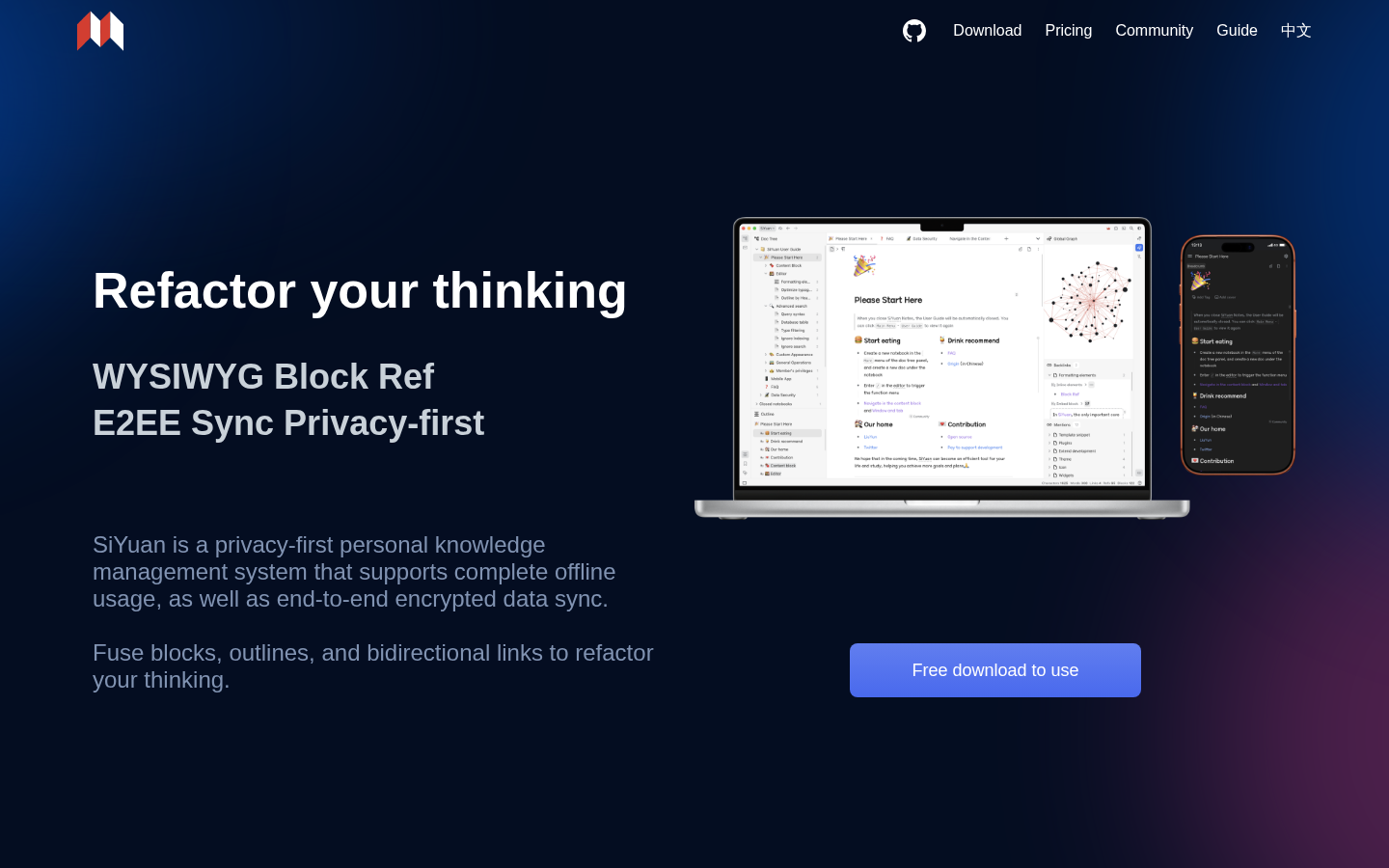
Siyuan is a privacy-first, self-hosted personal knowledge management system written in TypeScript and Go. It's designed for users who want their notes encrypted, synced across devices, but never touching a third-party cloud. The system supports bidirectional linking, full-text search, and a plugin ecosystem for extending functionality.
Pros:
- Fully local-first architecture with optional self-hosted sync; your data never leaves your infrastructure unless you choose
- End-to-end encryption support and transparent data format (stores notes as Markdown and JSON)
- Active plugin ecosystem and REST API for integration and customization
Cons:
- Steeper learning curve than OneNote; requires more setup for self-hosted sync
- Smaller community than OneNote, so fewer third-party integrations out of the box
Paperless-ngx
Paperless-ngx is a document management system that scans, indexes, and archives physical and digital documents with full-text search. It's the spiritual successor to Paperless and is maintained by an active community. You run it on your own hardware or server, and it builds a searchable archive you own completely.
Pros:
- Powerful full-text search and automatic document tagging using OCR
- REST API and extensible backend; integrates with scanners and workflows
- No cloud dependency; documents stay on your server and can be encrypted at rest
Cons:
- Focused on document archiving rather than freeform note-taking; requires some initial setup and scanning workflow
- Not designed as a real-time collaborative tool; better for personal or team archives than live shared notes
TagSpaces
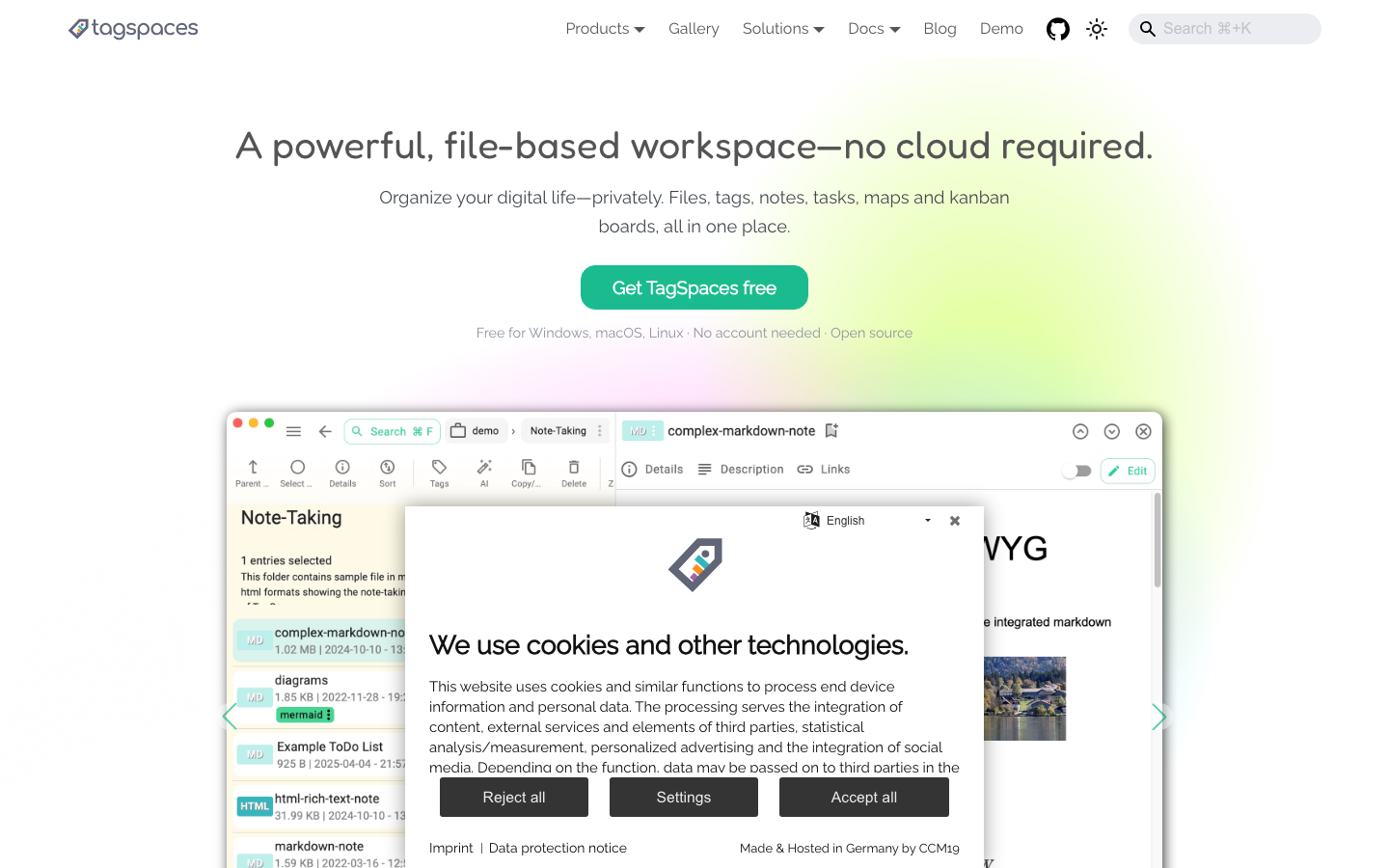
TagSpaces is an offline, open-source document manager that organizes files using a tagging system instead of rigid folders. It runs entirely on your machine (or self-hosted), requires no account, and works with any file type. It's lightweight and designed for users who want to keep their filing system simple and local.
Pros:
- Zero setup friction; works offline with no account or authentication required
- File-agnostic tagging system is flexible for mixed document types and non-linear organization
- Minimal resource footprint; runs well on older hardware or as a portable app
Cons:
- Simpler than OneNote; lacks advanced features like bidirectional linking or collaborative real-time editing
- No built-in full-text search across document content (only file names and tags)
Papra
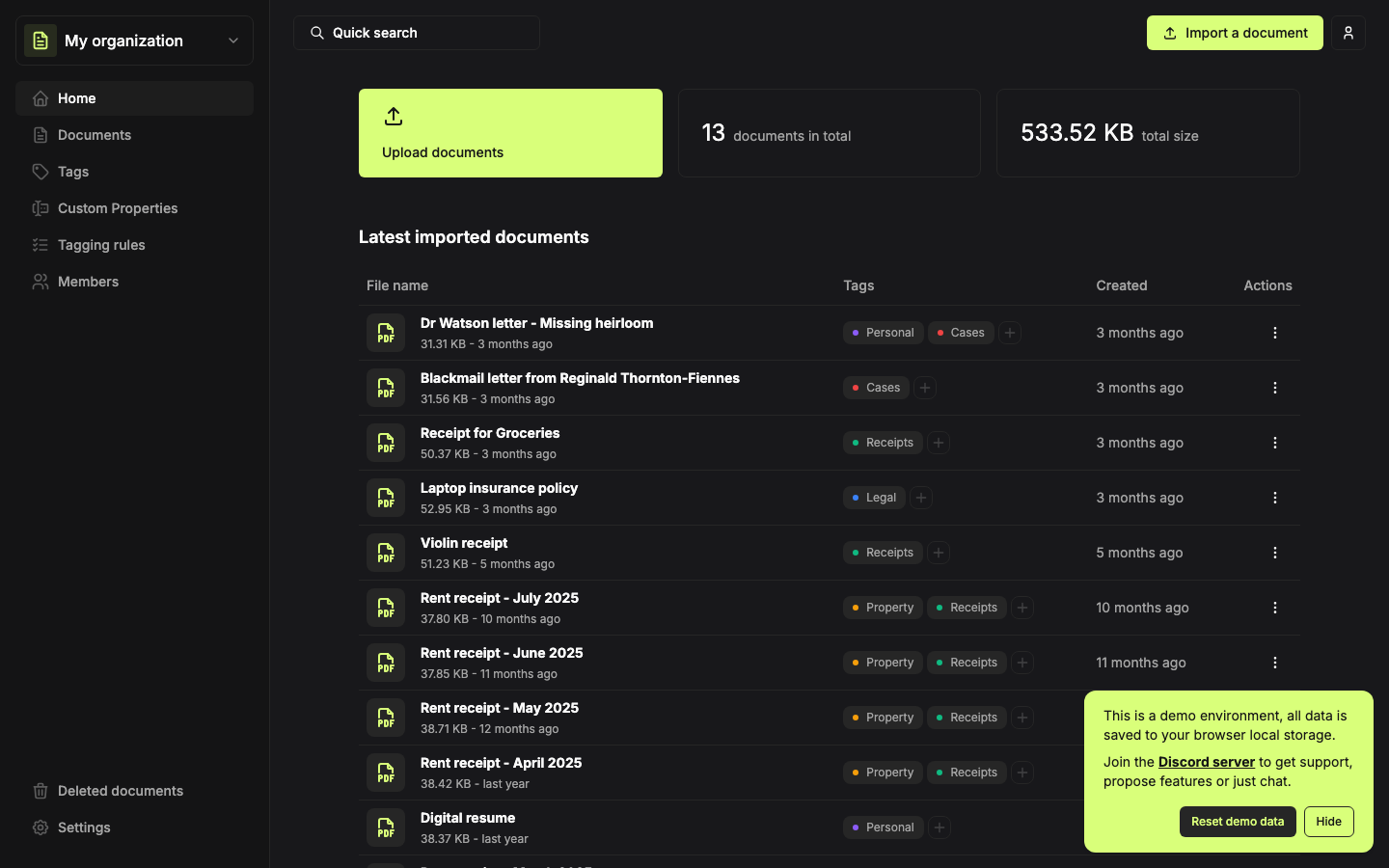
Papra is a minimalistic document archiving platform built in TypeScript. It focuses on simplicity: upload documents, organize them, retrieve them. It's self-hosted and designed for teams or individuals who want a lightweight archive without feature bloat.
Pros:
- Minimal, clean interface; fast to deploy and learn
- Self-hosted by default; full control over data and infrastructure
- Lightweight and easy to integrate into existing workflows
Cons:
- Very early-stage and smaller community; fewer features than alternatives
- Limited documentation and ecosystem compared to more mature projects
eLabFTW
eLabFTW is an electronic lab notebook (ELN) built for research teams and labs. Written in PHP, it's designed for structured experiment logging, timestamped entries, and team collaboration. It's self-hosted and widely used in academic and industrial research settings.
Pros:
- Purpose-built for research workflows; supports timestamping, signatures, and audit trails required by regulatory compliance
- REST API and extensible backend; integrates with lab equipment and data pipelines
- Mature codebase with active academic adoption and community
Cons:
- Overkill for general note-taking; the structured experiment-log model doesn't map well to casual knowledge management
- Steeper setup and configuration than general-purpose note tools
How to choose
Start by defining your use case: knowledge management and sync (Siyuan), document archiving with search (Paperless-ngx), lightweight offline tagging (TagSpaces), minimal archiving (Papra), or research lab notebooks (eLabFTW).
For teams migrating from OneNote, Siyuan is the closest functional replacement—it handles notes, linking, and sync without cloud lock-in. If your workflow is document-heavy (PDFs, scans, receipts), Paperless-ngx is the better fit. For smaller teams or individuals who just need to organize files without complex features, TagSpaces is the fastest path to productivity. Evaluate your self-hosting capacity: all five projects are self-hosted, but Siyuan and eLabFTW require more infrastructure than TagSpaces. Finally, consider team size: Siyuan and eLabFTW support collaboration; TagSpaces and Papra are better for single-user or small-team archives.