







TL;DR
- High-traffic sites paying per-pageview: Rybbit offers the same privacy-first model without usage-based billing, so your analytics costs don't scale with success.
- Teams needing full data sovereignty: Deploy Litlyx or Vince on your own infrastructure to keep visitor records entirely off third-party servers and avoid vendor lock-in.
- Mobile and cross-platform tracking: Aptabase extends privacy-first analytics beyond web to desktop and mobile apps with a unified dashboard.
Why teams leave Plausible Analytics
The friction point is straightforward: Plausible's cloud pricing starts at €9/month for 10,000 pageviews and scales with traffic. For a growing site, that compounds quickly—a high-traffic property pays steadily more each month, with no ceiling. Even though Plausible itself is privacy-respecting and GDPR-compliant, the hosted plan still means your analytics data lives on Plausible's servers under a usage-based model.
The secondary concern is control. While Plausible offers a self-hostable Community Edition (AGPL-licensed, free), teams often discover this option only after committing to the cloud product. By that point, switching infrastructure or avoiding per-pageview billing requires migration effort. Teams that prioritize data sovereignty—keeping visitor records on hardware they own, avoiding vendor dependency, or operating in air-gapped environments—find the self-hosted escape route valuable but not the default path.
For organizations scaling analytics across multiple properties or handling high-volume traffic, the cost and control trade-offs become material enough to explore alternatives that bundle self-hosting and privacy as the primary offering, not an afterthought.
Quick comparison
| Name | License | Self-Hosted | Data Ownership | Query Flexibility | Best For |
|---|---|---|---|---|---|
| Rybbit | AGPL-3.0 | ✓ | Full | High | Privacy-first, intuitive UI, high-traffic sites |
| Goatcounter | — | ✓ | Full | Moderate | Lightweight, minimal-data analytics |
| Vince | AGPL-3.0 | ✓ | Full | Moderate | Google Analytics alternative, self-hosted first |
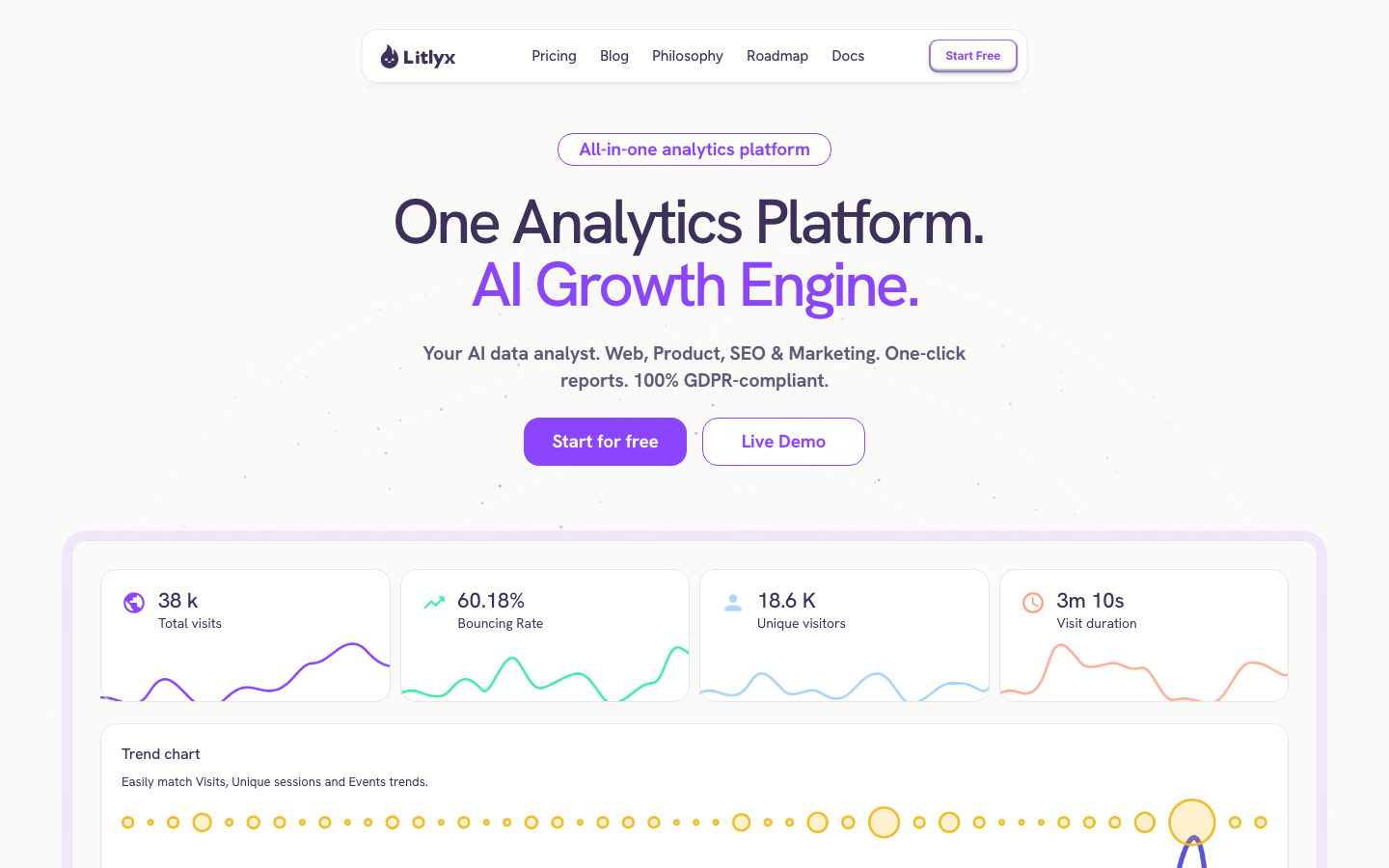
| Litlyx | Apache-2.0 | ✓ | Full | High | GDPR compliance, AI dashboard, rapid setup |
| Aptabase | AGPL-3.0 | ✓ | Full | Moderate | Mobile, desktop, and web app analytics |
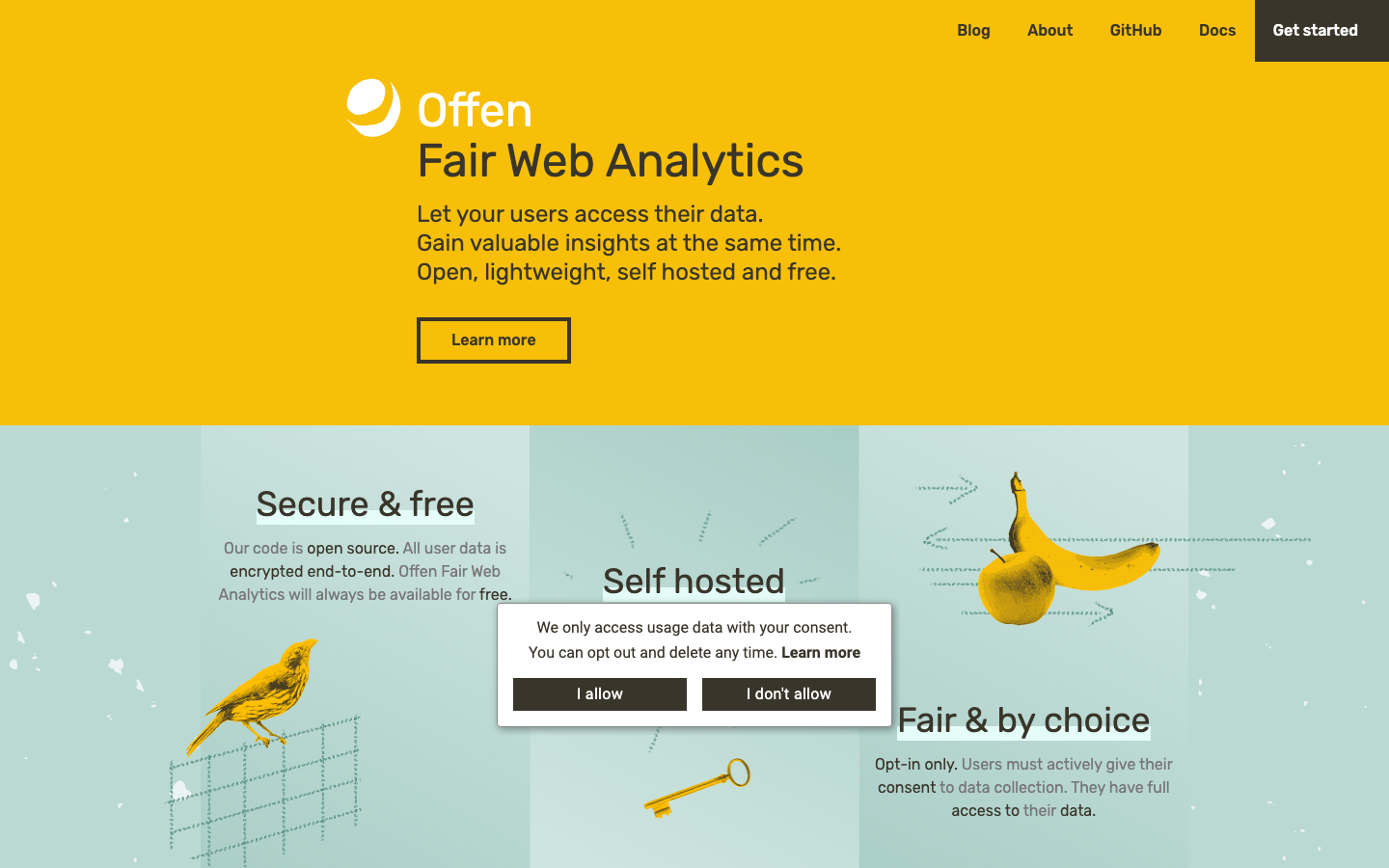
| Offen | Apache-2.0 | ✓ | Full | Moderate | Fair analytics with visitor consent controls |
Top open-source alternatives to Plausible Analytics
Rybbit
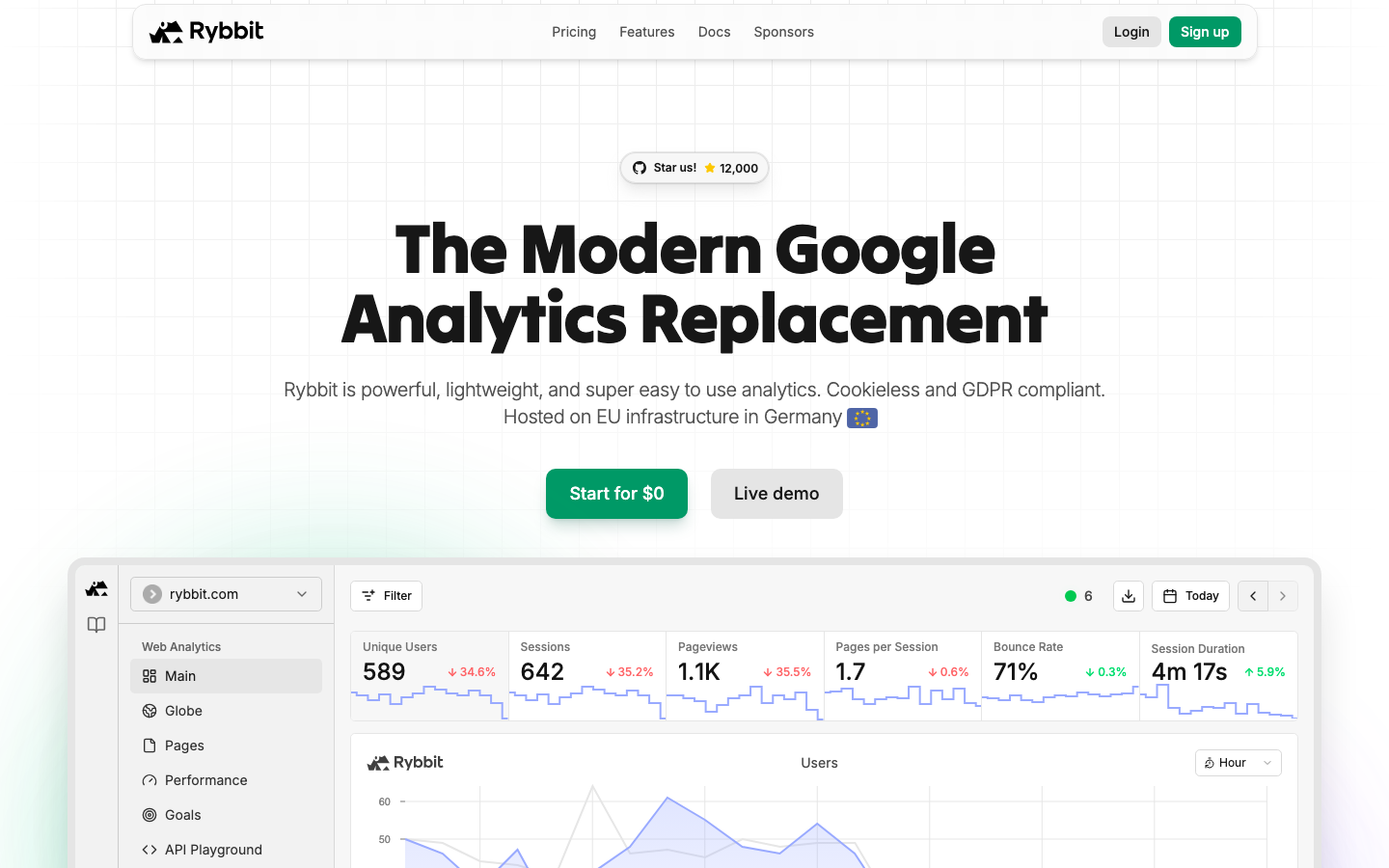
A privacy-first analytics platform with 12,000+ GitHub stars, built for intuitive traffic measurement without cookies or personal data. Rybbit positions itself as 10x more intuitive than Google Analytics, making it accessible to non-technical teams while maintaining strong privacy guarantees.
Pros:
- Self-hostable on your infrastructure; no per-pageview billing or vendor lock-in.
- High query flexibility and modern dashboard UX, reducing the learning curve.
- AGPL-3.0 licensed, ensuring transparency and community-driven development.
Cons:
- Larger codebase (TypeScript) may require more DevOps overhead than minimal alternatives.
- Community support scales with project maturity; enterprise SLAs not guaranteed.
Goatcounter
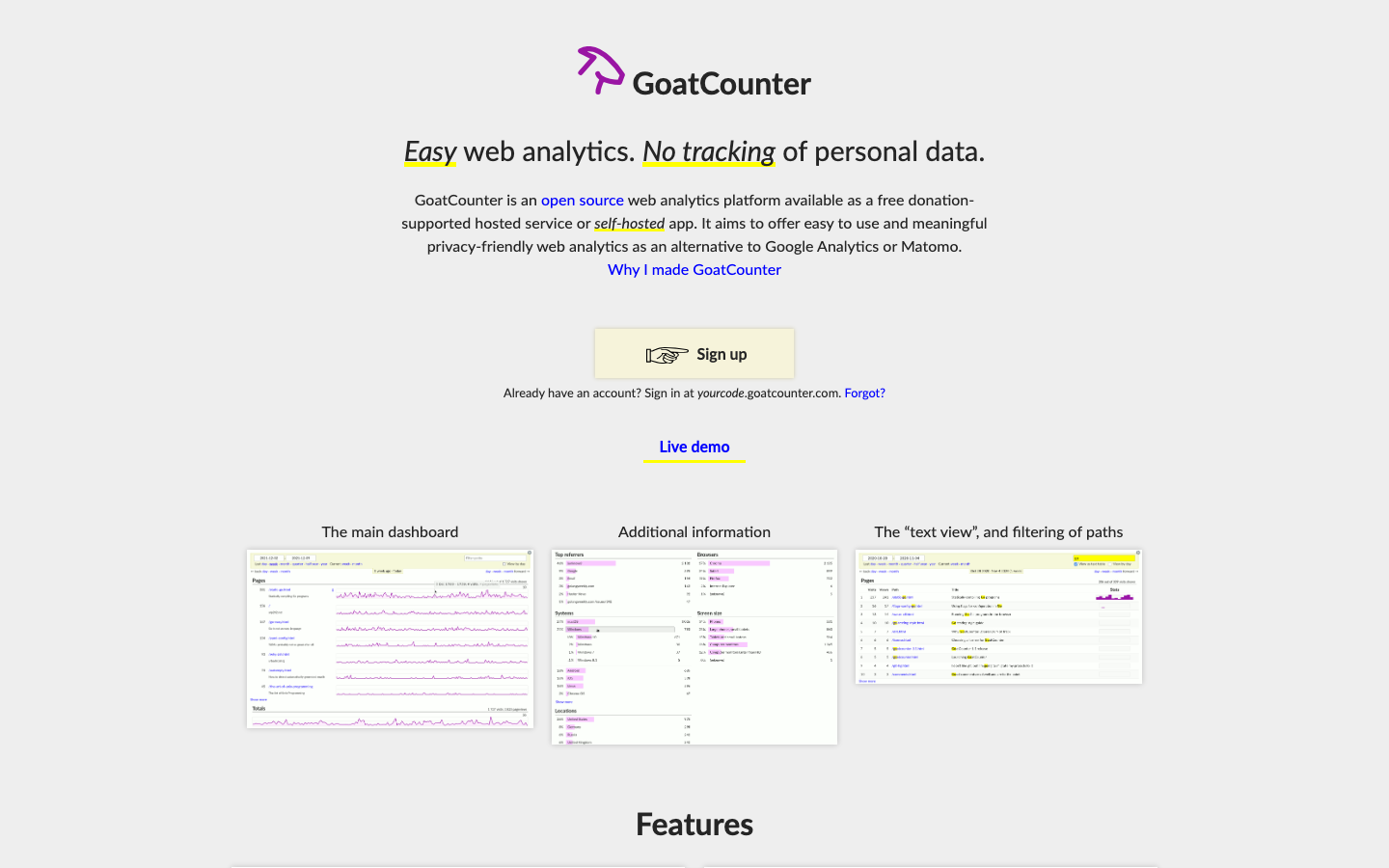
A lightweight web analytics tool focused on counting traffic without tracking individuals. Designed for simplicity, it measures page views and events without storing personal data or IP addresses.
Pros:
- Minimal resource footprint; easy to self-host on modest infrastructure.
- No personal data collection by design, reducing compliance burden.
- Straightforward interface suitable for small to medium sites.
Cons:
- License not declared; less clarity on long-term legal standing than AGPL/Apache projects.
- Limited query flexibility compared to feature-rich alternatives; better for basic traffic counts than deep analysis.
Vince
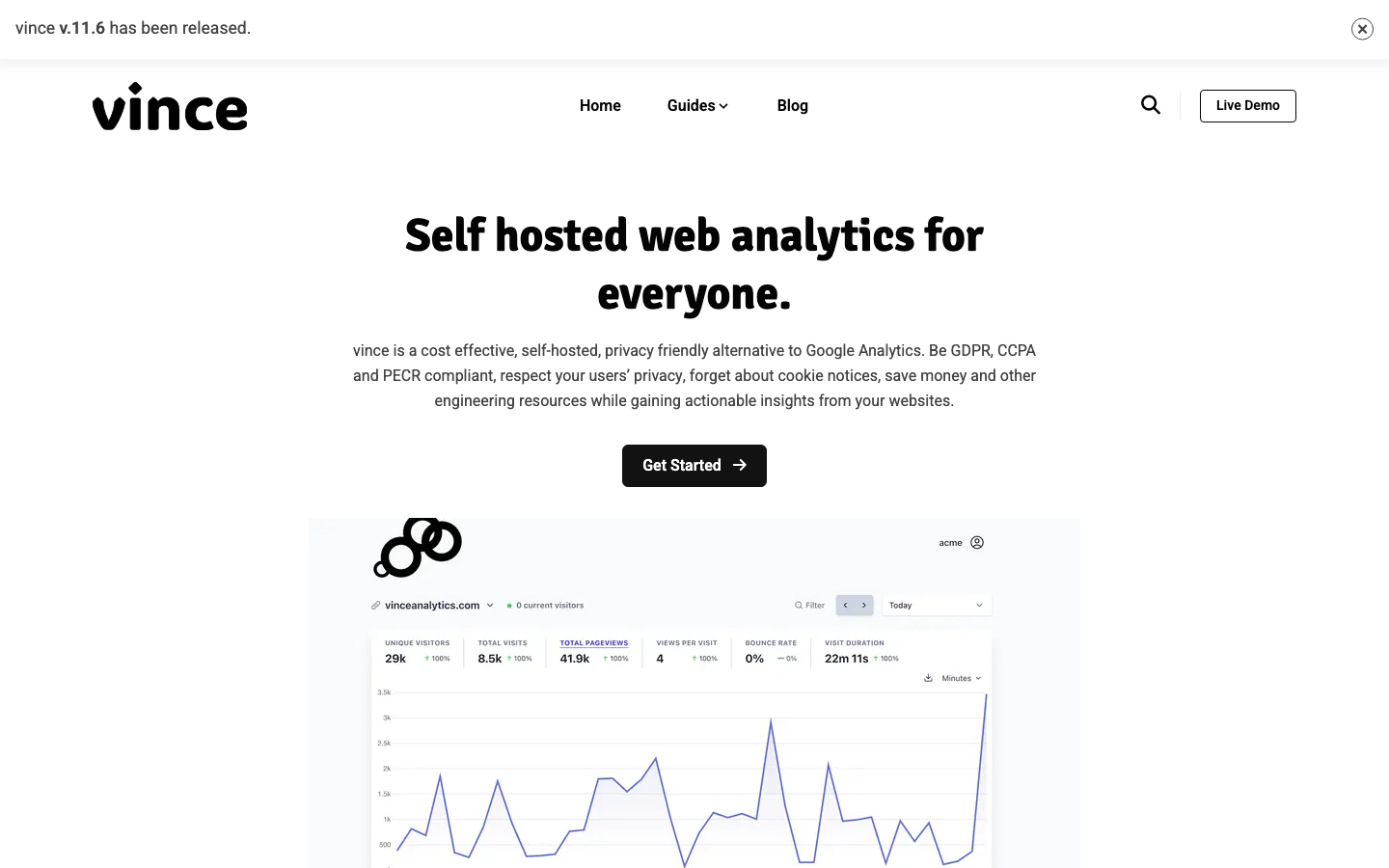
A self-hosted alternative to Google Analytics written in Go, emphasizing privacy and data sovereignty. Designed for teams that want Google Analytics' feature set without the tracking or cloud dependency.
Pros:
- Built in Go; fast, lightweight, and minimal resource consumption for deployment.
- AGPL-3.0 licensed with clear open-source governance.
- Straightforward Google Analytics migration path for teams switching from proprietary tools.
Cons:
- Smaller community (2,000 stars) means fewer integrations and less third-party tooling.
- Query flexibility is moderate; advanced custom analysis may require direct database access.
Litlyx
A modern, AI-powered analytics dashboard with GDPR compliance built in. Positioned as an all-in-one alternative to Google Analytics, Mixpanel, Plausible, and Matomo, with setup claimed in 30 seconds.
Pros:
- Apache-2.0 licensed; permissive for commercial use and modification.
- AI-powered dashboard reduces manual report creation; strong query flexibility.
- Rapid deployment and GDPR-first design appeal to compliance-heavy teams.
Cons:
- Newer project (1,726 stars); ecosystem and long-term stability less proven than larger alternatives.
- TypeScript stack requires JavaScript/Node.js infrastructure familiarity.
Aptabase
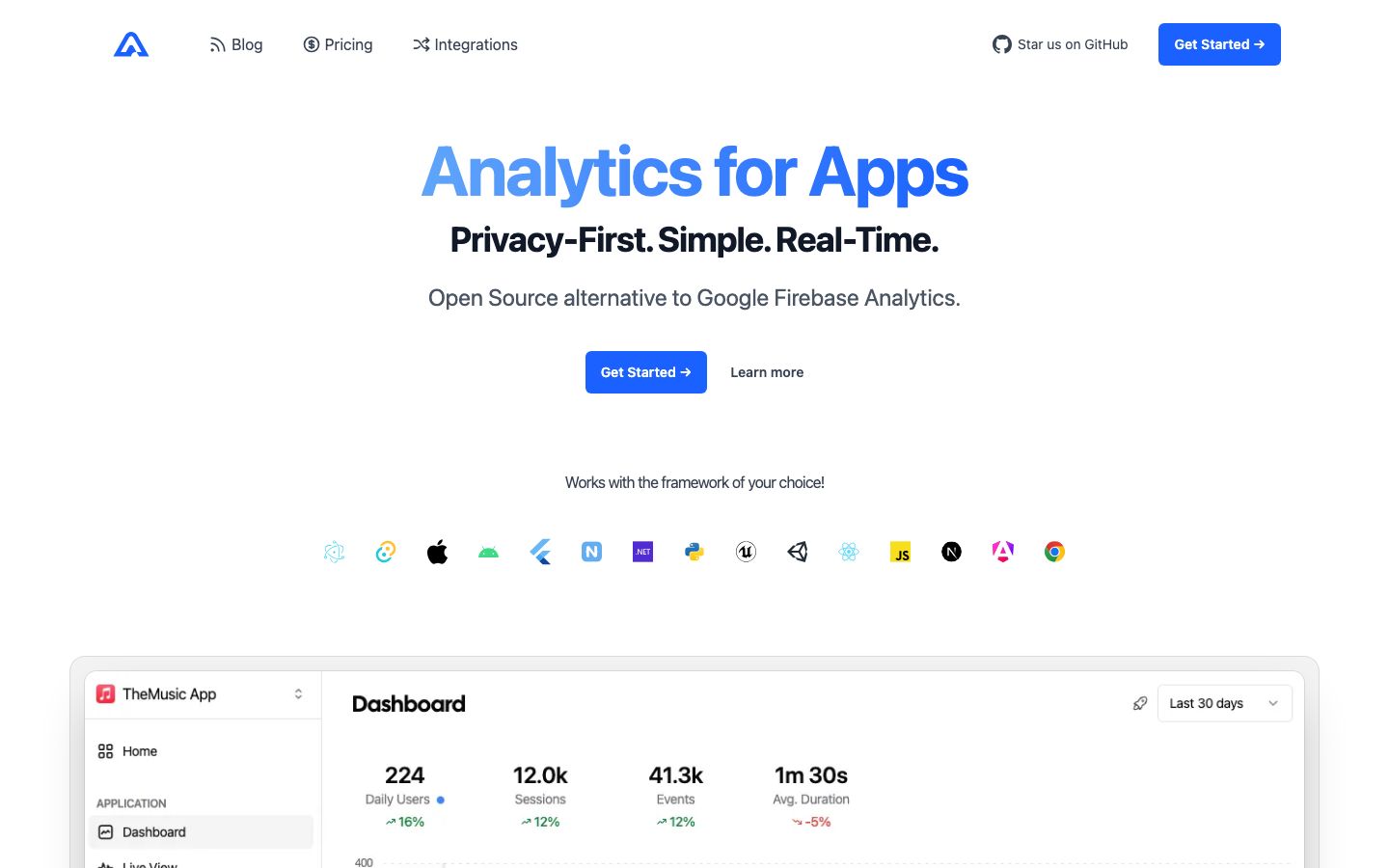
Privacy-first analytics for mobile, desktop, and web applications, addressing the cross-platform gap. Built for app developers who need consistent analytics across iOS, Android, Windows, macOS, and web without vendor tracking.
Pros:
- Unified SDK for mobile, desktop, and web; single pane of glass for multi-platform products.
- AGPL-3.0 licensed; self-hostable with full data control.
- Purpose-built for app analytics, not a web-first tool retrofitted for mobile.
Cons:
- Smaller community (1,700 stars); fewer integrations with app distribution platforms.
- Best suited for app-centric teams; less powerful for pure web analytics use cases.
Offen
Fair web analytics with built-in visitor consent controls, emphasizing transparency and user agency. Visitors can see and control their own analytics data, differentiating it from privacy-first tools that simply don't collect.
Pros:
- Apache-2.0 licensed; permissive and stable.
- Unique consent model gives visitors transparency and control, building trust.
- Lightweight and self-hostable with minimal infrastructure needs.
Cons:
- Smallest community (976 stars); slower feature velocity and ecosystem growth.
- Consent-first model adds UI complexity compared to fully privacy-respecting alternatives that don't ask permission.
How to choose
Start with your infrastructure preference: if you're already running Kubernetes or have DevOps capacity, Rybbit or Litlyx offer the richest query flexibility and modern dashboards. For lightweight deployments or resource-constrained environments, Goatcounter or Vince minimize operational overhead. If your product spans mobile and desktop, Aptabase is the only choice that unifies analytics across platforms. For teams prioritizing visitor transparency as a differentiator, Offen adds a consent-first layer. All six are fully self-hostable, so the decision hinges on feature richness, team size, and whether you need cross-platform coverage—not on whether you can escape per-pageview billing, since none of them charge by usage.