












TL;DR
- High-volume SMS teams should evaluate novu or FreeSWITCH to escape per-message fees and unpredictable regulatory overhead that compounds with scale.
- Email-first notification stacks benefit from react-email paired with nodemailer to build and send without carrier compliance registration costs.
- Real-time messaging and WebRTC needs point toward ntfy for push notifications or janus-gateway for video infrastructure, both avoiding Twilio's metered model.
Why teams leave Twilio
A startup's SMS volume hits 10,000 messages a month. The team expected predictable costs. Instead, they're hit with per-message fees, carrier pass-through charges, and then the compliance wall: Standard Brand registration ($46), per-campaign vetting ($15), and monthly per-campaign carrier fees that keep climbing—the Campaign Registry raised standard fees again on August 1, 2025. Even a failed message costs $0.001 to process. By month three, they've spent more on regulatory overhead than on the messages themselves. They're locked into Twilio's phone-number inventory and API contracts, and the bill is unpredictable.
This is the structural problem with Twilio's model. Usage-based pricing works well for occasional users, but it scales poorly for teams sending volume. Each compliance layer—A2P 10DLC registration, per-campaign vetting, recurring carrier fees—adds friction and cost that Twilio doesn't absorb; you do. There's no way to budget confidently, and switching providers means abandoning phone numbers and rewriting integrations. Vendor lock-in is baked into the platform.
Open-source alternatives let you own the infrastructure. You control message routing, compliance handling, and cost structure. You're not paying per message or per campaign—you're running software on your own hardware or cloud account. For teams at volume, or teams that simply want predictability and control, that shift is transformative.
Quick comparison
| Name | License | Self-Hosted | Federation | E2E Encryption | Best For |
|---|---|---|---|---|---|
| novu | — | Yes | — | — | Multi-channel notification orchestration (SMS, email, push, Slack) |
| ntfy | Apache-2.0 | Yes | — | — | Simple push notifications via HTTP |
| react-email | MIT | Yes | — | — | Building transactional email templates in React |
| nodemailer | License not declared | Yes | — | — | Sending email from Node.js backends |
| server | License not declared | Yes | — | — | Real-time WebSocket messaging with UI |
| janus-gateway | GPL-3.0 | Yes | — | — | WebRTC server for video/voice calls |
| FreeSWITCH | License not declared | Yes | — | — | Full telecom stack (voice, SMS, video infrastructure) |
| Asterisk | License not declared | Yes | — | — | PBX and VoIP call routing |
Top open-source alternatives to Twilio
novu
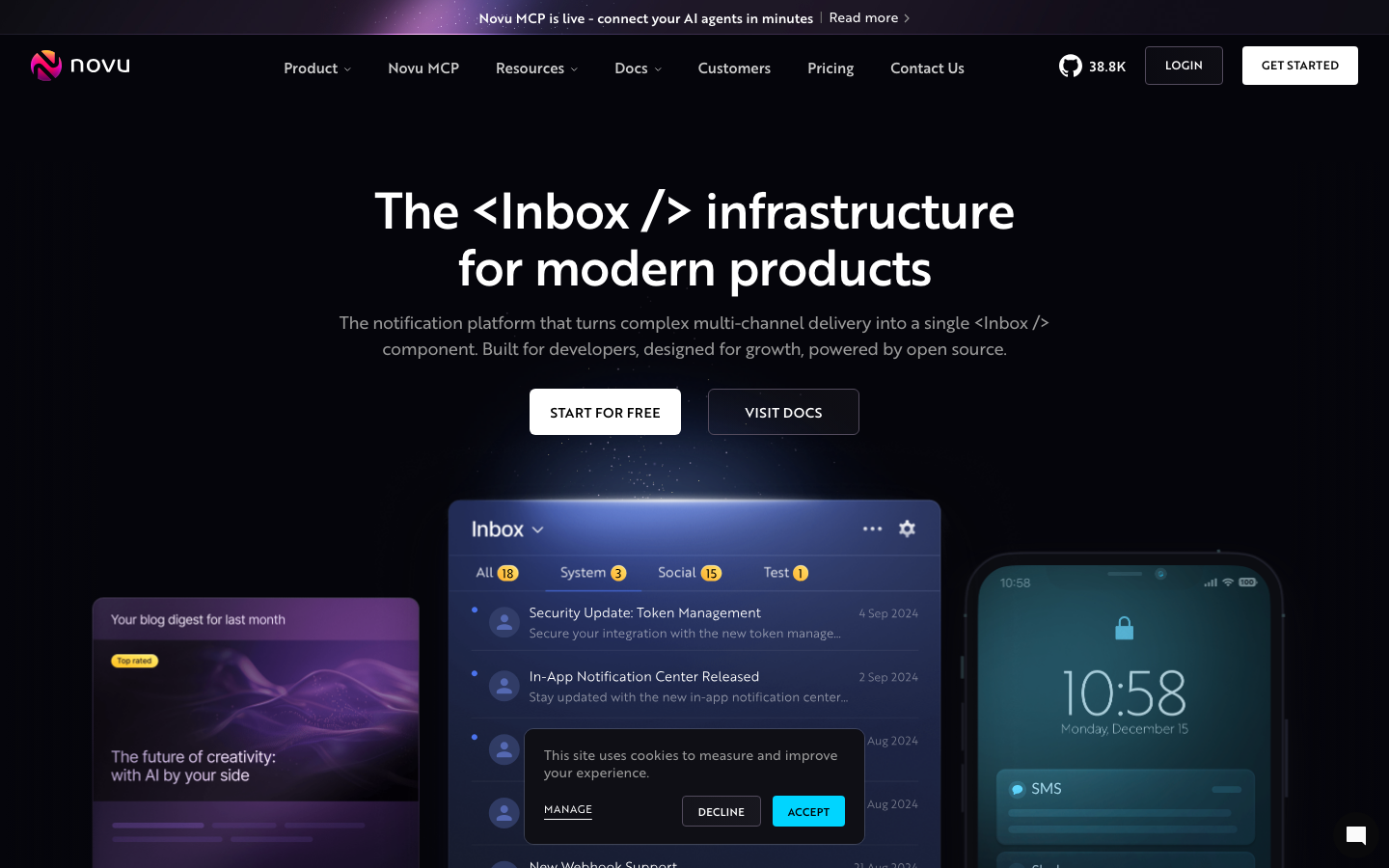
Novu is an open-source notification infrastructure platform that unifies SMS, email, push, and Slack into a single orchestration layer. It lets you manage multi-channel campaigns, templates, and subscriber workflows without touching Twilio's per-message pricing or compliance burden.
Pros:
- Multi-channel in one platform (SMS, email, push, Slack) reduces tool sprawl and integration complexity.
- Self-hosted on your infrastructure eliminates vendor lock-in and gives you full data ownership.
- Built-in template and workflow management simplifies notification logic at scale.
Cons:
- Requires operational overhead to self-host and maintain the infrastructure.
- SMS delivery still depends on third-party carrier integrations you must configure and manage.
ntfy
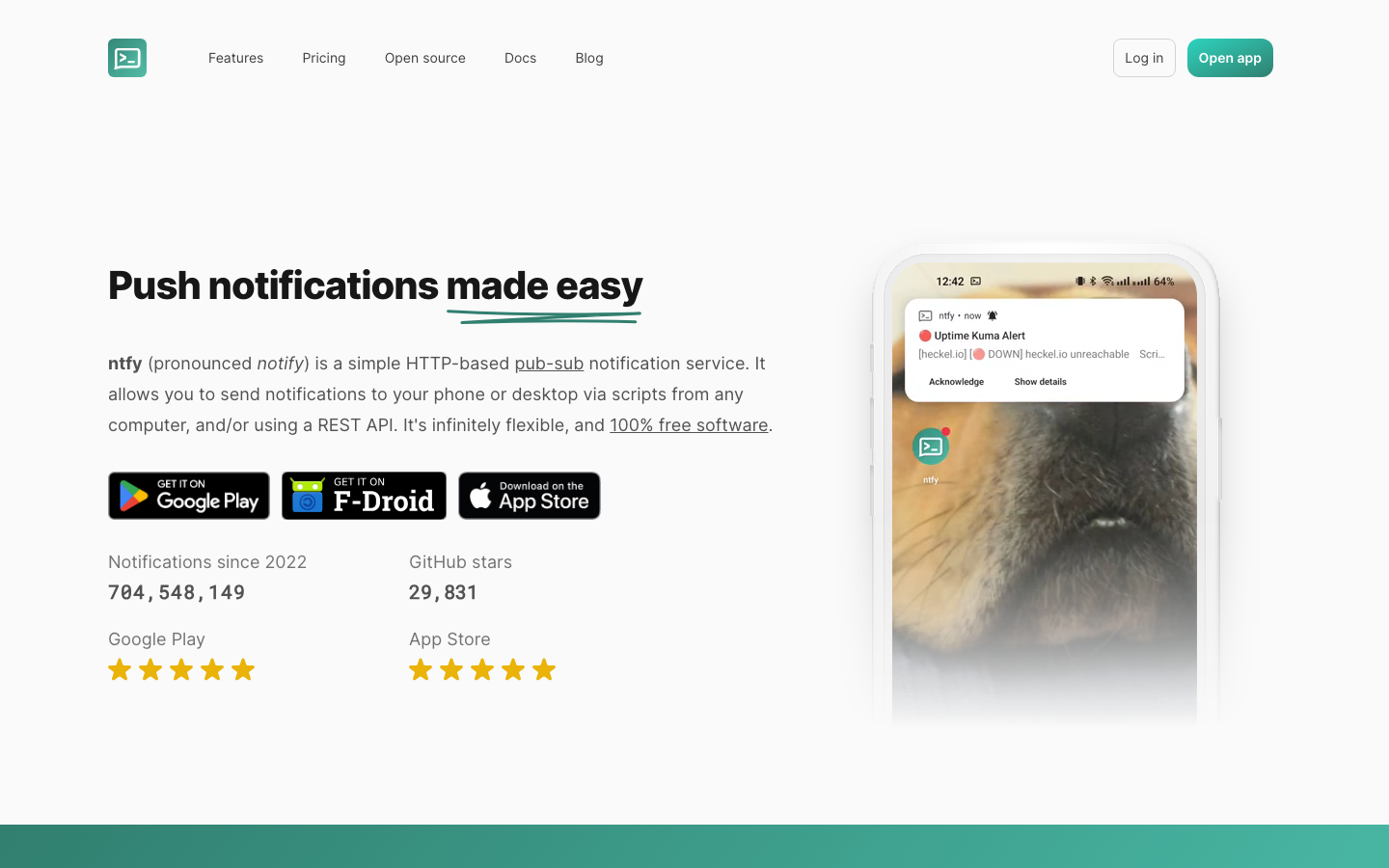
Ntfy is a minimal, HTTP-based push notification server written in Go. You send a PUT or POST request to trigger notifications to your phone or desktop, with no complex SDKs or per-message fees.
Pros:
- Extremely lightweight and easy to deploy; runs on a Raspberry Pi or small VPS.
- No per-notification charges or metering—flat infrastructure cost.
- Simple HTTP API makes integration trivial for small teams.
Cons:
- Limited to push notifications; does not cover SMS, email, or voice.
- Minimal feature set compared to full notification platforms.
react-email
React-email is a library for building email templates using React components, then sending them via standard email transports. It decouples email design from delivery, letting you version templates in code and send via any SMTP backend.
Pros:
- Email templates as React components make them testable, reusable, and version-controlled.
- Works with any SMTP server or email service, avoiding lock-in to a single vendor.
- Dramatically reduces boilerplate and template maintenance overhead.
Cons:
- Email-only; does not handle SMS, voice, or push.
- Requires a separate SMTP or email delivery service for actual sending.
nodemailer
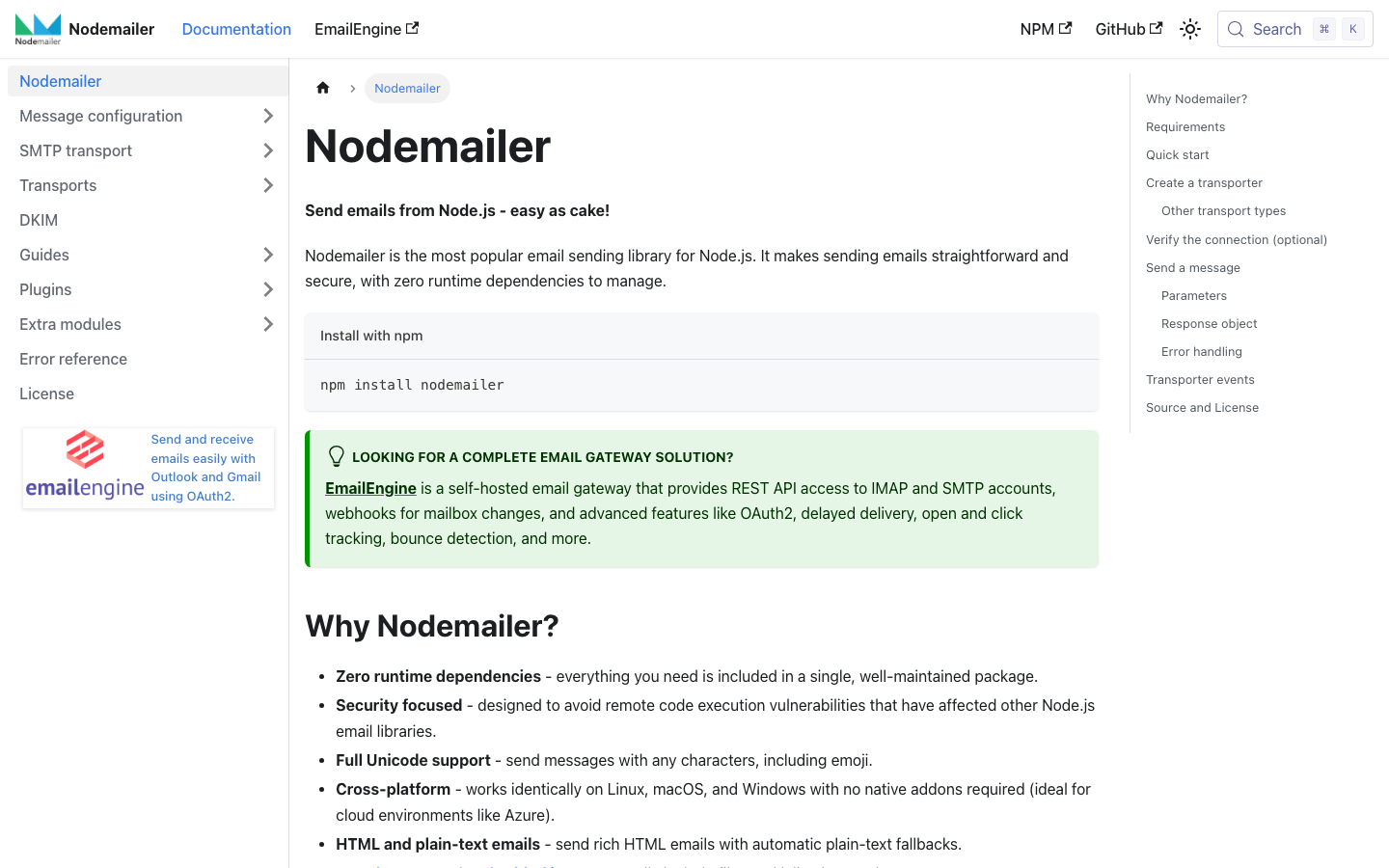
Nodemailer is a Node.js library for sending emails via SMTP, Gmail, or other transports. It's the de facto standard for email delivery in Node backends, with support for attachments, templates, and multiple transports.
Pros:
- Mature, battle-tested library with massive ecosystem support.
- Works with any SMTP server—no vendor lock-in.
- Minimal setup and no per-message fees.
Cons:
- Email-only; does not cover SMS, voice, or push notifications.
- Requires you to manage SMTP credentials and transport configuration.
server
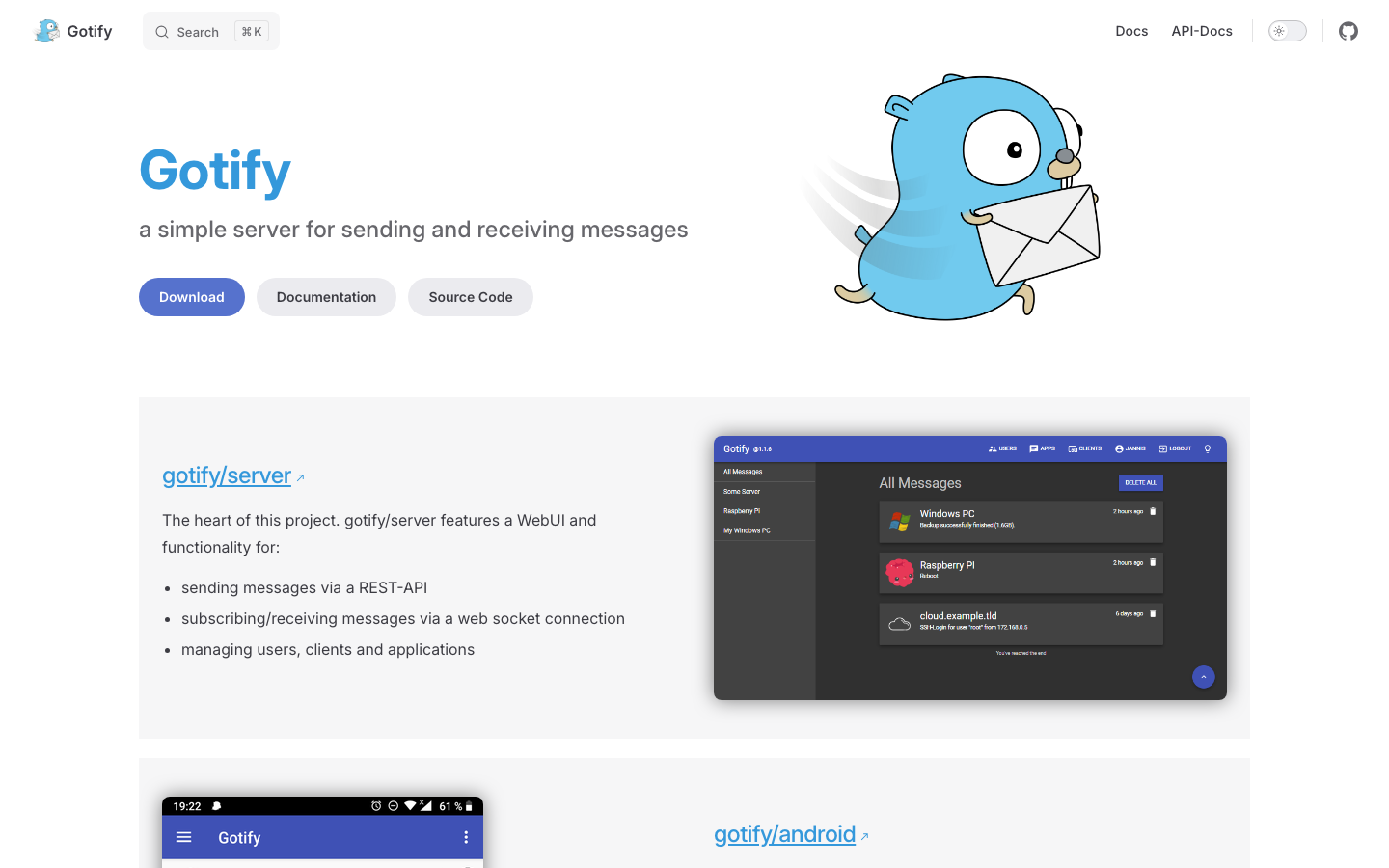
Server is a lightweight WebSocket-based messaging platform with a built-in web UI. It enables real-time message exchange between clients and is designed for teams needing instant, bidirectional communication without external dependencies.
Pros:
- Real-time messaging over WebSocket with zero external service dependency.
- Includes a sleek web UI out of the box for quick deployment.
- Lightweight and easy to self-host on minimal infrastructure.
Cons:
- Narrowly focused on real-time messaging; not a replacement for SMS or email delivery.
- Limited to internal team communication; not suitable for customer-facing notifications.
janus-gateway
Janus is a WebRTC server that enables peer-to-peer and server-mediated video, audio, and data streaming. It's a modular, plugin-based platform for building video conferencing, live streaming, and real-time communication applications.
Pros:
- Open WebRTC stack gives you full control over video/audio infrastructure without cloud vendor fees.
- Modular plugin architecture allows customization for specialized use cases.
- No per-call or per-minute charges; infrastructure cost is your only expense.
Cons:
- Steep learning curve; requires understanding of WebRTC, SDP, and signaling protocols.
- Does not cover SMS, email, or traditional voice calls—video/data only.
FreeSWITCH
FreeSWITCH is a full software-defined telecom stack that handles voice calls, SMS, video, and IVR on commodity hardware. It's a complete replacement for proprietary telecom switches, running from a Raspberry Pi to multi-core servers.
Pros:
- End-to-end telecom infrastructure in one platform: voice, SMS, video, IVR, all self-hosted.
- Massive cost savings for teams running high call/SMS volume—no per-minute or per-message fees.
- Fully customizable; you own the entire stack and can integrate it into any workflow.
Cons:
- Significant operational and learning overhead; requires telecom and networking expertise.
- Carrier integration and compliance (e.g., A2P 10DLC) still required for SMS and voice, but managed by you, not Twilio.
Asterisk
Asterisk is an open-source PBX and VoIP platform that routes calls, manages extensions, and integrates with traditional and IP phone systems. It's a mature foundation for building custom telephony applications.
Pros:
- Decades of stability and a large community; battle-tested in enterprise deployments.
- Full PBX features (call routing, IVR, voicemail, conferencing) without vendor lock-in.
- Runs on any hardware; no per-call fees.
Cons:
- Primarily VoIP and call-routing; SMS and video support are limited or require additional modules.
- Steep operational overhead; requires telecom and Linux expertise to deploy and maintain.
How to choose
For SMS volume at scale, FreeSWITCH or novu eliminate per-message fees and give you cost predictability—but FreeSWITCH demands more operational skill. For email-heavy workflows, combine react-email with nodemailer to own your templates and delivery without Twilio's compliance overhead. For real-time or video, janus-gateway or ntfy avoid metering entirely. For small teams or prototypes, start with ntfy or nodemailer—they're minimal, self-contained, and require no telecom expertise. For enterprises needing a unified notification platform, novu bridges the gap between simplicity and scale, orchestrating multiple channels in one place while you retain full data ownership.