




TL;DR
- Cost predictability matters: Chatwoot strips away per-resolution metering and per-seat lock-in, letting you pay once to self-host and scale without surprise billing.
- Own your support data: Teams tired of vendor lock-in choose LiveHelperChat to keep customer conversations, tickets, and history on their own infrastructure.
- Community-first support: Talkyard brings discussion and knowledge-sharing in-house, reducing dependence on a single proprietary platform for customer engagement.
Why teams leave Zendesk
Zendesk's pricing has become a three-layer cake: per-agent seat fees, AI add-on costs, and since 2025, per-resolution charges ($1.50–$2.00 depending on commitment level). That last layer is the sticking point—customers report the per-resolution model is hard to forecast, especially as support volume grows. You end up paying for tickets, then paying again for AI to help resolve them, then paying per resolution itself.
Beyond cost, there's the ownership question. Your tickets, macros, customer history, and support workflows live in Zendesk's proprietary cloud. Exiting means data extraction, API rate limits during migration, and often months of rebuilding context in a new system. For teams handling sensitive customer data or operating in regulated industries, that lack of control is a dealbreaker. Open-source alternatives flip the model: self-hosted ticketing and shared inboxes with no per-resolution metering, no per-seat gatekeeping on core features, and full ownership of your support data from day one.
Quick comparison
| Name | License | Self-Hosted | API / Extensibility | Stack / Language | Best For |
|---|---|---|---|---|---|
| Chatwoot | — | Yes | REST API, webhooks, custom integrations | Ruby | Omni-channel support desks; teams replacing Zendesk or Intercom |
| LiveHelperChat | Apache-2.0 | Yes | Extensible via PHP, webhooks, third-party integrations | PHP | Live chat + ticketing; Telegram, WhatsApp, Facebook Messenger support |
| Formbricks | — | Yes | REST API, SDK, custom surveys | TypeScript | Customer feedback and surveys; lightweight alternative to Qualtrics |
| Talkyard | AGPL-3.0 | Yes | REST API, plugin architecture | TypeScript | Community discussions, knowledge bases, and customer forums |
| Talk | — | Yes | REST API, plugin system | TypeScript | Commenting and moderation; alternative to Disqus |
Top open-source alternatives to Zendesk
Chatwoot
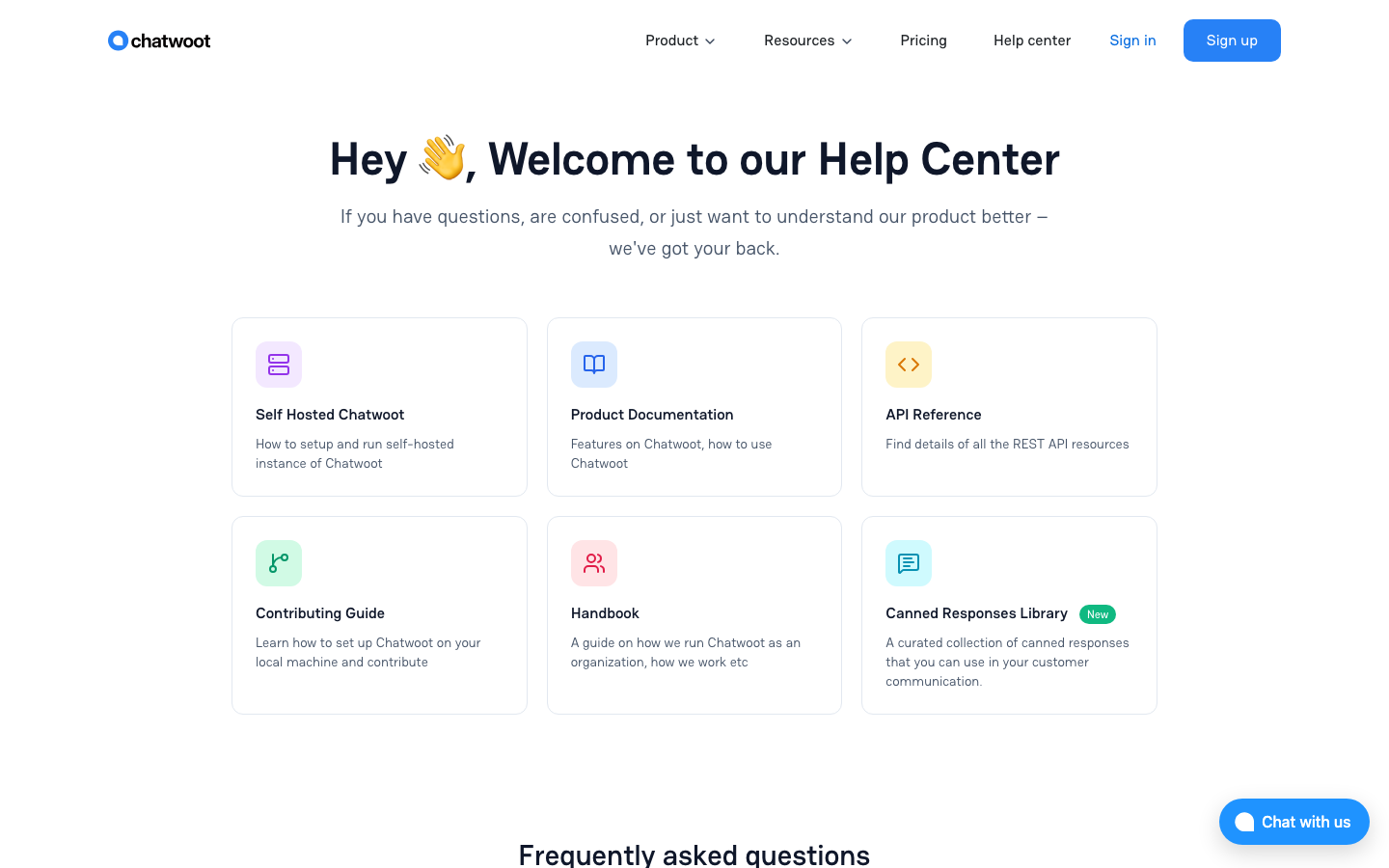
An open-source omni-channel customer support platform that consolidates email, chat, social media, and messaging apps into a single inbox. Designed to replace Zendesk, Intercom, and Salesforce Service Cloud without the per-seat or per-resolution pricing trap.
Pros:
- Unified inbox for email, live chat, WhatsApp, Facebook, Instagram, and Telegram—no per-channel seat charges.
- Self-hosted on your infrastructure; no usage-based billing or hidden AI add-on costs.
- Strong REST API and webhook support for custom workflows and third-party integrations.
Cons:
- Smaller ecosystem than Zendesk; fewer pre-built enterprise integrations.
- Requires DevOps overhead to self-host and maintain at scale.
LiveHelperChat
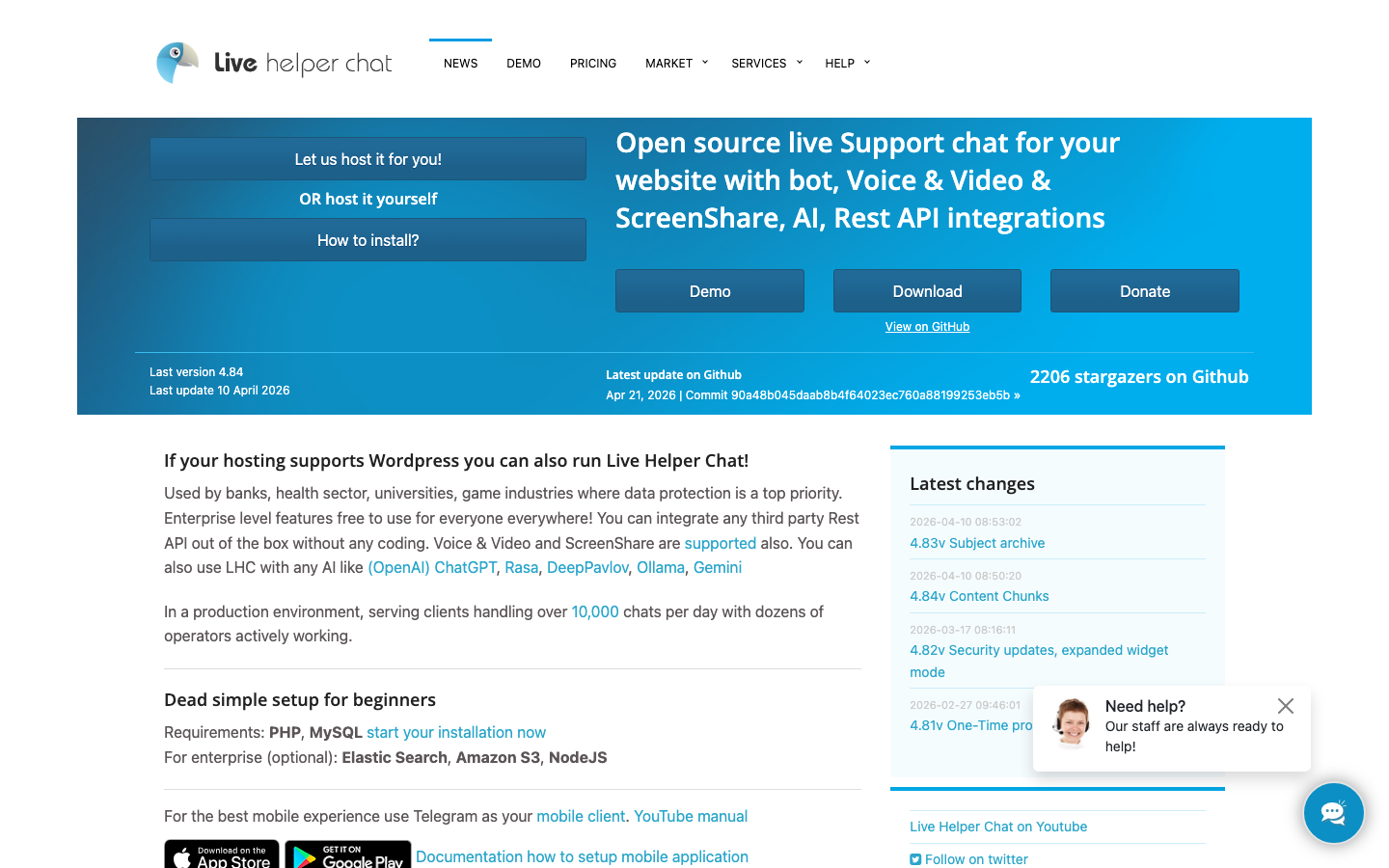
A PHP-based live chat and ticketing system with built-in support for voice, video, screen-sharing, and messaging platforms (Telegram, WhatsApp via Twilio, Facebook Messenger). Sits between a lightweight live-chat tool and a full helpdesk.
Pros:
- Rich real-time communication: live chat, voice, video, and screen-sharing in one platform.
- Apache 2.0 licensed; fully open and extensible via PHP.
- Native integrations with Telegram, WhatsApp, and Facebook without per-message metering.
Cons:
- PHP stack may require different hosting or DevOps expertise than modern alternatives.
- Less polished UI compared to Zendesk, with a steeper learning curve for complex workflows.
Formbricks
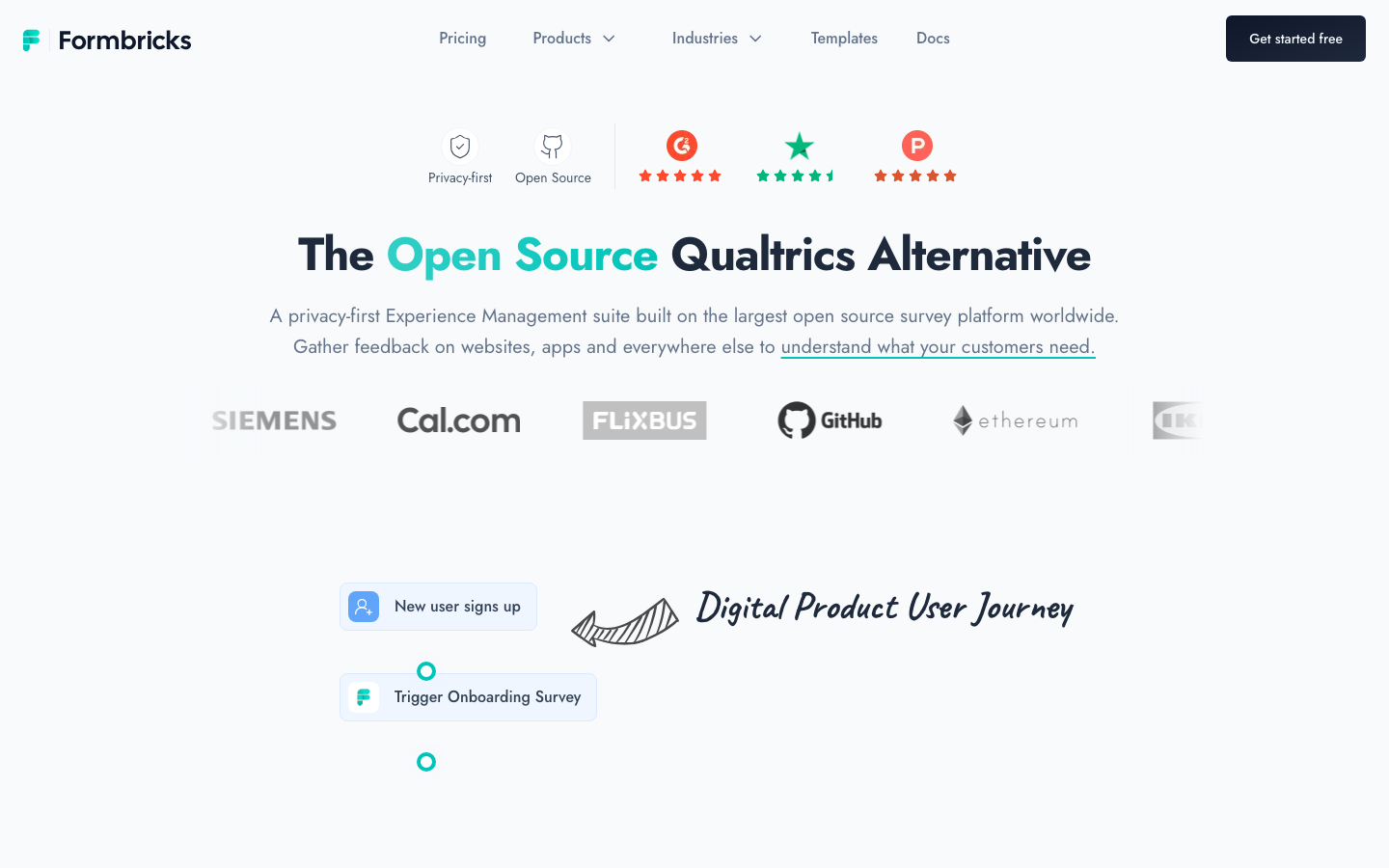
An open-source survey and customer feedback platform positioned as an alternative to Qualtrics. Captures in-app feedback, NPS, and surveys without sending data to a third-party SaaS.
Pros:
- Self-hosted feedback collection; no per-response charges or data-sharing agreements.
- Lightweight REST API and SDK for embedding surveys in web and mobile apps.
- GDPR-friendly by default when self-hosted.
Cons:
- Narrower scope than Zendesk; designed for feedback, not full ticketing or support workflows.
- Best paired with a dedicated helpdesk tool rather than as a standalone replacement.
Talkyard
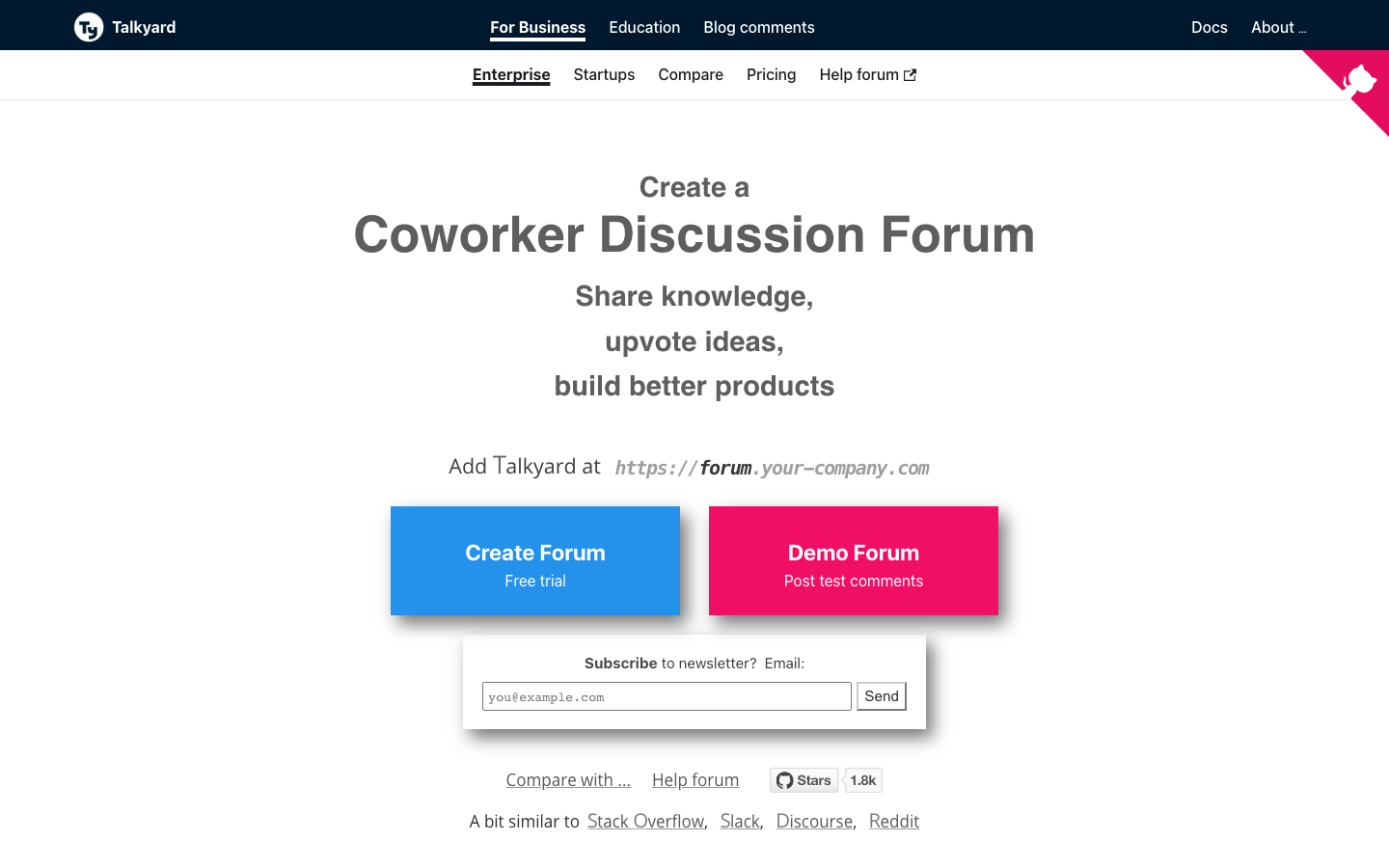
A community discussion and knowledge-base platform combining features from Stack Overflow, Slack, Discourse, Reddit, and Disqus. Useful for customer forums, internal Q&A, and self-service support.
Pros:
- Flexible discussion model: questions, ideas, problems, and chat-like threads in one platform.
- AGPL-3.0 licensed with a strong REST API for custom integrations.
- Reduces support ticket volume by enabling peer-to-peer and community-driven answers.
Cons:
- Not a ticketing system; works best as a complement to a helpdesk, not a replacement.
- Community moderation and maintenance required to keep quality high.
Talk
An open-source commenting platform from Vox Media, built to replace Disqus and similar proprietary comment systems. Focused on moderation, community engagement, and comment threads.
Pros:
- Lightweight and fast; minimal overhead compared to Zendesk or full helpdesk platforms.
- Strong moderation and anti-spam tools; REST API for customization.
- No tracking or data-sharing; comments stay on your server.
Cons:
- Designed for comments and discussions, not support tickets or customer service workflows.
- Requires integration with a separate ticketing system to handle support requests.
How to choose
If you're replacing Zendesk wholesale, start with Chatwoot—it's the most direct alternative, with omni-channel inbox, ticketing, and no per-resolution metering. If you need live chat plus messaging-platform support (WhatsApp, Telegram), LiveHelperChat adds real-time communication tools. For teams using Zendesk mainly for customer feedback and surveys, Formbricks cuts costs without the enterprise overhead. If support volume is driven by repetitive questions, layer Talkyard as a self-service knowledge base to reduce tickets in the first place. Use Talk only if your primary need is moderation and community comments, not support ticketing.