
Scheduling infrastructure for absolutely everyone.
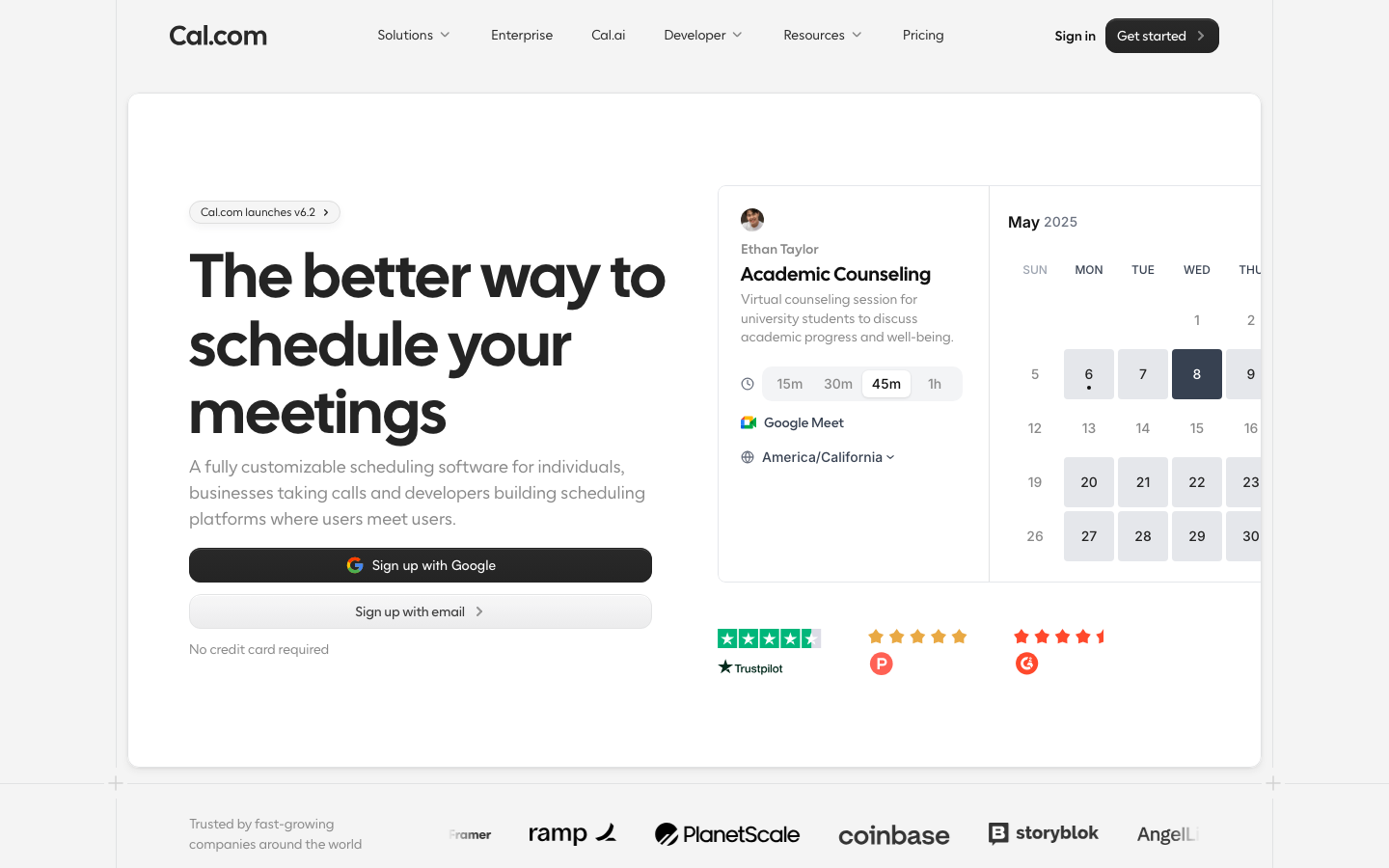
Cal.com is an open-source scheduling infrastructure platform that serves as a self-hosted alternative to Calendly. It gives users complete control over their scheduling data, workflows, and appearance with white-label capabilities and API-driven architecture designed for custom deployments.
Cal.com is built for organizations and individuals who need scheduling flexibility beyond standard tools—from small businesses and freelancers to enterprises requiring self-hosted solutions, custom branding, and control over their scheduling infrastructure.
Scheduling infrastructure for absolutely everyone.

Rallly is an open-source scheduling and collaboration tool designed to make organizing events and meetings easier.

:date: Easy!Appointments - Self Hosted Appointment Scheduler

Calendar sync tool & universal calendar MCP server. Aggregate, sync and control calendars on Google, Outlook, Office 365, iCloud, CalDAV or ICS.

LibreBooking is an open-source resource scheduling solution. It provides a flexible, mobile-friendly, and extensible interface for organizations to manage resource reservations. The "develop" branch contains the latest code of the project.

Manage My Damn Life (MMDL) is a self-hosted front end for managing your CalDAV tasks and calendars.

🌐 The Internet Computer! Free, Open-Source, and Self-Hostable.

:hedgehog: PostHog is the leading platform for building self-driving products. Our developer tools – AI observability, analytics, session replay, flags, experiments, error tracking, logs, and more – capture all the context agents need to diagnose problems, uncover opportunities, and ship fixes. Steer it all from Slack, web, desktop, or the MCP.

Infisical is the open-source platform for secrets, certificates, and privileged access management.

A self hosted virtual browser that runs in docker and uses WebRTC.

Weighs the soul of incoming HTTP requests to stop AI crawlers

Kodi is an award-winning free and open source home theater/media center software and entertainment hub for digital media. With its beautiful interface and powerful skinning engine, it's available for Android, BSD, Linux, macOS, iOS, tvOS and Windows.

Ready-to-use Media-over-QUIC / SRT / WebRTC / RTSP / RTMP / LL-HLS / MPEG-TS / RTP live media server and media proxy that allows to read, publish, proxy, record and playback real-time video and audio streams.

Free and Open Source Machine Translation API. Self-hosted, offline capable and easy to setup.

ActivityPub-federated video streaming platform using P2P directly in your web browser

Style and Grammar Checker for 25+ Languages
