




TL;DR
- Minimalist developers and headless-system builders should reach for MPD: a lightweight daemon that powers many dedicated music players, giving you total control over the stack without a prescriptive OS or UI layer.
- Squeezebox-ecosystem loyalists will find Lyrion Music Server (the slimserver project) the natural fit, syncing multiple players across rooms with the protocol and client apps they already know.
- Audiophile Raspberry Pi enthusiasts who want a turnkey, multiroom-capable alternative should consider moOde: it bundles MPD with a polished web interface and respects the open-source ethos without premium paywalls.
Why teams leave Volumio
A music-loving team sets up Volumio on a Raspberry Pi, streams their library through the web UI, and everything works. Six months in, they want to add a second speaker in another room, enable remote access from outside the house, or stream lossless audio from a high-res service—and discover each feature now lives behind Volumio Premium's paywall. The frustration isn't just cost; it's the creeping sense that the free tier is a demo.
Volumio's structural tension stems from its evolution: it began as Michelangelo Guarise's open-source project but became a company in 2020. Today, the core OS remains free (GPL v3, current as of October 2026), but the features that matter most to power users—multiroom sync, remote access, native TIDAL and Qobuz integration, even CD playback—are locked behind Volumio Premium, listed at €7.49 a month or €69.99 a year (US$8.49 / US$79.99) for new subscribers. The free tier is genuinely usable, but it's constrained: you get a single-device player, no remote access, and a basic UI. For teams wanting to build a distributed audio system or integrate premium streaming services, the cost compounds fast, especially if Volumio's hardware ecosystem (Primo, Rivo, Motivo) is in scope.
Equally important: Volumio is a turnkey OS, not a building block. If you don't want Volumio's opinionated stack, or if you need to run a music server on an existing Linux box or NAS without replacing the OS, you're out of luck.
Quick comparison
| Name | License | Server or Player | Client Protocol | Transcoding | Best For |
|---|---|---|---|---|---|
| MPD | GPL-2.0 | Server (daemon) | MPD protocol | — | Developers; custom stacks; headless systems |
| Lyrion Music Server | License not declared | Server | Squeezebox/Squeezelite | — | Squeezebox users; multiroom sync; existing player ecosystem |
| moOde | GPL-3.0 | Player (OS + UI on MPD) | MPD protocol | Yes | Raspberry Pi audiophiles; turnkey multiroom without subscriptions |
Top open-source alternatives to Volumio
MPD
Music Player Daemon is a server-side application for playing music—the engine that powers many dedicated audio players, including moOde. It's lightweight, runs on almost any Linux system, and speaks a simple, well-documented protocol that dozens of clients understand. You control it via network commands, not a web browser, making it ideal for automation, headless setups, and custom integrations.
Pros
- Minimal footprint; runs on older hardware, NAS devices, and embedded systems without bloat.
- Transparent, modular design; you choose your UI (web, mobile app, CLI) and build around it.
- Mature: in development since 2003, with years of stability.
Cons
- No built-in web UI or mobile app; you must pair it with a separate client.
- Steeper learning curve for non-developers; configuration is text-based.
Lyrion Music Server
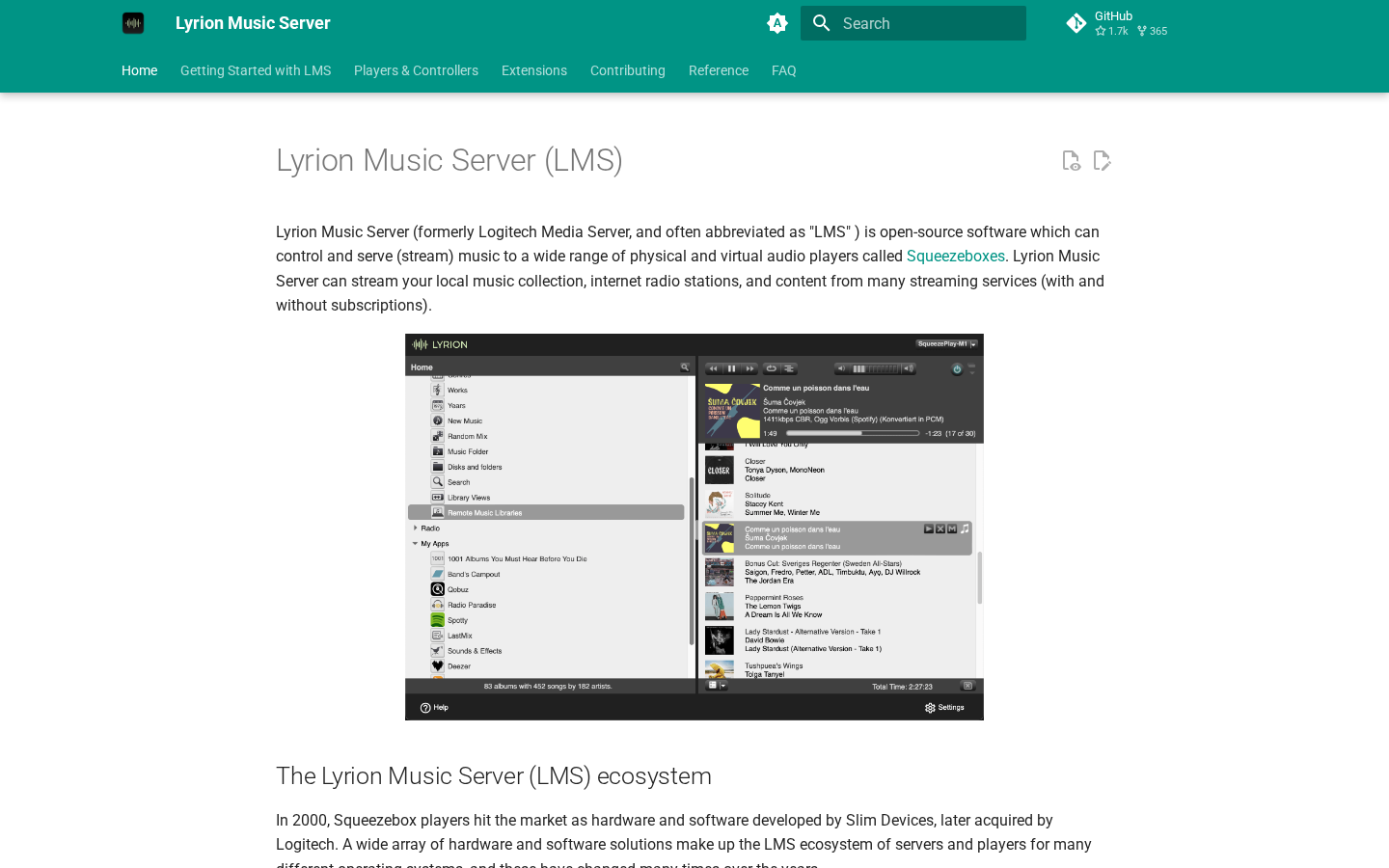
Lyrion Music Server (the slimserver project, formerly Logitech Media Server) is the server backbone of the Squeezebox ecosystem, managing music libraries and synchronizing playback across multiple Squeezebox and Squeezelite players. It's written in Perl and designed specifically for multiroom audio, making it the natural choice if you already own Squeezebox hardware or want to use Squeezelite software players.
Pros
- Purpose-built for multiroom sync; remote access and player management are native, not gated.
- Mature, stable codebase with a dedicated user community and plugin ecosystem.
- Works with both legacy Squeezebox hardware and free Squeezelite software players.
Cons
- Locked into the Squeezebox/Squeezelite player ecosystem; limited flexibility if you want to use other audio hardware.
- Perl codebase and an interface that shows its age.
moOde
moOde is an audiophile streamer purpose-built for the Raspberry Pi family, combining MPD under the hood with a polished web UI and multiroom synchronization. It's a complete OS image you flash to an SD card—similar in ease to Volumio—but remains fully open (GPL-3.0), free, and subscription-free.
Pros
- Turnkey experience: download, flash, boot, and stream; no command-line setup required.
- Multiroom audio without paywalls; remote access and synchronized playback are included.
- Active community and regular updates; respects the open-source ethos.
Cons
- Raspberry Pi only; no x86/x64 PC image like Volumio offers.
- Smaller ecosystem of official hardware and plugins compared to Volumio's commercial lineup.
How to choose
Pick MPD if you're comfortable with Linux and want maximum flexibility—you're building a custom audio stack, integrating with home automation, or running music on existing infrastructure. Choose Lyrion Music Server if you already use or plan to buy Squeezebox players; it's the only server purpose-built for that hardware, and multiroom sync is native and free. Go with moOde if you want a Volumio-like experience (download, flash, play) but need multiroom and remote access without hitting a subscription wall—and you're willing to standardize on Raspberry Pi hardware. For teams evaluating cost and lock-in, all three alternatives eliminate the premium-tier paywall; the choice hinges on your hardware constraints and whether you value a unified OS or a modular approach.