
Sync-in Server · Secure, open-source platform for file storage, sharing, collaboration, and syncing.
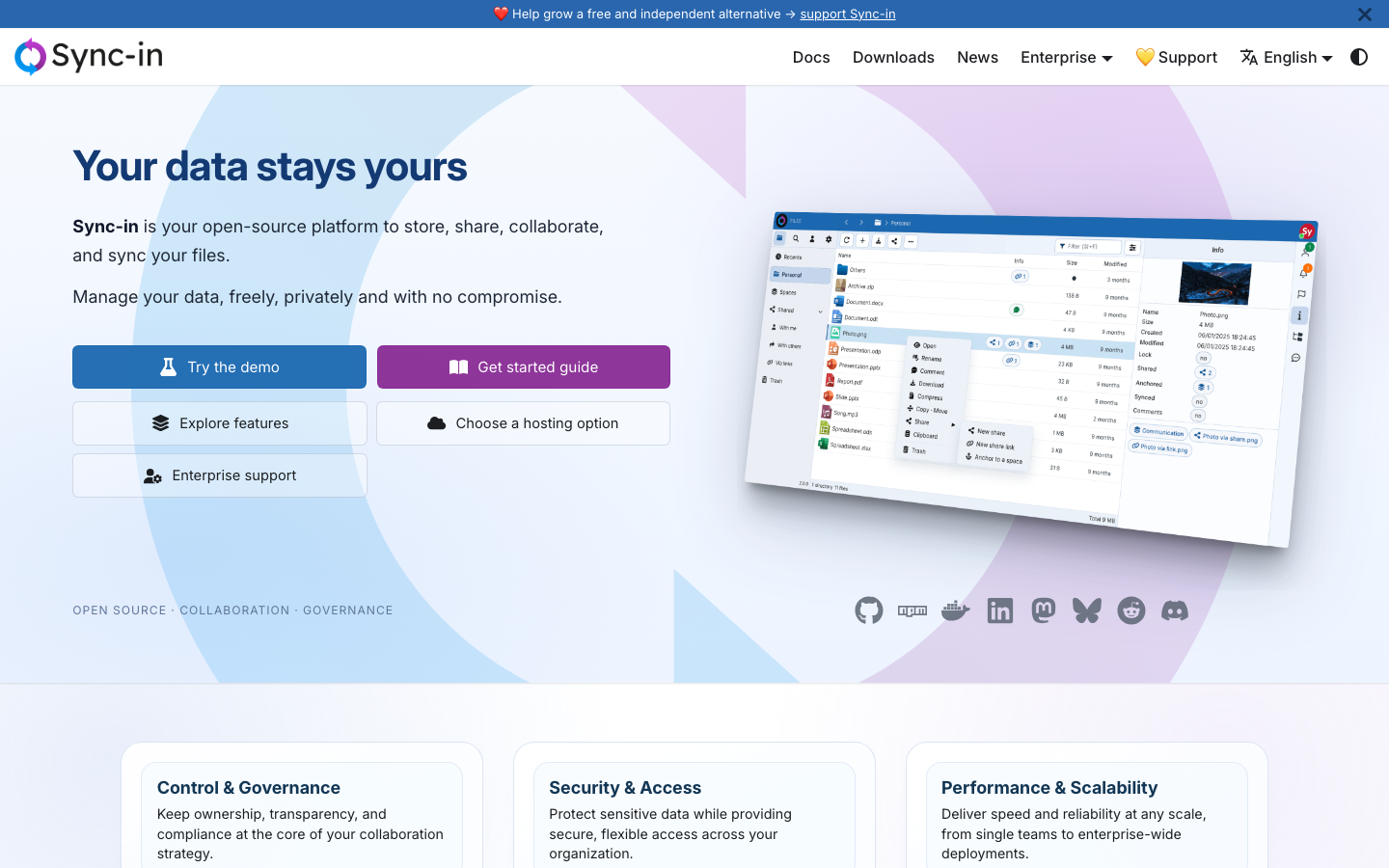
Sync-in Server is a self-hosted, open-source platform that gives you complete control over your data while enabling secure file sharing, real-time collaboration, and seamless synchronization. Built on open standards, it supports enterprise authentication, advanced access control, and flexible deployment across on-premise and private cloud environments.
Sync-in is designed for organizations and individuals who need a secure, self-hosted alternative to cloud storage services. It's ideal for enterprises requiring data sovereignty, teams prioritizing collaboration and security, and users wanting full control over their file storage infrastructure.

Open Source Continuous File Synchronization

🌐 The Internet Computer! Free, Open-Source, and Self-Hostable.
🌐 The Internet Computer! Free, Open-Source, and Self-Hostable.

☁️ Nextcloud server, a safe home for all your data

📂 Web File Browser

🌩 Self-hosted file management and sharing system, supports multiple storage providers
CLI proxy that reduces LLM token consumption by 60-90% on common dev commands. Single Rust binary, zero dependencies

Give your AI agent eyes to see the entire internet. Read & search Twitter, Reddit, YouTube, GitHub, Bilibili, XiaoHongShu — one CLI, zero API fees.
🌐 The Internet Computer! Free, Open-Source, and Self-Hostable.
🌐 The Internet Computer! Free, Open-Source, and Self-Hostable.

:hedgehog: PostHog is the leading platform for building self-driving products. Our developer tools – AI observability, analytics, session replay, flags, experiments, error tracking, logs, and more – capture all the context agents need to diagnose problems, uncover opportunities, and ship fixes. Steer it all from Slack, web, desktop, or the MCP.

Infisical is the open-source platform for secrets, certificates, and privileged access management.

🎧 Your Personal Streaming Service

A self hosted virtual browser that runs in docker and uses WebRTC.

Weighs the soul of incoming HTTP requests to stop AI crawlers

Kodi is an award-winning free and open source home theater/media center software and entertainment hub for digital media. With its beautiful interface and powerful skinning engine, it's available for Android, BSD, Linux, macOS, iOS, tvOS and Windows.
